Some 31 counties could lose at least
Sh7.74 billion in revenue if Parliament
approves the Commission on Revenue Allocation proposal.
This loss is based on the current
allocation of Sh387.42 billion, however, the amount that the devolved
units potentially stand to lose could
be greater if Parliament endorses the
formula and fails to raise the allocation to a specified limit.
According to CRA, none of the 47
devolved units will lose revenue if
Parliament gives them a minimum
of Sh417.42 billion.
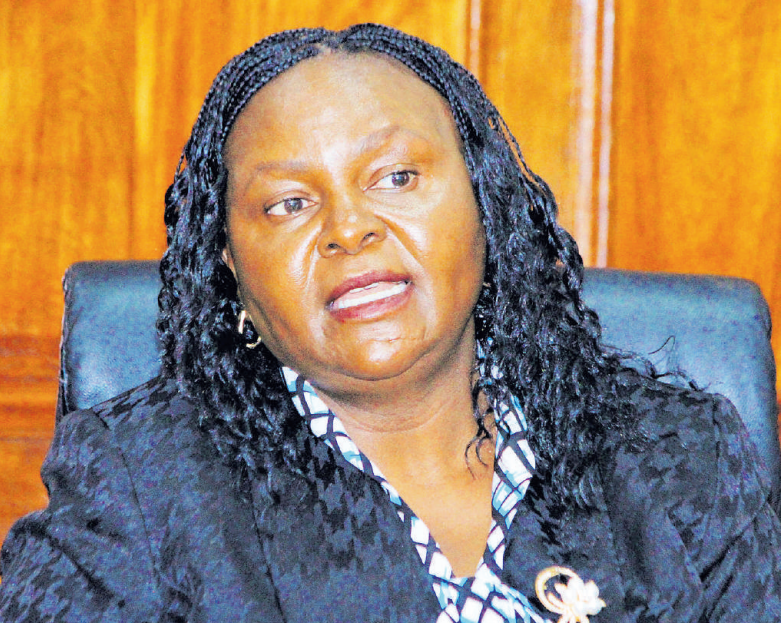
“In implementing the Fourth Basis,
a cushioning and stabilisation factor
has been built in the framework to
ensure no county government gets
less than what they were allocated
in the financial year 2024-25,” said
CRA chairperson Mary Chebukati
in a report to the Senate.
However, the National Treasury
has proposed an allocation of Sh405
billion, indicating many counties
may lose revenue if the formula is
approved.
The revelations follow an analysis
by the Senate Finance and Budget Committee on the proposed formula
by the CRA.
The review shows that Nairobi, Nakuru, Turkana, Kakamega and Kilifi
are the biggest losers in the proposal that has triggered uproar among the
devolution players.
Nairobi’s losses amount to Sh611
million – from the current Sh20.17
billion to Sh19.56 billion, with Nakuru’s share falling by Sh414 million
– from Sh13.66 billion to Sh13.25
billion.
Turkana will lose Sh400 million,
Kakamega will forgo Sh393 million,
Kilifi will lose Sh369 million and
Mandera will lose Sh354 million.
According to the formula, which
will determine how counties share
revenue from 2025-26, CRA has
assigned the population the biggest
weight at 42 per cent.
In the current formula, the population weighs 18 per cent. But was
weighted at 45 per cent in the first and
second-generation formulae.
Geographical size has been given
a weight of nine per cent from the
current eight.
Equal share has been given a weight
of 22 per cent from the current 20
while the weight for the poverty index
has been retained at 14 per cent.
“To facilitate service delivery, the
recommendation provides for an
equal minimum allocation across
all counties, using population and
geographical size of a county as the key transfer parameters,” Wanyonyi
said in a report to the Senate.
CRA has introduced the income
distance index and assigned it a
weight of 13 per cent.
“To address
economic disparities and promote
development, the framework uses
income distance and poverty parameters as measures of inequality among
county governments.
The new framework will dictate
revenue sharing among the counties
for five years, from 2025-26 to 2029-
30,” the report said.
Kitui will lose
Sh330 million, Machakos (Sh291 million), Kisii (Sh282 million), Narok
(Sh280 million), Kwale (Sh261 million), Makueni (Sh257 million) and
Uasin Gishu (Sh257 million).
Kisumu will lose Sh255 million,
Bungoma (Sh250 million), Homa
Bay (Sh248 million), Meru (Sh242
million), Mombasa (Sh239 million,
Trans Nzoia (Sh228 million), Murang’a (Sh225 million) and Nandi
(Sh223 million).
Others are Nyeri (Sh198 million),
Busia (Sh189 million), Migori (Sh183
million), Nyandarua (Sh180 million),
Kirinyaga (Sh165 million), Embu
(Sh157 million), Kiambu (Sh140
million), West Pokot (Sh48 million),
Bomet (Sh28 million) and Baringo (Sh15 million).
However, the report
shows that 16 counties would gain
significantly in the proposed formula
with Marsabit and Garissa getting
more than Sh1 billion more each.
Garissa will gain Sh1.82 billion in
revenue, followed by Marsabit with
Sh1.53 billion.
Isiolo, Kajiado, Wajir and Lamu
will gain Sh869 million, Sh720 million, Sh569 million and Sh398 million.
Other gainers are Kericho (Sh365
million), Vihiga (Sh347 million), Samburu (Sh723 million), Tharaka Nithi
(Sh267 million), Taita Taveta (Sh235
million) and Laikipia (Sh218 million).
Others are Elgeyo Marakwet
(Sh161 million), Siaya (Sh141 million), Nyamira (Sh102 million) and
Tana River (Sh74 million).
Senators whose counties are set to
lose revenue have vowed to fight the
proposed formula.
“If you come with formula which
is going to reduce money from some
devolved units and you deny them
the ability to perform their functions,
then that is not the formula that
should get the support of the Senate,” said Nyamira Senator Okong’o
Omogeni.
The lawyer dismissed the formula
as unfair, and one that would stifle
and prevent counties from optimally
performing their functions.
“For example, Wajir, Mandera, Garissa and Marsabit are getting Sh7
billion more. From the total addition
of Sh30 billion, Sh7 billion only benefits four counties. I think that is very
unfair,” he said.
The senators questioned where
and how CRA came up with some
parameters for sharing revenue.
“I have serious issues with income
distance as a parameter. Where has
that thing come from?” Kitui Senator
Enoch Wambua posed.
“Or is there was a dissenting view of
the commission on the presentation?
If you come to us in bad faith, then
we treat you in bad faith,” he said.
Kirinyaga Senator James Murango
warned the commission not to expect senators to support the formula, which is “skewed to disadvantage
some counties”.
“Those senators whose countries
are losing money, are opposing and
those gaining revenue are supporting
the formula. And it’s okay,” he said.
Article 217 of the constitution says
the revenue-sharing formula should
be reviewed every five years.
However, the Sixth Schedule of the
constitution further provides that the
first and second determinations of
the basis of the division of revenue
among the counties be made at three-year intervals.