The way leave battle between Kenya Power and county governments
could push up the cost of electricity
by Sh5.40, according to the power
retailers’ managing director Joseph
Siror.
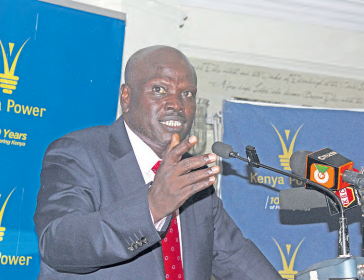
Speaking to editors in Nairobi,
Siror termed the plan by counties
to charge for way leave on power
infrastructure as unconstitutional.
He said that the proposal to
charge Sh200 per metre for electricity infrastructure, would translate into Sh63.8 billion per year,
translating to approximately 30
per cent of the energy sector’s revenue requirements, which must be
recovered from the monthly electricity bills.
“The overall impact is that electricity will become unaffordable to
a majority of Kenyans,” Siror said.
He added that the move would
erode gains made in reducing
power costs in the country where
the base tariff has declined from
Sh19.04 per unit in 2023 to the current Sh17.94 on a stronger shilling.
“The strengthening of the shilling
has resulted in lower pass-through
costs to customers, including forex
and fuel costs, which are heavily
dependent on the prevailing dollar
exchange rate.”
While Kenya Power is citing Section 223 of the Energy Act 2019,
which prohibits any public entity from charging levies on public
energy infrastructure without regulatory approval, the Council of
Governors (CoG) is accusing the utility firm of disregarding advisory from the Attorney General and
the provisions of Section 57 of the
Physical and Land Use Planning
Act 2019.
It stipulates that ‘A person shall
not carry out development within
a County without development
permission granted by the respective County Executive Committee
Member in charge of Land Use
Planning’.
According to the power distributor, the introduction of way leave
on its expansive power lines which
measure 319,000 kilometres of
power lines across all 47 counties
will impact retail tariffs.
Last week, governors accused
the power distributor of wielding
unchecked power over counties
and other entities, saying that it
often resorts to abrupt power disconnections without due consideration of the broader impact.
Siror said Kenyans should expect
power cost to drop further as the
Kenya Power onboard cheaper Independent Power Producers IPPs.
He said the public should not
be opposed to Independent Power
Producers (IPPs), saying that they
are needed for power stability.
“IPPs are not bad. They are much
needed for power stability. Our
focus should be on ensuring that
we onboard cheaper ones so that
consumers benefit. We are planning
to onboard two which will sell us
power at less than 6 US cents,’’
Siror said.
He explained that power prices have dropped by close to Sh2
per unit in the past year on stable
shilling.
“This has added to the gains from
the decline in the base energy cost following a review of the electricity tariff in April 2023 which put
in place a three-year tariff that
provides for a lower cost per unit,
starting in July of each of the three
years.
According to him, the base tariff
has declined from Sh19.04 per unit
in 2023 to the current Sh17.94.
He added that the firm is working towards lowering system losses,
a move that will see users benefit
more.
System loss is the difference
between total net generation and
energy sales on the system expressed as a percentage of net generation. These losses accrue from
leakages due to illegal connections
or shaky transmission.
“As we cut losses we are gearing
towards lowering the cost of power
because once we lower our distribution and transmission losses,
that directly translates through our
power bills and that is what energy
efficiency is all about,’’ Siror said.
The firm attributed the challenge
to heavy reliance on distribution
lines for transmission, explaining
that lower voltage levels contribute
to higher system losses.












![[PHOTOS] Ruto pushes for stronger Kenya-EU economic ties in Brussels](https://cdn.radioafrica.digital/image/2026/06/3aebc395-285b-441c-8aa4-33cb538f8d44.jpg)