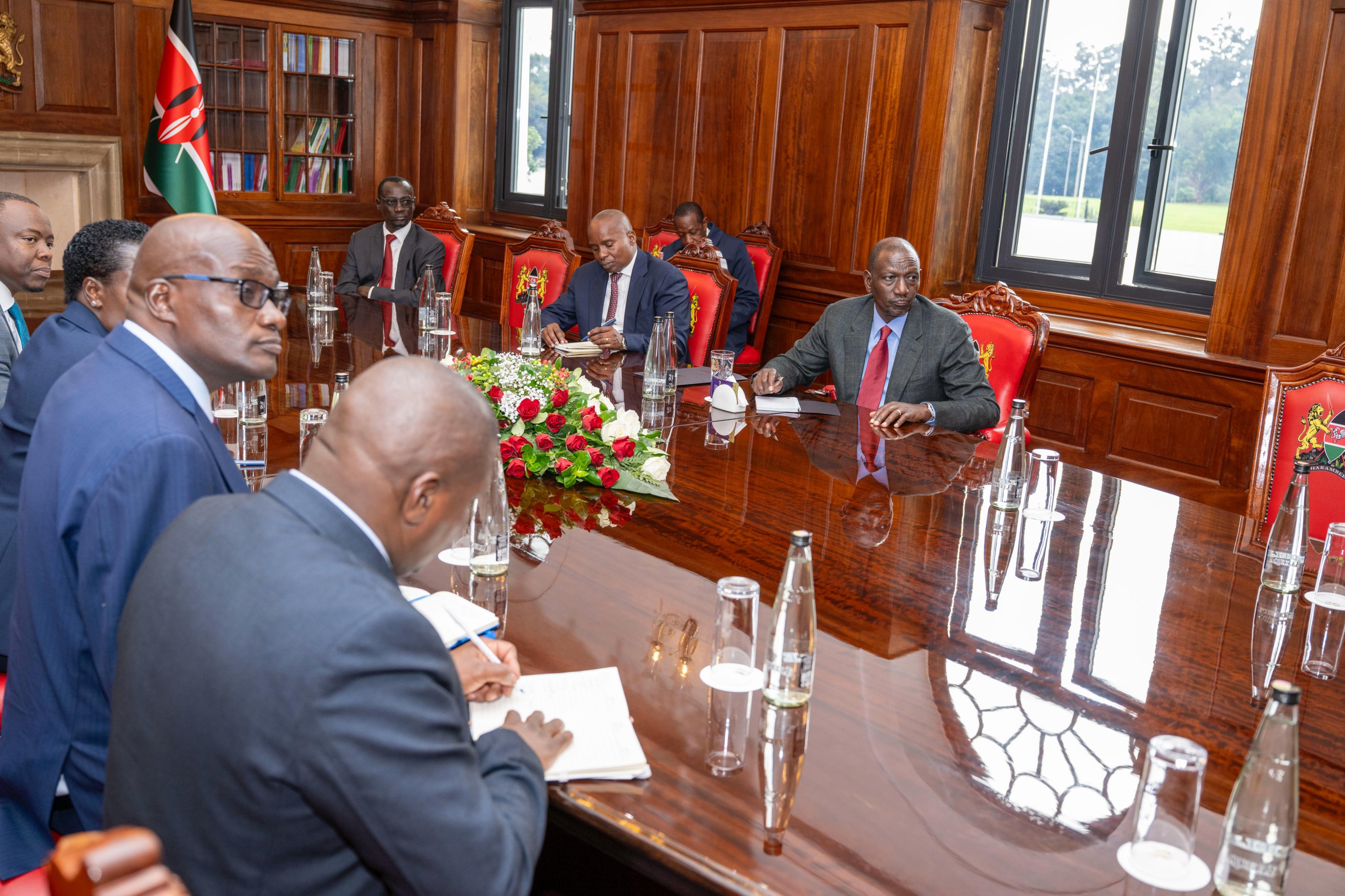
A reunion of former President Uhuru Kenyatta’s Cabinet at Prof George Magoha’s (deceased) house gave a platform to former Interior CS Fred Matiang’i to lecture the new administration.
One could clearly see the delusion that he still thought he was in power, speaking with such arrogance.
President William Ruto is very keen to ensure KRA reaches its target of raising Sh3 trillion to Sh4 trillion in the short term and Sh5 trillion in the long run.
At the same time, as the country awaits the tabling of the first supplementary budget of this new administration, the President is implementing austerity measures that have seen more than SH300 billion expenditure slashed.
Still, the government will have to borrow more than SH600 billion to meet the deficit caused by low revenue in an economy that still reeling from the aftershocks of both Covid-19 and the prolonged electioneering period.
Already, KRA has missed its targets by about Sh50 billion between May and November last year, casting doubt on whether the Sh2.1 trillion collected in FY 2021-22 shall be realised in FY 2022-23.
It is thus understandable President Ruto is going into overdrive in ensuring the country moves away from the debt trap the previous administration set it up for.
Interestingly, big business and big land owners have been exempted from paying tax, through two curious provisions of law that cushioned certain families with huge tracts of land (estates) from paying taxes.
Others have even applied for exemption of their businesses up to Sh1.4 billion! This means such businesses will definitely out-compete their rivals in the market, owing to such higher levels of disposable liquidity.
This scenario clearly depicts an unequal society whose business environment can only lead to oligopolistic market dominance by the well-connected companies. It’s not even state capitalism but rather using the state apparatus to promote private businesses of the ruling class at the expense of everybody else.
Such an environment doesn’t augur well for competition and innovation to attract the best ideas and pricing! It thus follows that political patronage becomes the only sure bet for businesses to thrive. This is a sad state of affairs that needs to change for Kenya to realise its full potential.
In order to sabotage the government, the opposition led by Raila Odinga has gone into overdrive asking Kenyans to resist paying taxes.
The scheme here looks like that of helping the common mwananchi, but in effect, it’s aimed at protecting those fuelling the resistance, since they are the greatest beneficiaries of tax exemption.
In fact, there is no way a normal Kenyan can fail to pay tax since it’s already embedded in daily expenses for existential purposes. However for big business, any exemption means that they are cushioned from the vulgarities of the market forces, effectively being ‘subsidized’ by the government.
At some point, such exemptions were to the tune of Sh40 billion and this must have gone up considerably by now. Such an amount is equivalent to the Hustler Fund that is a game changer to millions of Kenyans.
KRA, therefore, needs to be empowered to carry out its mandate impartially to unlock the huge potential towards financing of our national budget, thus reducing the deficit that has occasioned unsustainable borrowing.
It should also be a concern already that the Kenya shilling is losing its value against the dollar, with some estimates estimating a high of 180 by the end of this year.
If this were to happen, we wouldn’t be able as a country to pay back our debts. Some people are literally hoarding the greenback at the expense of the country. This is tantamount to economic sabotage.
As the government is looking at budget financing options, including privatisation of some key State-Owned Enterprises (SOEs) for infrastructure projects. It's very important that such efforts ensure that certain critical sectors of the economy aren’t open to too much competition to cushion Kenyans from exploitation.
It’s also important to ensure local content in terms of new business ownership in the country by foreigners is well protected to increase the number of enterprises in Kenya, under the public, private partnerships.
We shouldn’t forget our competition is external. Trade between African countries is only 10 percent compared to Europe 32 percent, China 16 percent and the US 6 per cent.
This means that if empowered, Kenyans who are a very enterprising lot can generate more revenue for government if they are to trade beyond our borders, especially within Africa.
Finished fully value-added products is the way to go and that’s why the flagging off of a shipload of value-added tea to Australia is so important. If such practice is encouraged, this will lead to a wider diversification of products for export since money will always follow a profitable idea.
(Edited by V. Graham)