The changes have been introduced by Dr John Nkengasong, who was appointed to head the US President's Emergency Plan for Aids Relief (Pepfar) last year.
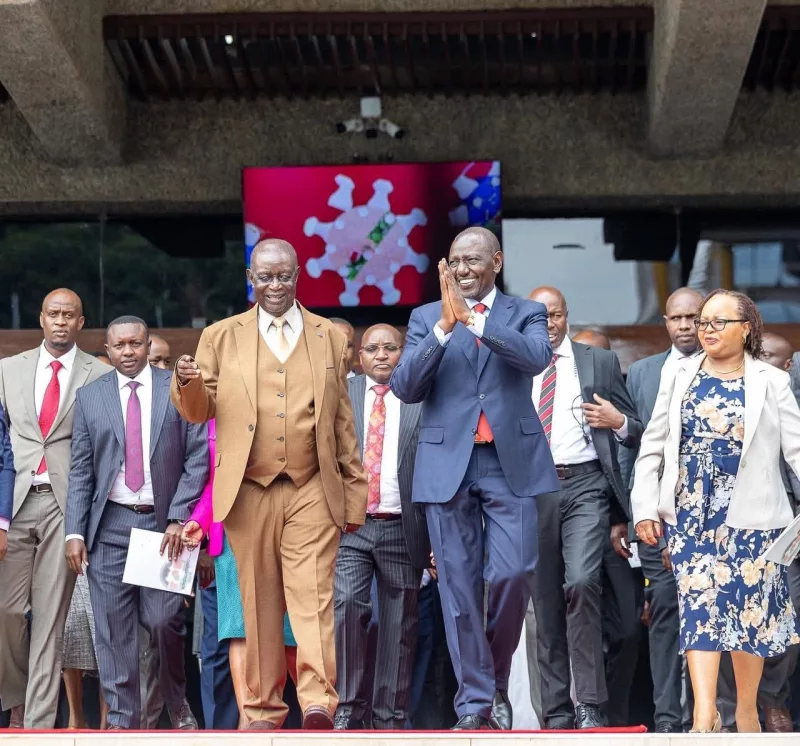
Nkengasong, who is visiting Kenya, met President William Ruto at State House on Sunday.
The changes, applicable to all Pepfar-supported countries, include scrapping the one-year funding cycle and replacing it with a two-year cycle.
Nkengasong also hinted at future reduced funding, saying there will be reduced staff as the country takes increased ownership of HIV response.
“The major changes include introduction of a two-year planning cycle, a shortened planning timeline, and updated country operational /regional operational plan tools that reduce staff level of effort without sacrificing transparency,” he said in a 2023 guidance letter for all countries that receive Pepfar funding.
The operational plans are drawn by recipient countries explaining how they will spend money given to them.
Since Pepfar was founded in 2003, it has become of the world’s biggest donor for HIV response programmes.
It has spent about $90 billion globally, with Kenya getting one of the largest chunks.
“Pepfar has invested more than $8 billion to improve health outcomes for millions of Kenyans [since 2003],” Dr Nkengasong said after meeting President Ruto.
The new changes are aligned with Pepfar’s updated strategic direction, revealed by Nkengasong in September last year.
This plan aims to end HIV/ Aids as a pandemic by 2030.
Dr Nkengasong said Pepfar will prioritise its funding on projects that support children, adolescent girls and young women and key populations such as men who have sex with men and sex workers.
Pepfar will next month announce how much it will give Kenya for 2023, after which the country will draw a plan indicating how it will spend the money.
Dr Nkengasong said the new two-year funding cycle begins next year and will promote longer-term planning and align with the Global Fund, which has a similar cycle.
Currently, Pepfar announces funding amounts every year, depending on how much money it receives from the US annual budget.
It has been reducing funding to Kenya every year since 2012 and the annual cycles mean the country is unable to make any long-term plan.
However, Dr Nkengasong said the additional year of planning remains notional and subject to the availability of funds.
“Any such notional fund allocations are strictly for internal planning purposes and… must not be used as a basis for any public, multilateral, or bilateral announcements of intended pledges or other commitments,” he said.
He also insisted Pepfar will be resolute in asking beneficiaries to decriminalise the rights of the key populations.
This, he said, is in line with President Biden’s 2021 memorandum on advancing the human rights of lesbian, gay, bisexual, transgender, queer and intersex persons around the world.
The memorandum directed that the US foreign assistance should promote and protect the human rights of LGBTQI+ persons.
“Specifically, this directive includes strengthening existing efforts to combat the criminalisation by foreign governments of LGBTQI+ status or conduct,” Dr Nkengasong said.
“In countries where gaps are evident for these populations, we will want country operating plans/regional operating plans strategy to clearly address them.”
Key populations, in the Pepfar context, refer to sex workers, gay men and other men who have sex with men, transgender people, people who inject drugs and people in prisons or other enclosed settings.
Last year, Pepfar gave Kenya about $345 million (Sh39.17 billion), compared to $365 million (Sh41.44 billion) in 2021.
Former acting Pepfar boss Dr Angeli Achrekar said Kenya must take up more responsibilities such as viral load tests for children.
“Pepfar Kenya has one of the largest programmes and budgets, but falls in the bottom third when it comes to host country government co-financing,” she said in a planning letter, sent to Kenya in early 2022.
She added, “Now that Pepfar Kenya’s focus is shifting to sustaining its HIV impact, the co-financing commitments and follow-through need to be a priority."
Dr Achrekar also said Pepfar-funded programmes in Kenya must not hire extra staff and some jobs would be merged.
In 2017, Pepfar gave Kenya $570 million, which was reduced to $500 million in 2018, and further to $370 million in 2019.
In 2020, The amount slightly rose to $375 million, but dropped to $365 million in 2021 and $345 million this year.
Pepfar contributes more than 50 per cent of total HIV/Aids funds in Kenya every year.
The rest comes from Global Fund, while the government mainly pays salaries of health workers involved in HIV response.