Activist Omtatah once wanted to be a priest, now aims for senator
Pest, troublemaker, watchdog, rights defender, champion of Constitution.
by The Star
Audio By Vocalize
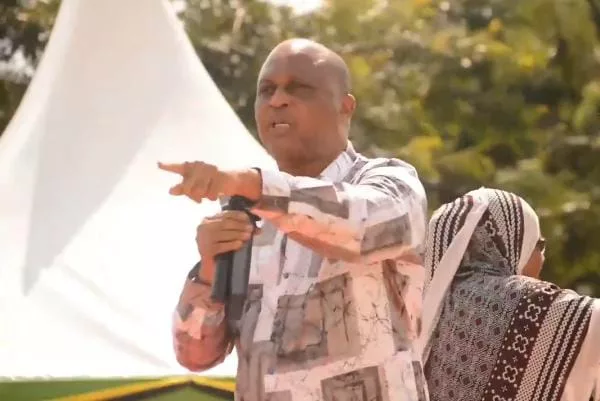
Activist Okiya Omtatah going to court
He's not a lawyer but many people consider Okiya Omtatah Public Defender Number One. Others Public Pest Number One.
He'd probably say proudly that they are both correct.
All his life, Omtatah knew he was born to defend the people and make a difference, he told the Star in an interview.
Whether he ended up as a priest, a dream he still cherishes, or a businessman, or anything else, he knew nothing would stop his activism.
The 54-year-old activist is running to become senator for Busia county from where he says he'll continue championing people's rights.
He runs a trucking company.
For more than 30 years, Omtatah’s name has been featured in the media and countless times, he's demonstrated in the streets against injustice.
Later, he took his fight to the corridors of justice where he challenged government decisions that veered from the Constitution or flew in its face.
Wearing modest suits and dusty shoes, he carries heavy files as he treks 1.8 kilometres from his office to the Milimani law courts.
Though he never set foot in law school, he's always prepared and knowledgeable and argues his cases with passion, coherence and eloquence.
“I am guided by a lesson from my grandfather: If you remove a thorn from the path, you may save somebody, and that good deed is your rent here on earth,” Omtatah said.
Having participated in countless demonstrations and presented more than 100 cases in court in public defence, Omtatah has no doubt settled his earthly rent many times.
Though he has won many cases and has been sued 28 times by the state — unsuccessfully — he is most proud of three.
InAugust 2019, Omtatah won a major victory after he recovered 843 acres of public land in Busia county following an eight-year-long legal battle.
There is only much I can do from outside, but I can continue advocacy for justice and equality through legislation. As a senator, I can legislate and provide oversight to prevent things from going wrong
The government had acquired the land from residents of Nasewa in the 1990s and gave it to Busia Sugar Company to build a factory but it was never built there.
The company was later put under insolvency by Mumias Sugar Company, which claimed the land, arguing the company owed it Sh100 million. Omtatah won the case and the land was handed over to the government.
OnJune 19, 2019, a three-judge bench comprising justices Martha Koome (presiding), Gatembu Kairu and Jamila Mohammed ruled Kenya Railways failed to comply with procurement laws while issuing a contract to China Roads and Bridge Corporation.
Though the government refused to make public the contract, Omtatah said the irregular dealings were exposed.
Activist Okiya Omutata in a Mombasa Court on March 31, 2014, when he alleged his life was in danger, said two strangers approached him, showed him their weapons.
The High Court in 2014 ordered the Kenya Police Service to ensure that an emergency toll-free telephone number 999 is restored and in working condition after a petition by Omtatah.
The court instructed the police to provide a toll-free emergency line and the Communication Authority to build a system that can handle at least 4,000 calls at peak hours and 500,000 complaints per month.
That's not enough for the father of three. He is now bidding for the Senate position in Busia county, his birthplace. He is running on the ticket of the National Reconstruction Alliance (NRA) party that supports Raila Odinga.
“There is only much I can do from outside, but I can continue my advocacy for justice and equality through legislation. As a senator, I can legislate and also provide oversight to prevent things from going wrong,” Omtatah said.
“My reward is the satisfaction that I did not advance the status quo. Even when I'm unsuccessful, I know that I tried my best
"Busia is a border town and we have the international boundary where we collect a lot of taxes, he said.
"I’m also concerned with questions that touch on the budget, appropriation of funds and representation. There are questions of accountability and transparency at the county and national government that the outgoing senator has not been able to bring out succinctly," he said.
Critics suggest his victories are for financial gain and not for principle, but he shrugs that off.
“My reward is the satisfaction that I did not advance the status quo. Even when I'm unsuccessful, I know that I tried my best to change things. I spend money from my trucking business to cover my court and other costs.
“I was brought up in a family that does not exalt material gains. My father, though a headteacher and farmer, spent all his gains educating children he barely knew.
"He owned a butchery but we ate meat twice a week. He took in refugees from Uganda during the war and never sought compensation. That is how he was nurtured and he passed the same values on to us,” he explained.
Omtatah, the fourth of 12 siblings, said he spent most of his time with his grandfather whom he helped on the farm; he also herded cattle.
“My grandfather was a very early riser and would also insist on my waking up early though I had nothing to do. He said even waking up was doing something,” he recounted.
Omtatah described his father as a devout Christian, very regimented and strict, always ensuring that everyone followed orders.
“Whenever I wrote a letter to him from school, his response would come back with that letter attached with misspellings marked and corrections indicated,” he said, laughing.
“Two other things I took from my father are cleanliness and love for farming," Omtatah said.
His mother, now age 83, was always his fallback, during tough times as a child.
“She is very warm and though strict, she was a bit more lenient and understanding. My mother, an English tutor, never taught me. All my siblings, like her, write almost in calligraphy. My letters are everywhere,” he quipped.
Omtatah said that as a father, he is only 50 per cent of what his own father and grandfather were to him.
“I have missed out on a few things, partly because of the environment of raising children and the strict regime of management that they followed,” Omtatah said.
“I have raised kids who are slightly softer than I am, but maybe they have never had a chance to prove how tough they are,” he said, laughing.
Omtatah's biggest regret as a father is not teaching his children a local dialect, as he was, and that his children think his world is bigger because of that.
“My grandfather was very insistent on my speaking the local dialect and so I can speak Ateso and Luhya. Now I see that I should have insisted that my children learn a local dialect, such as Kikuyu, having grown up in Nairobi,” he said.
For a long time, people thought I wasn’t married. I deliberately kept my family out of the limelight to protect them. during the schools' parent-teacher days, I didn't participate, they understood
Omtatah is married with three children; one died in April 2020. Tears filled his eyes as he shared how his daughter, a third-year university student, died.
“She was the light of the family and to date, we all miss her. That was my greatest loss,” he said.
“The girl, a law student, was following my activism, the rest are a little reserved. She had malaria that was mismanaged leading to her sudden death."
He took a long pause before quickly moving to talk about the other children, and why he deliberately keeps them out of the limelight.
“For a long time, people thought I wasn’t married. I deliberately kept my family out of the limelight as a protection mechanism. In fact, during the schools' parent-teacher days, I didn't participate. I explained to them why I didn't participate and they understood,” he said.
Omtatah was all set to be a priest, in his words, “a small one in a corner of the world somewhere with his flock and the Bible”, but he fell very ill and had to drop out of seminary and move to a nearby school.
“That would have been the best life I would have led, as a priest, not any administrative work, and I miss it. I didn't drop out of the seminary out of morality and faith issues, but because I fell ill,” he explained.
If like the priesthood, his beginning political journey fails, Omtatah says, he will continue advocating for people's rights as he does today.
(Edited by V. Graham)
“WATCH: The latest videos from the Star”
This is premium content
Subscribe to Continue Reading
Help us continue bringing you unbiased news, in-depth investigations, and diverse perspectives. Your subscription keeps our mission alive and empowers us to provide high-quality, trustworthy journalism. Join us today to make a difference!