

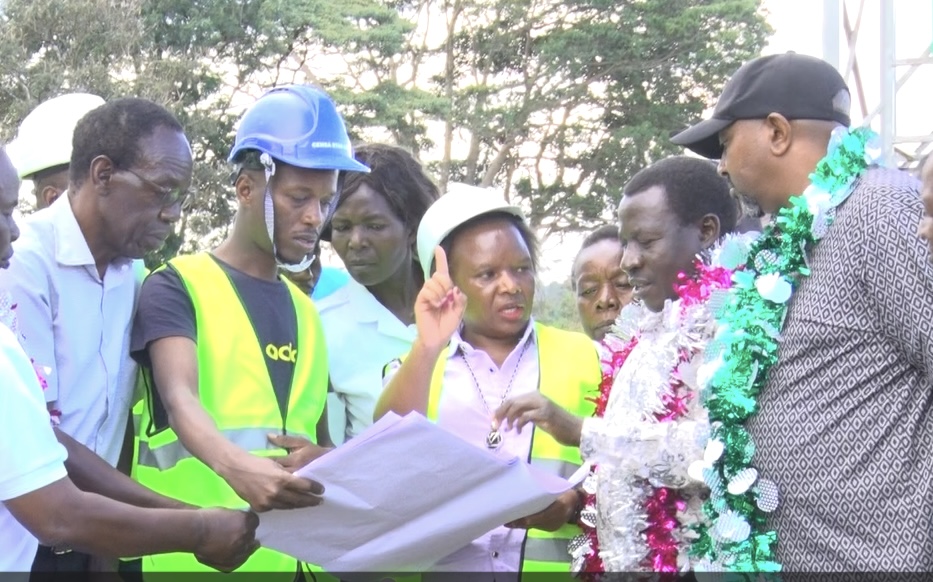
 Trans Nzoia education executive Janerose Mutama (c) during the groundbreaking ceremony at Mitoto vocational training Centre for visually impaired.
Trans Nzoia is on course to make history in inclusive education following the launch of what will become its first-ever vocational training centre for learners with visual impairments, a project that leaders say will transform lives far beyond the county’s borders.
The milestone was marked with a groundbreaking ceremony at Mitoto Vocational Training Centre, where Salus Oculi Kenya, a charitable organisation, committed funding for the construction of key facilities.
The support will see the centre equipped with dormitories, classrooms, a bakery, dining hall, kitchen, sheep pen and other essential amenities, laying the foundation for the first vocational institution for the visually impaired in western Kenya.
Education and vocational training executive Janerose Mutama described the initiative as long overdue, noting it comes more than six decades after independence.
She said the project represents a shared responsibility between the government, parents, development partners and the community in ensuring no learner is left behind.
Mutama said the county government, working with Kiminini MCA Joshua Amwai, acquired the land for the centre, while Safaricom funded the construction of the initial classrooms.
With the backing of Governor George Natembeya, the county will construct a perimeter fence, put up sanitation facilities and secure an additional acre of land to allow for future expansion.
Beyond infrastructure, the county has also moved to improve learner support.
Mutama announced that students at the centre will receive Sh18,000 in capitation, bringing them at par with learners in the county’s 32 vocational training centres, up from the previous Sh1,700.
The county will also meet examination costs, citing the special needs of the learners.
She further assured Early Childhood Development Education caregivers and vocational training instructors who have been volunteering at the centre that they will be prioritised for employment once staffing plans are finalised, with official communication expected by January.
Education and vocational training chief officer Kennedy Etiang said practical steps were underway, revealing that a contractor had been identified to begin fencing the institution immediately.
He also issued cheques worth Sh147,000 to 49 visually impaired learners currently enrolled at the centre.
From next year, Etiang said, each learner will receive Sh18,000 in capitation and an additional Sh3,000 bursary, translating to Sh21,000 annually.
He acknowledged the Salvation Army Church for supporting the learners through a lunch programme and said the county would complement such efforts to ensure students are adequately catered for.
While welcoming donor support, Etiang urged institutional managers to account for every shilling received, warning that prudent use of funds is critical to sustaining the centre.
MCA Joshua Amwai traced the project’s journey, saying he allocated Sh3 million from ward development funds to purchase the land.
He said engagement with Safaricom yielded Sh5 million for classrooms and offices, while donors from Taiwan funded a Sh3.5 million solar-powered borehole. He said it had taken nearly a year of documentation and consultations with Salus Oculi Kenya to reach the groundbreaking stage.
County director for vocational training Eliud Lusweti described the centre as life-changing, noting that Trans Nzoia had never had such a facility in its 60 years of independence.
He said the Mitoto institution will be the largest vocational training centre for the visually impaired in western Kenya, attracting learners from counties including West Pokot, Homa Bay, Siaya, Bomet and Trans Nzoia itself.
Lusweti cautioned against politicising the project, urging stakeholders to focus on its impact on children with visual impairments rather than political mileage.
Representatives of Salus Oculi Kenya said the organisation has implemented 35 projects countrywide, ranging from eye units to special schools.
Chairman David Mazsusa said the Mitoto project is supported by partners including Deutches Blindenhilfswerk, the German Federal Ministry for Economic Development and Cooperation and Ananse of Bielefeld, Germany.
He said the first phase will focus on construction, while the second phase will equip the facilities with furniture, kitchenware, Braille machines and other learning aids, alongside capacity building for teachers, parents and local leaders.
Construction
is expected to begin this month and be completed within four months, with
monitoring and evaluation continuing until July next year.