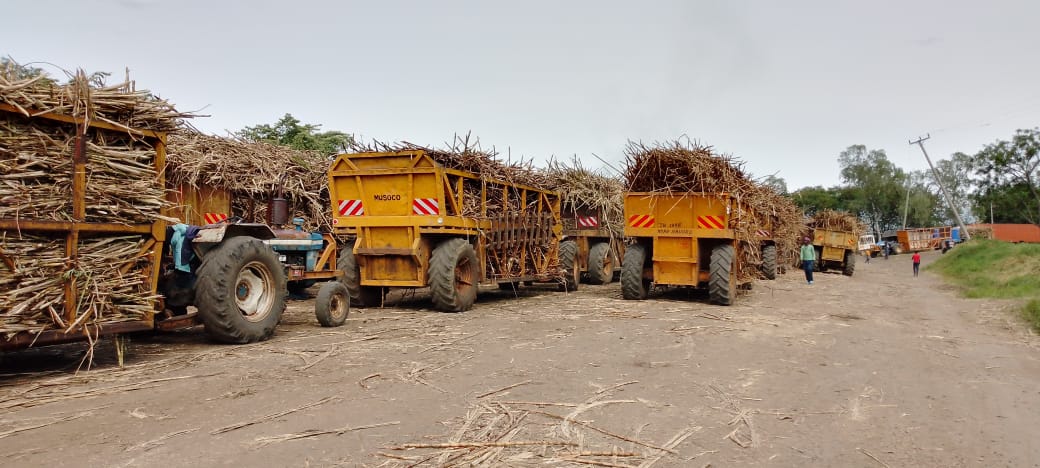
 Sugarcane trucks at Chemelil sugar factory/ Faith Matete
 The nationwide strike by sugar factory workers has been suspended following high-level talks between the government and the Kenya Union of Sugar Plantation and Allied Workers (Kuspaw).
The industrial action, which began
on January 29, affected operations at Muhoroni, Nzoia, Sony and Chemelil sugar
factories, as workers protested unpaid salary arrears and terminal benefits totalling Sh10.8 billion owed to both
serving and former employees.
The
breakthrough came after crisis talks held at Kilimo House in Nairobi, chaired
by Agriculture Cabinet
Secretary Mutahi Kagwe.
The
meeting brought together senior officials, including Agriculture Principal
Secretary Kipronoh Ronoh, Kenya Sugar Board CEO Jude Chesire, Harun
Khator, chairperson of the Sugar Transition Committee and Kuspaw officials led by general secretary Francis Wangara.
Following
what officials described as “extensive deliberations,” the parties agreed to
suspend the strike with immediate effect, allowing workers to return to duty as
payment mechanisms are finalised.
Under
the agreement, the government
will release Sh1 billion within the next two weeks to cushion workers facing
acute financial hardship.
The
remaining arrears will be settled through the Supplementary Budget and
subsequent national budgets, subject to parliamentary approval.
Payments
will be made in phases and will cover salary arrears, redundancy dues, pensions and other terminal benefits.
In
a statement, Kagwe acknowledged the hardship endured by sugar workers and
apologised for delays in meeting earlier
commitments, attributing the setbacks to fiscal constraints.
He
also clarified that the outstanding arrears are obligations of the government arising from the sugar sector
transition process and not liabilities of private millers currently leasing and
operating the factories.
“The
arrears are owed by the government,
not private millers,” Kagwe said, emphasising that private investors were not party to the agreements that
created the debts.
He
cautioned that directing industrial action at private millers or factory
operations does not resolve the root cause of the dispute and only serves to
prolong worker suffering and disrupt sector recovery.
The
CS appealed to Parliament, particularly legislators from sugar-growing
regions, to support and fast-track the
required budgetary allocations to conclusively resolve the matter.
“As
government, we accept responsibility
for these debts. We will push Parliament hard to resolve this through the
Supplementary Budget so that the sugar sector is stabilised once and for all,” he said.
Wangara
welcomed the renewed government commitment, noting that many workers who exited
service are living in severe hardship, with no housing, medical cover or stable
livelihoods.
“We have
agreed to suspend the strike in good faith as we monitor the release of funds
and implementation of the agreed milestones,” he said. “Workers have suffered long enough, and this issue must
now be resolved conclusively.”
The union also raised additional
concerns, including delayed remittance of union deductions, poor and
exploitative employment terms in some factories, non-compliance with agreed
transition arrangements particularly on worker retention and alleged
intimidation of union officials.
These
matters were flagged for urgent follow-up with millers and investors.
Chesire
reaffirmed the board’s
commitment to continued engagement with both unions and millers, urging all
parties to maintain stability to allow factories to operate and generate
revenue critical to sustaining the sector.
Kagwe
further condemned the destruction of property, intimidation and other unlawful
acts witnessed during the strike, while reiterating that peaceful
demonstrations remain protected under the law.
He
said security agencies have been directed to restore and maintain normalcy in
all affected areas.
The
Ministry of Agriculture, Kenya Sugar Board, National Treasury and Kuspaw will continue to work closely to track
disbursements, ensure compliance by millers and address outstanding labour
issues, including the possible
reinstatement of suspended employees.