Report reveals wages of Sh15.63bn were processed manually and by vouchers.
by The Star
Audio By Vocalize
Nandi Governor Stephen Sang with former Embu Governor and CoG chairman Martin Wambora as he hands over to chairperson Anne Waiguru of Kirinyaga and deputy chairman Ahmed Abdulahi (Wajir) during the Council of Governors in Mombasa on September 17
Why hasn't devolution produced dramatic improvement in residents' lives through development?
Counties improperly and irregularly spend too much on salaries and allowances, putting personal benefits for a few far ahead of economic progress for the many.
A new report paints a grim picture of the state of devolution 10 years after its birth as counties pay billions in salaries, leaving almost nothing for development.
A new report by the Controller of Budget shows that while governors' appetite for hiring continues to grow, the counties are unable to raise meaningful own-source revenue.
At the same time, some MCAs continue to rake in millions in sitting allowances, far beyond the limits set by the Salaries and Renumeration Commission.
In her latest report, Controller of Budget Margaret Nyakang’o reveals that in the last financial year, counties overshot the legal ceiling in paying salaries.
In her annual implementation review report, Nyakango'o says only four counties managed to cap their expenditure for personnel emoluments at 35 per cent of the county’s total revenue, as required by law.
These were Mandera, Tana River, Isiolo and Kwale.
The rest of the 43 counties exceeded the legal limit.
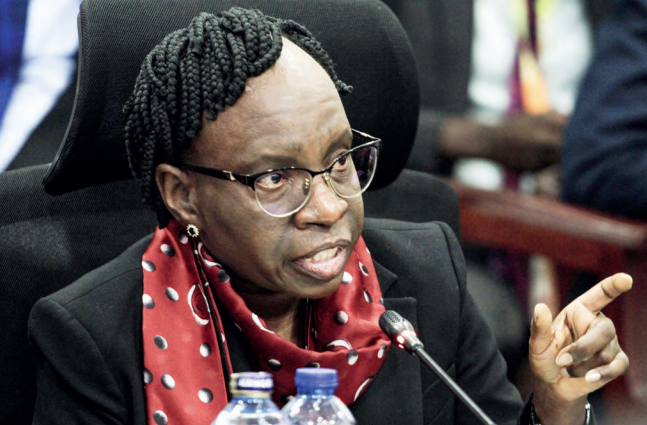
Controller of Budget Margaret Nyakang'o.
Regulation 25(1)(b) of the Public Finance Management (County Governments) Regulations, 2015 sets the limit of county government's expenditure on wages and benefits at 35 per cent of total county revenue.
“County governments should ensure spending on personnel emoluments is contained at sustainable levels,” Nyakang'o said.
In total, all the 47 counties spent Sh190.11 billion on employee compensation, translating to 43.6 per cent of available revenue.
The counties spent only Sh98.47 billion on development.
In Garissa county, for instance, the former administration of Ali Korane spent Sh5.29 billion on salaries and another Sh1.56 billion on operations and maintenance.
However, the county spent only Sh978 million on development.
Kiambu, under former Governor James Nyoro, spent Sh7.64 billion on salaries and Sh2.28 billion on operations and maintenance.
It spent only Sh2.88 billion on development.
In Machakos, under former Governor Alfred Mutua, recurrent expenditure stood at Sh8.67 billion; development expenditure was Sh1.32 billion.
Nairobi county, under former Governor Ann Kananu, paid salaries totalling Sh14.79 billion.
Only Sh3.02 billion was spent on development.
Only a few governors allocated a big chunk of their budgets to development.
For instance, West Pokot, then under John Lonyangapuo, spent Sh2.96 billion on salaries and Sh1.59 billion on development.
In Uasin Gishu, under Jackson Mandago, the county spent Sh3.82 on salaries and Sh3.78 on development
“On the low development expenditure, county governments should prioritise the implementation of development projects in FY 2022-23 to improve the standard of living for their citizens.
"[They should] and ensure that spending on development activities meets the minimum set threshold of 30 per cent of their annual budgets,” Nyakang'o said.
She also said counties should review their revenue targets to confirm they are realistic and implement strategies to mobilise own-source revenue collection.
While salaries take the lion's share of county revenue, the devolved units are unable to raise adequate own source revenue.
In the last financial year, county governments generated a Sh35.91 billion own-source revenue.
This was only 59.4 per cent of the annual target of Sh60.42 billion.
Only four counties achieved their annual targets.
These are Turkana at 113.5 per cent, Migori at 110.5 per cent, Lamu county at 105.5 per cent and Vihiga at 101.6 per cent.
Eight counties recorded less than 50 per cent performance of their own target.
They are Busia, Murang’a, Garissa, Kajiado, Embu, Kitui, Nairobi City, Nyandarua and Bungoma.
“The eight counties that recorded below 50 per cent performance of own-source revenue ... review should build capacity revenue enhancement and management in the coming financial year,” Nyakang'o said.
MCAs continue to take in more money in sitting allowances, in some counties surpassing the SRC recommended monthly cap of Sh124,800.
County assemblies recording the highest average monthly sitting allowance per MCA were Migori at Sh160,112, Homa Bay at Sh138,674 and Kisii at 126,079.
The report also reveals wages amounting to Sh15.63 billion were processed through manual systems and vouchers, not the required Integrated Payroll Personnel Database (IPPD) system. Bomet, Nakuru and Garissa clocked the nine-digit figure.
This situation, the Controller of Budget said, was due to lack of personal numbers for staff to process salaries through the system.
Nyakang’o said this was contrary to government policy that requires wages for all employees be processed through the IPPD system.
Failure to pay all salaries through the IPPD system amounted to 36.7 per cent of the total PE exchequer request of Sh3.37 billion.
The manual payroll, she said, is prone to abuse and leads to the loss of public funds due to lack of proper controls.
Among the counties making high wage payments through manual systems were Bomet at Sh1.24 billion, Nakuru (Sh1.06 billion), Garissa (Sh1.03 billion), Vihiga (Sh934.89 million) and Siaya (Sh792.55 million).
Others were Kiambu (Sh776.11 million), Homa Bay (Sh694.33 million), Laikipia (Sh646.68 million), Kisumu (Sh515.30 million) and Murang’a (Sh504.12 million).
To address this problem and seal the loophole, the Controller of Budget recommended counties expedite acquisition of staff personal numbers to ensure the entire wage bill is processed through the system.
“County governments are required to migrate to the Unified Human Resource Information System by October 2022 in line with the guidelines by the Head of Public Service,” the report read.
In the last quarter of 2020-21, 18 counties also went beyond the limit.
They included Baringo, Bungoma, Elgeyo Marakwet, Embu, Garissa, Homa Bay, Kiambu, Kirinyaga, Kisii, Kitui and Machakos.
Others were Meru, Murang’a, Nandi, Taita Taveta, Tharaka Nithi, Vihiga and West Pokot.
The Controller of Budget has repeatedly warned counties against against breaching the regulation. At one point, the Controller threatened to withhold funds for the particular counties.
The report shows that counties spent Sh117.19 billion, which accounted for 52.9 per cent of the total expenditure.
(Edited by V. Graham)
This is premium content
Subscribe to Continue Reading
Help us continue bringing you unbiased news, in-depth investigations, and diverse perspectives. Your subscription keeps our mission alive and empowers us to provide high-quality, trustworthy journalism. Join us today to make a difference!











![[PHOTOS] Red carpet in Pretoria as Ruto begins South Africa visit](https://cdn.radioafrica.digital/image/2026/06/abe3e750-6e5a-4394-a45c-899768be6240.jpeg)