The former Prime Minister’s supporters concluded the democracy hero would eventually crown his three-decade-long political journey with a resounding victory. And win his fifth run for State House.
His elder brother Oburu Oginga, now Siaya senator, expressed confidence Raila had secured what had eluded him for years — backing by 'the system'.
"Why haven't we gone to State House despite winning in the past? Because something was missing. The system. The system is very important and now we are with Uhuru Kenyatta who holds the system," Oburu said.
He gave the first signal Raila would run again.
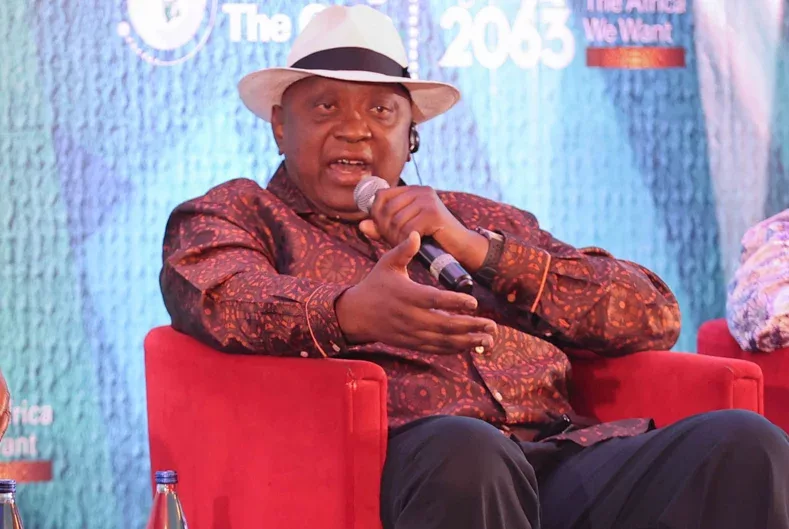
Months later, Uhuru publicly endorsed Raila, ending long speculation that was playing his handshake partner.
Endorsement, however, made it difficult for the former fiery opposition leader to criticise the Uhuru administration and even said he would take advice from Uhuru.
First, Uhuru did everything possible to weaken, diminish and demoralise Ruto and his Tangatanga team. Ruto's allies were purged from influential positions in Parliament, Ruto himself was eventually kicked out as Jubilee's deputy party leader.
That didn't subdue Ruto, it may have strengthened him. During the campaign he said he had three morning activities before Uhuru woke up.
Then the President was actively involved in the presidential campaigns, mobilising state machinery for Raila and promising to deliver his Mt Kenya backyard to Azimio la Umoja.
He dared those who thought he was a lame duck to bring it on, saying he could still "roar like a lion". It turned out, however, presidential support was more like a poisoned chalice, one of a number of reasons Raila lost.
Ruto called Raila an Uhuru project who would not, could not bring fresh ideas and real change. He was the candidate of continuity and suffering Kenyans wanted a sea change, Ruto said.
Among the obvious benefits to Raila, however, was support of the powerful Mt Kenya Foundation, which influenced Uhuru’s election in 2013 and 2017.
It was widely believed Raila had the state machinery at his disposal and torrents of cash from wide networks.
Powerful Cabinet secretaries vigorously campaigned for Raila in the hope Azimio would win. Put more correctly, they all hoped Ruto would lose.
Outgoing Interior CS Fred Matiang'i, whom Uhuru had elevated as 'super minister' replacing Ruto as overseer of projects, openly campaigned against the DP.
As did his ICT counterpart Joe Mucheru and Environment’s Keriako Tobiko, all buoyed by the President’s blessing. At some point, Tobiko called Ruto the President’s clerk.
This support fuelled the Tangatanga brigade's argument that Raila could not be his own man after forming government.
Amani leader Musalia Mudavadi and Ford Kenya’s Moses Wetang'ula led campaigns against the endorsement, saying 'Kenyans have never elected a project.'
“Azimio is a project of the 'deep state' and some influential people. Uhuru is the patron. He has installed Project Raila and is looking for a deputy for Raila,” Mudavadi said.
But history repeated itself, as when his political godfather President Daniel Moi endorsed him for the country’s top job in 2002.
This time around, Raila lost to Ruto, albeit with only about 200,000 votes, in a hotly contested election that ended up at the Supreme Court that upheld Ruto's win.
The political arena is abuzz with talk about whether Uhuru’s support helped Raila or resulted in the Azimio leader’s Waterloo.
Prof Macharia Munene, who teaches history and international relations, said although there seem to be similarities between Moi and Uhuru, there is a major difference between the two scenarios.
He said Moi knew what he was doing, giving Uhuru a chance to build up his political career, President Kenyatta ignored key warnings that followed his move.
Prof Munene said Uhuru appeared certain the Azimio candidate would win, as Raila has immense political experience.
The assumption on Uhuru’s side was that Raila would maintain his own bases and only needed a small push from someone (Uhuru) who appeared to be popular.
“Ordinarily, that would be a fair assumption," Munene told the Star. "But Uhuru also ignored reality. For some time, people told him things were not good, which he seems to have ignored.
The professor added, “His failure to listen to warnings was probably because he believed he was popular and powerful.
“He assumed he would tell people to do things and they would do them because he is powerful. That is where the problem was,” he explained.
The USIU don said the other assumption was that Uhuru imagined he was popular and had great influence that could be transferred to Raila.
He further observed that the President, rejected by his own Mt Kenya backyard, failed to properly explain why he defaulted on his 2013 agreement with Ruto — to endorse him for two terms.
“What he was telling people to do was against his own previous position. He was campaigning against himself. He failed to explain why he was doing it.”
“The reality on the ground was that much as people like Uhuru, there are things they wouldn’t do just because he directed them,” the political analyst added.
He said President's apparent choice of Martha Karua as Raila's running mate worsened things for the Azimio ticket, as Uhuru was seen as the 'puppet master'.
Uhuru’s allies, however, dismissed assertions the President didn’t deliver his promises to Raila, despite the latter giving him the free space to rule.
Immediate former Gatanga MP Joseph Nduati said claims of betrayal were far-fetched.
“He was supported in all ways. There are some things people cannot see. There was no betrayal and Jubilee did its best. Raila got over 880,000 votes [in Mt Kenya], way higher than in the past," he told the Star.
“You cannot get such votes if you don’t have support," Nduati said, adding that the question should be whether Raila’s strongholds performed as before.
“His strongholds suffered a huge reduction amid low voter turnout. We also saw Ruto chipped away Raila'a support in Western, Coast, Ukambani and Northeastern,” Nduati said.
Dr Charles Nyambuga, a political commentator from Maseno University, said an election win has more to do with an individual’s efforts than support from powerful people.
“It is more your own work and your own plans. An endorsement of a sitting head of state could work to a small advantage but it is not the whole thing,” Nyambuga said.
He said it was time to redesign the entire political landscape and the next election would present new terrain.
“If someone wants to compete in 2027, they have to start now. They cannot wait. I don’t see Raila contesting," Dr Nyambuga said.
Raila started campaigning shortly after his reelection in 2017.
For Raila supporters, the ODM leader was not a problem because he has been there over the years.
And while there were grumbles the President did not deliver his promise, the events at the Supreme Court showed otherwise.
President Kenyatta visited Raila's family on Tuesday and even joined him for the Azimio parliamentary group meeting on Wednesday.
He still maintains Raila is his leader.
Some observers say Ruto may have taken advantage of Uhuru's attempts to humiliate him to play the sympathy card.
By first accepting — and celebrating — that he was an underdog, he created a narrative that he was being fought by the 'dynasties'.
“That resonated. The sympathy card was great and Ruto exploited it,” Prof Munene said.
As a result, he said, Ruto penetrated not just Uhuru’s backyard but also Raila bases, including Nyanza, Coast, and Northeastern.
(Edited by V. Graham)
divided nation
“WATCH: The latest videos from the Star”