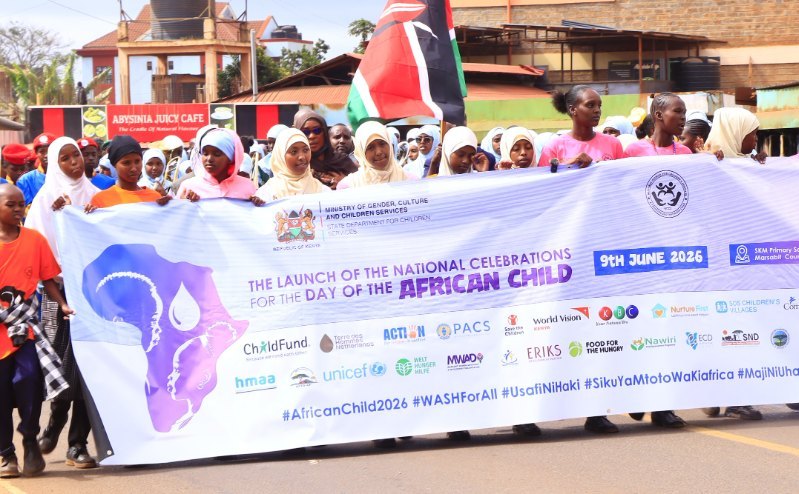
School children mark the Day of African Child in Marsabit town./STEPHEN ASTARIKO
For many children around the world, water is something they rarely think about. It flows from a tap in the kitchen, fills school sinks and runs through homes without question.
But for thousands of children in Marsabit county, water is a daily struggle that determines whether they attend school, stay healthy or remain safe from harmful practices.
Community members, development partners and other stakeholders recently gathered in Marsabit town during the national launch ahead of the national celebrations to mark the Day of the African Child.
This year's theme is: "Ensuring Universal Access to Water, Sanitation and Hygiene for Every Child in Africa."
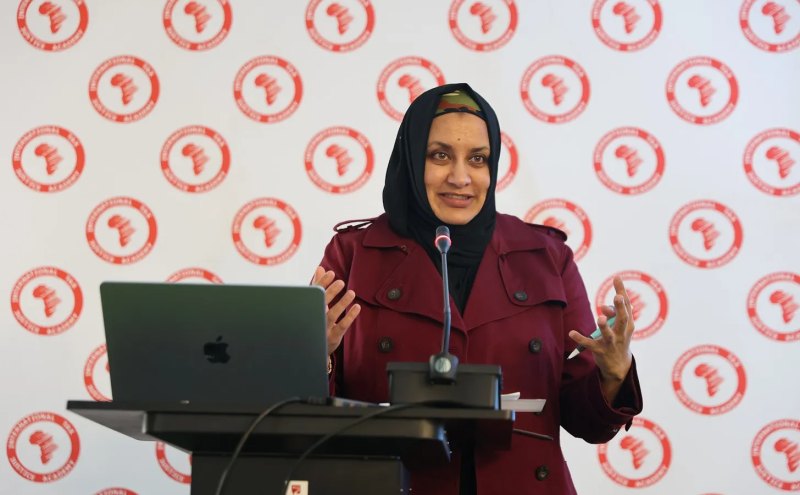
Addressing stakeholders during the celebrations, Cavallera Girls Secondary School student Gumatu Wario Barille spoke with conviction about the reality facing children in her county.
Gumatu said the celebrations in Marsabit served as a stark reminder that for many children in the county, access to water remains a distant dream rather than a guaranteed right.
"For many children across the world, water comes from taps and sanitation is guaranteed. But for a child in Marsabit, water is a daily struggle, involving long treks, missed lessons and barriers to education," she said.
Her words captured the reality of life in Kenya's largest county, where vast distances, prolonged droughts and inadequate infrastructure continue to deny many children access to one of life's most basic necessities.
Although Article 43 of Kenya's Constitution guarantees every person the right to clean and safe water, that promise remains elusive for many families in Marsabit.
In a region frequently battered by drought, households often travel long distances in search of water, leaving children vulnerable to missed schooling, poor health and insecurity.
National Council for Children's Services Board member Joseph Iha Wanje acknowledged the challenge and called for greater investment to ensure children enjoy the rights guaranteed to them.
"My ministry remains committed to collaborating with county governments to strengthen water and sanitation systems in homes, schools and institutions," he said. "But this is now a call to action for all partners — invest in children to ensure every child in Kenya has access to safe water."
Marsabit Women Advocacy and Development Organization (MWADO) chief executive Nurriah Golloh said the consequences of water scarcity extend far beyond thirst.
She noted that water shortages are increasingly contributing to social challenges that disproportionately affect girls.
"Acute water shortages are directly linked to chronic school absenteeism. And where water is absent, retrogressive practices rush in — FGM, early marriages, defilement and gender-based violence. Thirst becomes a weapon against girlhood," she said.
She noted that in some communities, families struggling to cope with prolonged water shortages resort to marrying off daughters as a survival strategy, exchanging them for dowries that help sustain households during difficult times.
"As Africa reflects on the rights and welfare of its children, our message is clear: universal access to water and sanitation cannot remain a promise on paper. It must become a reality in our homes, schools and communities," she said.
"Only then will our children no longer have to walk long distances in search of water, and only then will the right to water cease to be an aspiration and become what it was always meant to be — a guarantee," Nurriah added.
In such settings, a functioning water project becomes much more than infrastructure. It becomes a shield against vulnerability, helping keep girls in school and protecting them from harmful practices.
Development partners echoed the need for sustained investment in water, sanitation and hygiene services.
Compassion International Kenya programmes manager Eugene Juma emphasised that access to safe water directly influences children's health, education and dignity.
"Access to water, hygiene and sanitation protects children from preventable diseases. It improves school attendance and learning outcomes. It restores dignity and safety for children and their families," he said.
As the host county for this year's national celebrations, Marsabit leaders used the occasion to challenge both national and county stakeholders to move beyond annual commemorations and deliver lasting solutions.
Deputy Governor Solomon Gubo posed a question that resonated throughout the gathering.
"Is there a permanent, remarkable water and sanitation project we can undertake in Marsabit for posterity instead of just marking the day?" he asked.
"The national government must end the biting water and sanitation challenges in this region. Not with speeches. With pipes," he said.
His remarks reflected growing calls for sustainable investments capable of transforming lives long after commemorative events have ended.
Marsabit County Commissioner Stanley Kamande also challenged communities to abandon harmful cultural practices that continue to endanger children.
"I hear that FGM is still an alternative coping mechanism among pastoralist communities here. It is high time communities stopped such practices once and for all," he said.
His comments highlighted the complex relationship between poverty, resource scarcity and harmful traditions, underscoring the need for both infrastructure development and social transformation.
For the children of Marsabit, access to water means far more than filling a container. It means attending school consistently, staying healthy and growing up free from exploitation and violence.
It means having safe sanitation facilities, supportive learning environments and communities that protect rather than endanger them.
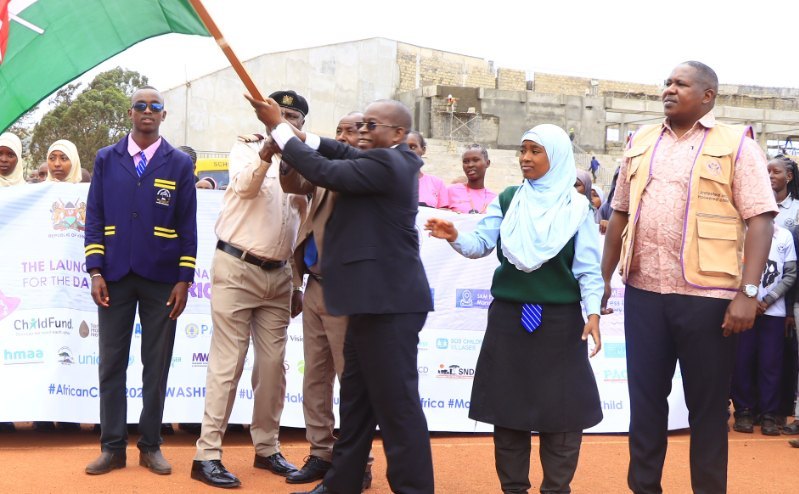
Joseph Iha Wanje, Member of the Board of Directors at the
National Council for Children’s Services flags off a procession during the launch of the Day of African Child in
Marsabit County. /STEPHEN ASTARIKO
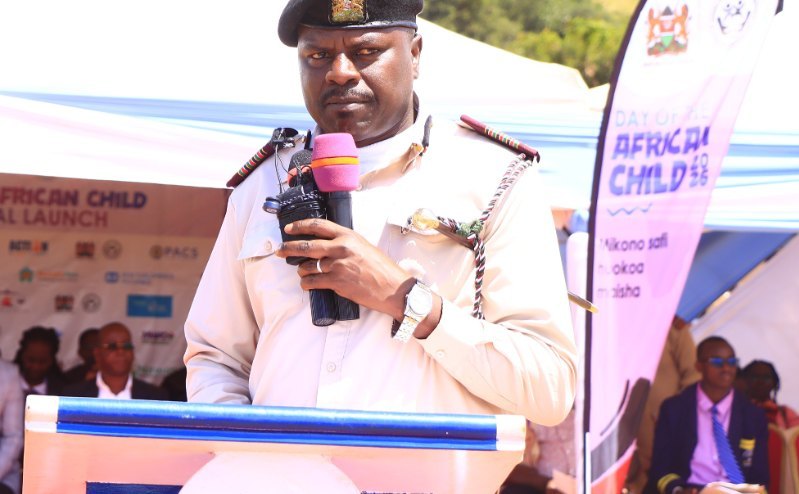
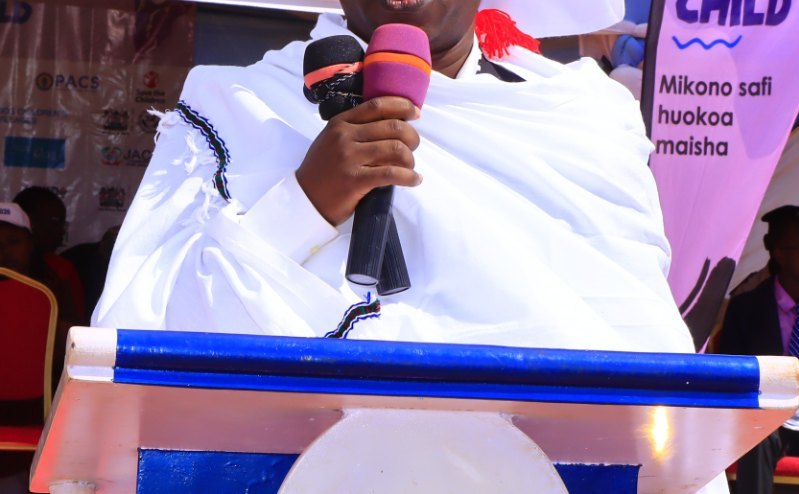
Joseph Iha Wanje, Member of the Board of Directors at the National Council for Children’s Services addressing the public during the Day of African Child in Marsabit Town. /STEPHEN ASTARIKO
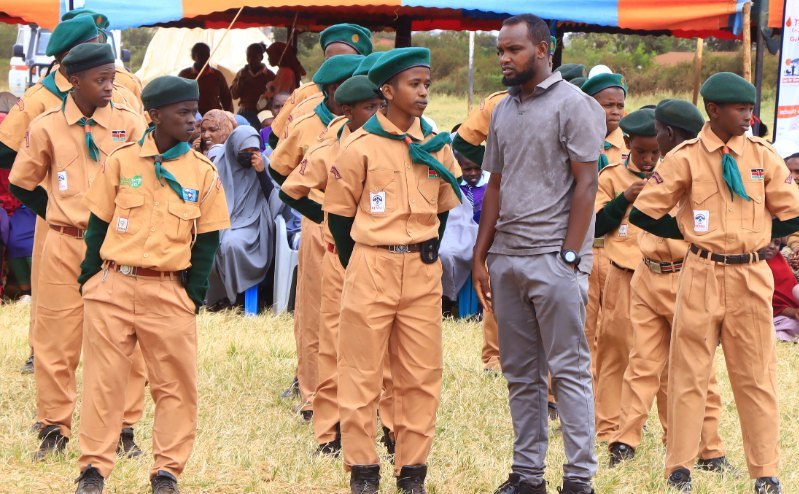
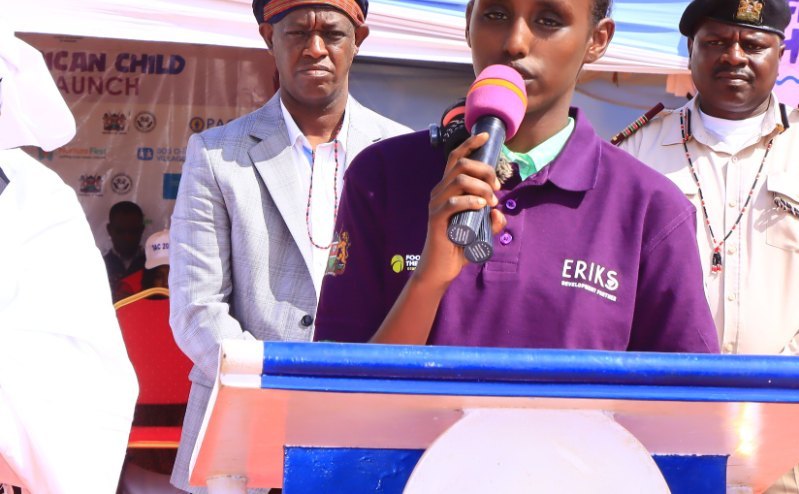
Cavallera Girls Secondary School Student Gumatu Barille addresses the public during the Day of African Child in Marsabit town. /STEPHEN ASTARIKO