
Labour ministry announces 8,972 overseas jobs
These job openings span several sectors.
3mon agoJANET ONYANGONews
Dr Mary Wanjiku, a gynaecologist in Muthiga, Kiambu, says the idea of estate doctor is appealing.
In Summary

Audio By Vocalize
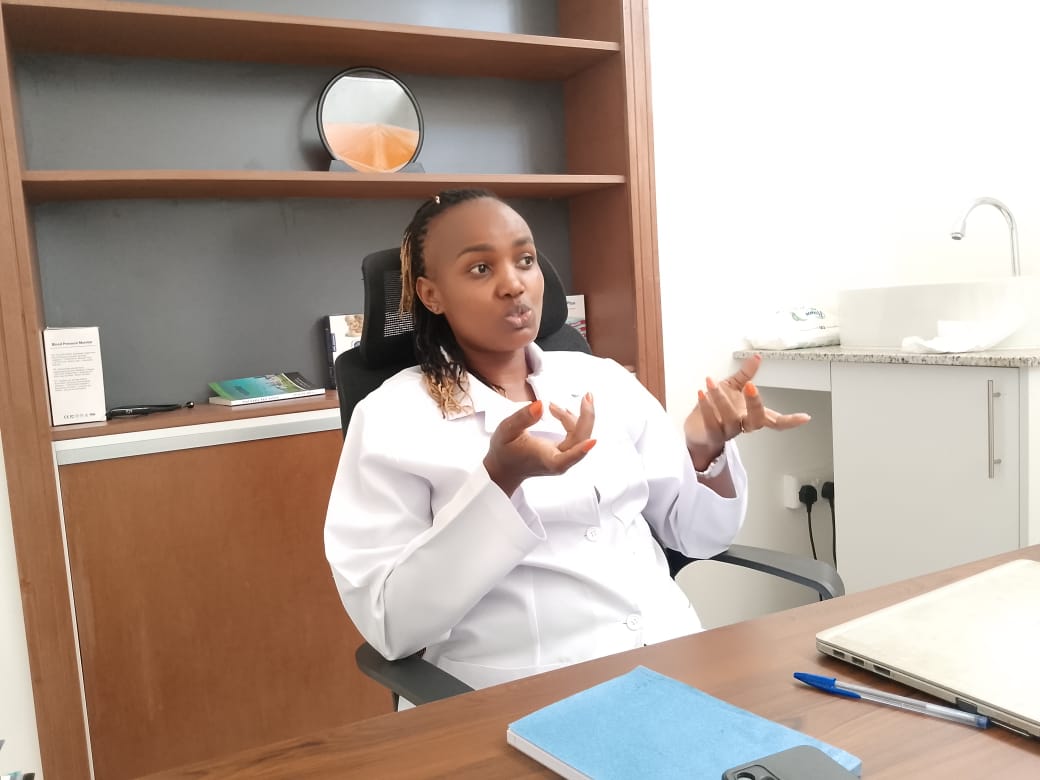 Dr Mary Wanjiku, a consultant gynaecologist and obstetrician, opened service in Muthiga less than a year ago because, she says, “the need is obvious.”
The matatu grinds to a stop outside a new shopping mall in Muthiga, near Kikuyu town, in Kiambu county.
On the ground floor is a new supermarket, some electronics shops and a few unoccupied stalls.
On first floor, two women sit on chairs, inside the freshly painted clinic.
Dr Mary Wanjiku stands by the reception counter, smoothing a folder of notes.
“I used to live in Rironi, near Limuru” she says, looking out at the street.
“I’ve seen this area grow. People travel from Kikuyu, Kangemi and even Westlands to find a gynaecologist. But there was nowhere here you could just walk into and be seen.”
Dr Wanjiku, a consultant gynaecologist and obstetrician, opened the clinic in Muthiga less than a year ago because, she says, “the need is obvious.”
“If you’re a mother, the ideal is one doctor for every 1,000 people,” she says.
“We are nowhere near that. I think we are at one doctor for 5,000, maybe 6,000 people per doctor. We are very few in Kenya.”
Kenya’s 2023 Health Labour Market Analysis puts the total health workforce across 13 major occupations at almost 190,000 active workers, but medical doctors (generalists and specialists) make up only about 6.7 per cent of that.
According to another study, there are roughly 13,000 doctors in Kenya and of those, only about 4,908 are specialists, meaning fewer than half the doctors have specialist training.
The problem is not only how many specialists there are, but where they practise. Kenya Medical Practitioners and Dentists Council notes most of the specialists are bunched in Nairobi, Mombasa, Eldoret and Kisumu, leaving large rural or peri-urban populations underserved.
But according to property consulting firms, there is ongoing robust growth in satellite towns such as Kikuyu, Kiserian, Juja and Thika, where land and property prices remain within reach of a wider spectrum of developers and middle class families.
“Price affordability was a factor in the performance of the various satellite towns in land price movement in the quarter, showing rising sensitivity among buyers amid tougher economic conditions as towns with a more affordable price entry point outperformed nearby areas with costlier land,” HassConsult co-CEO Sakina Hassanali said in April this year.
That is one reason medical specialists like Dr Wanjiku are setting up in Nairobi’s expanding satellite towns.
“Here I see everyone,” she says.
“Lower middle class to middle class. At times women come just to ask about consultation fees, and I find myself consulting them anyway.”
 Muthiga is one of the fastest-growing satellite towns near Nairobi.
Her clinic offers the full spectrum of obstetrics and gynaecology: antenatal care, deliveries, fibroid operations, menopause management, cancer screening and the diagnostic work-up for fertility problems. For the more expensive interventions like IVF, she refers patients to specialists in larger hospitals.
Such clinics were mostly available in Nairobi, at a higher cost.
Fertility issues, she says, are common among the middle and lower middle people.
“We are seeing a lot of women and men now suffering from fertility,” she says.
“I have seen a mother of 23 who has been married two years and has not conceived. For women under 35 we give one year. Above 35, six months, because ovarian reserve declines.”
Her explanations point to blocked tubes from untreated infections are common, male factors account for roughly half of infertility cases, and many problems can be diagnosed with relatively simple tests before anyone talks about expensive assisted reproduction.
Pain and menstrual disorders bring their own steady flow of patients.
“People should not suffer because of pain,” she says.
“Pain is telling you there’s a problem. I have seen girls miss school and women miss work because of heavy periods or cramps. It’s manageable.”
She describes how she designed the clinic for privacy: separate consultation rooms, a procedure room placed away from the waiting area, a discreet entrance, because stigma drives delay. Women worry about gossip if they seek help for sexual or reproductive health issues.
“I used to go to Westlands for a fibroid scan,” says one patient, Esther (she agreed to used only one name), who lives near Muthiga, a bustling suburb.
“The queues were long; here I come early, they see me quickly. It saves me money and time.”
Grace Mwende comes for her antenatal visits. “I feel more comfortable here. I can walk, I don’t pay for a matatu or have to drive to town.”
The move to suburban practice also exposes the financial tightrope small clinics walk.
Dr Wanjiku runs mainly on cash patients for now. “I haven’t started taking insurance,” she admits. “Claims can take years to be settled, while clinic bills, such as staff, supplies, rent, come every day.”
National reviews of health financing and provider surveys show delays and administrative burdens in claims processing discourage some private providers from accepting insurance, even when social schemes cover the services.
 A shopping mall near Muthiga, one of the fastest-growing towns near Nairobi.
Official data and professional organisations agree that suburban clinics alone will not solve the national shortage of specialised services.
The Health Labour Market Analysis and the Kenya Health Workforce Report make the point that Kenya needs continued investment in training, stronger retention policies and incentives for specialists to practise outside central urban hospitals if universal access is to be achieved.
Dr Wanjiku’s vision is modest and practical: a clinic where women can walk in from their homes, be seen, treated with dignity and referred easily when higher-level care is needed. She wants to add paediatrics, partner with other specialists, and normalise conversations about menopause and reproductive health.
“Menopause is stigmatised,” she says. “People see it as the end of femininity, but I see it as an empowering time. Women can rediscover themselves.”
She says if Kenya’s specialists continue to gravitate towards suburbs rather than only the inner city, that could ease the strain on central hospitals and make care more affordable and accessible.
For the women of Muthiga, a small clinic with a capable doctor already makes a tangible difference.
“If a woman can walk in, be seen, and leave knowing she’s been cared for, then we’ve done something important,” Dr Wanjiku says.
These job openings span several sectors.