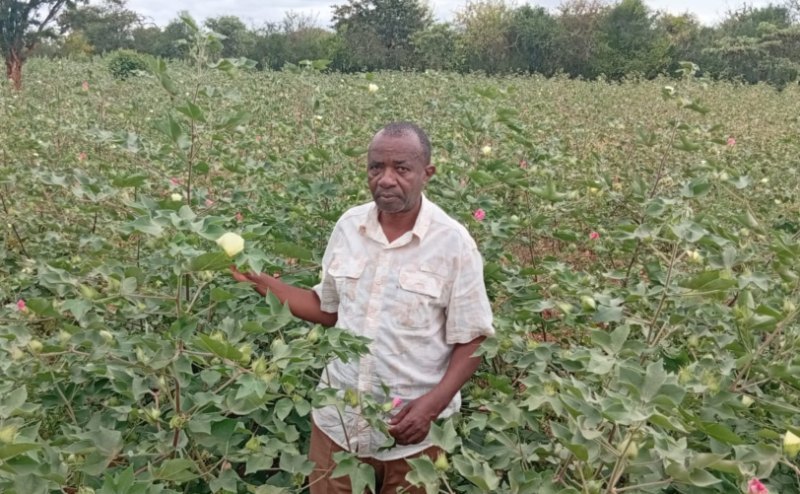
 A Ndalani cotton farmer in his farm/KNA
More than 1,000 cotton farmers in Yatta, Machakos county, have received pesticides and modern sprayers under a government initiative to boost production in semi-arid areas.
The support, rolled out through the Agriculture and Food Authority, targeted farmers from Ndalani, Kisiiki, Kiwanzani, Nthungululu, Mbembani, Kivingoni and Kakongo clusters.
The programme seeks to lower production costs, improve pest control and enhance cotton yields in an area where the crop has increasingly become a reliable source of income due to its ability to withstand harsh climatic conditions.
Francis Kilango, director of the National Cotton Growers Union and chairman of Ndalani Cotton farmers cooperative
society, urged
leaders to prioritise
investment in climate-smart agriculture to improve livelihoods in the region.
“Leaders, whether elected or aspiring, should support farmers to embrace resilient crops such as cotton and sunflower.
These crops perform well even in areas with unreliable rainfall and offer better returns to farmers,” Kilango said during the distribution exercise.
Cotton has become an important economic pillar for thousands of households across Yatta, providing farmers with a dependable source of income even during prolonged dry spells.
Farmers, led by Daniel Nzioki, welcomed the intervention, saying the generator-powered spraying machines will make pest control more efficient, reduce labour costs and improve productivity.
They also called for continued access to subsidised inputs, extension services and modern farming technologies to sustain the revival of cotton farming and strengthen household incomes across Machakos county.
The farmers at the same time, raised concerns over poor germination rates recorded from cotton seeds distributed during the last planting season, saying many farmers suffered losses.
“We are appealing to the government to provide Bt cotton seeds before the October planting season. Quality seed will increase yields, reduce production costs and protect farmers from unnecessary losses,” Nzioki said.
Cotton farming has steadily gained momentum in Yatta in recent years as more farmers shift to drought-tolerant crops including sunflower amid changing weather patterns, complementing earnings from maize and beans, which remain the area's main food crops.
Farmers say production has improved significantly following renewed government support, improved market access and growing awareness of the crop's economic value.
Meanwhile, at least 280 land disputes in Kajiado county have been resolved through the Alternative Justice System, providing residents with a faster and community-based mechanism for addressing longstanding land conflicts.
The AJS, which promotes alternative dispute resolution methods and helps reduce case backlogs in courts, gives councils of elders and religious leaders a greater role in the administration of justice, provided their decisions are in line with the constitution.
Speaking in Isinya, Kajiado Governor Joseph ole Lenku said the resolution of the land cases had enabled many residents to transition from letters of allotment to certificates of lease, thereby strengthening land ownership rights.
“The resolved cases have enhanced certainty, protected property rights and restored public confidence in land administration,” Lenku said.
The governor commended the AJS for its continued contribution in resolving land disputes and fostering harmony among communities across the county.
He
reaffirmed his administration’s commitment to addressing historical land
challenges that have hampered development for years, including the persistent
problem of double allocation of land.
Lenku said that through the department of lands, physical planning, urban development, housing and municipalities, the county has made significant progress in securing land ownership and promoting orderly development.
“We have issued lease titles to plot owners in Kajiado, Isinya, Noonkopir and Bulbul townships, while similar exercises are ongoing in Kiserian, Ongata Rongai, Olooloitikoshi and Kimuka,” he said.
The
governor further said that the
county has developed and validated physical and land-use plans for trading
centres across the county, including remote areas, to guide development,
improve service delivery and unlock investment opportunities.