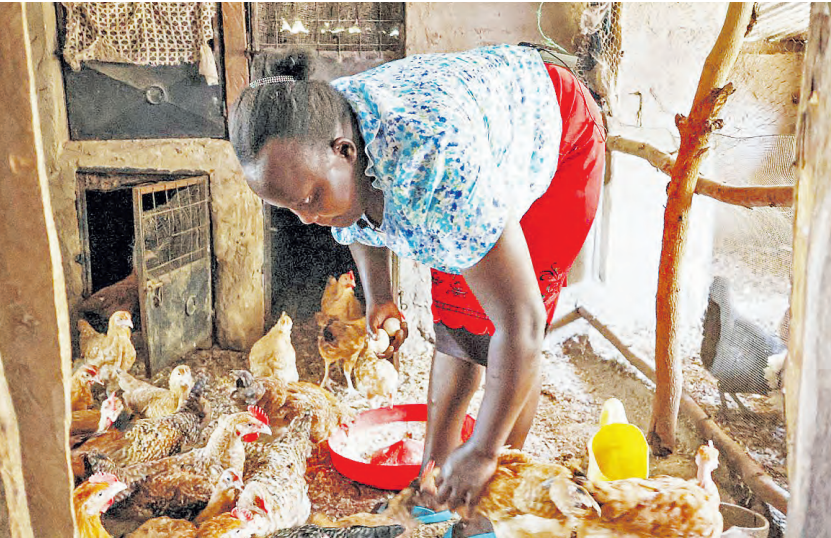
For years, Silvia Mueni, 30, has been
keeping a few free range chicken as
a part time job.
Mueni, a mother of two from
Musewani village in Yatta subcounty,
Machakos, started keeping between
10 and 12 free-ranging birds in 2019.
“Poultry is a woman’s venture.
Men here do not interfere or insist on
making decisions about the poultry
value chain,” Mueni says.
Before training, she did not consider poultry keeping as a money-making venture.
She therefore did not see
any need to vaccinate her chicken, let
alone keeping records.
In fact, Mueni would shake every
time she saw a syringe.
But in May last year, the Africa
Harvest Biotech Foundation International offered training that opened
her eyes.
“The training by Africa Harvest
Biotech Foundation International was
on brooding and how to do poultry
as a business venture,” Mueni says.
The foundation exists to realise the
vision of an Africa free from hunger, poverty and malnutrition by advancing agricultural technology
to improve food security, training
and skill transfer and in integrating
women and youth.
After training, she has grown her
flock to 120 birds.
Mueni says during the training, she
gained skills and knowledge on an
improved form of kienyeji breed that
matures within three to four months,
depending on the type.
“Improved kienyeji has good meat
and matures faster compared to pure
kienyeji. This means that it fetches
good money,” she says.
Mueni was also trained on how to formulate feed from her farm
produce, cutting the cost of buying
from shops.
“This means that I’m getting good
returns from my land. In three weeks,
I save Sh4,000.”
Vaccinating her flock kept diseases at bay and significantly improved
her returns, Mueni says, adding that
poultry diseases can wipe out all the
chicken.
Her fear of syringes disappeared
following a number of experiments
during the training sessions with
experts.
“I used the brooding knowledge
and skills I had acquired from the
training and this ensured there was
no chick that died.”
After the training, her first stock
was 100 chicks. She sold 50 chicks
once they were three weeks old and
left the remaining ones to mature.
“I made a profit of Sh4,500. I had
bought one chick at Sh120.”
At five months, the matured chicken was going up for Sh750.
“I can now make Sh12,000 to
Sh15,000 profit per month. There are
good returns in keeping improved
kienyeji,” Mueni says, adding that her
earnings have significantly improved.
As they underwent training, they
were linked to the market being
offered by global organic chicken,
removing the need for her to look
for a market.
Once chicken mature, the contractors come and weigh them alive
before paying the respective farmers.
“During the training, we also got
skills and knowledge in record-keeping. Record-keeping helps to keep
track of progress and other things
such as food, vaccines, expenditures among others,” Mueni says.
Records
also dictate the selling price for the
chicken.
As a result of her passion, Mueni is
now a trainer of trainers. “I have one
group in every sublocation. A group
that has few members is the one with
16 farmers while the highest has 45.”
Within Katangi ward, there are
four sublocations.
Mueni emphasises that poultry
farming has improved the lives of
many people and she now sees poultry farming as a great opportunity
for young women, as it allows her
financial independence.
“The proceeds from the sale of
chicken belongs to me. My husband
is not bothered with how I utilise
them."
As her business grows, she anticipates even higher earnings in the future. Mueni urged farmers to brand
themselves and ensure that they do
it to the best of their ability.
“If you are a chicken farmer, let
people know your venture,” she said,
adding that her business has several
customers as a result of best practices,” she said.