


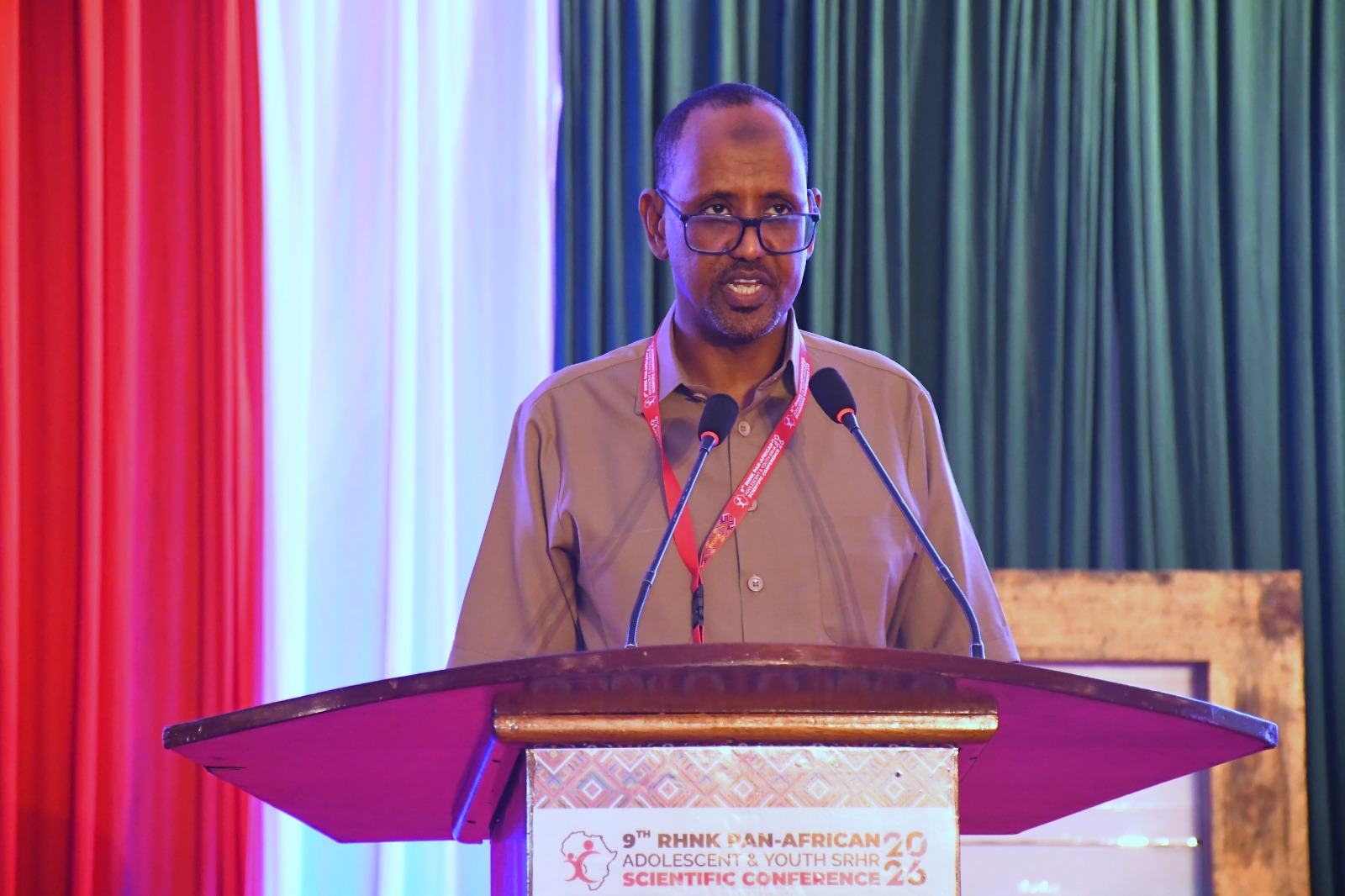
Ministry of Health Head of the Family Health Department, Dr Bashir Issak, speaking in Mombasa during the opening of the 9th Reproductive Health Network of Kenya (RHNK) Pan-African Adolescent and Youth Sexual and Reproductive Health and Rights (SRHR) Scientific Conference.
The Ministry of Health has announced plans to roll out
comprehensive sexuality education across the country.
The move is part of renewed efforts to curb rising teenage pregnancies and HIV infections among adolescents.
According to the Health ministry, 15 per cent of girls aged between 15 and 19 are either pregnant or already mothers, a figure that rises sharply in some counties.
In Samburu county, about 50 per cent of girls in this age group are either pregnant or have already given birth, while the rate stands at 36 per cent in West Pokot.
The ministry’s Head of the Family Health Department Dr Bashir Issak, described teenage pregnancy as one of Kenya's most urgent public health concerns.
“These numbers represent girls whose education has been interrupted, whose opportunities have been limited and whose futures depend on whether society is prepared to support and protect them,” Dr Issak said.
He was speaking in Mombasa during the opening of the 9th Reproductive Health Network of Kenya (RHNK) Pan-African Adolescent and Youth Sexual and Reproductive Health and Rights (SRHR) Scientific Conference.
To address the challenge, the government plans to strengthen sexuality education programmes, train healthcare workers to provide adolescent-friendly services and improve access to reproductive health information, medicines and commodities for young people.
The intervention comes amid growing concerns over rising HIV infections among adolescents and young adults.
Dr Issak revealed that, in 2025, young people aged between 15 and 24 accounted for 41 per cent of all new HIV infections in Kenya.
Mother-to-child HIV transmission also increased from 7.3 per cent to 9 per cent.
He noted that many young people continue to lack critical information on sexual and reproductive health.
Nationally, only 26 per cent of adolescent girls know that condoms can prevent HIV transmission, while in Garissa county, only 15 per cent have comprehensive knowledge about HIV.
“These are not just statistics. They are indicators of gaps in information, services and survival,” he said.
The ministry is also seeking to revive community-based prevention programmes affected by declining donor funding.
Dr Issak said strengthening grassroots interventions would be critical in addressing both teenage pregnancies and HIV infections.
While the government continues to provide free maternal healthcare through Taifa Care under the Social Health Authority (SHA), Dr Issak stressed that prevention must remain the priority.
More than 30 million Kenyans have already registered under SHA, enabling access to free primary healthcare services.
The ministry has also formalised 170,000 Community Health Promoters and launched digital health initiatives to improve healthcare delivery and track maternal health outcomes.
Health experts attending the conference warned that adolescent pregnancies, HIV infections and Gender-Based Violence continue to threaten the wellbeing and prospects of millions of African youths.
Reproductive Health Network Kenya executive director Nelly Munyasia said adolescent pregnancies remain a growing challenge across the continent.
This is even as access to reproductive health services faces disruptions due to shrinking global health financing.
“Adolescent pregnancies keep rising, HIV infections among young women remain devastatingly high, and gender-based violence continues to be normalised in many communities,” she said.
Munyasia noted that shortages of contraceptive commodities and funding cuts are placing additional pressure on health systems at a time when demand for youth-friendly services is increasing.
The four-day conference has brought together more than 750 participants from 44 African countries to discuss solutions aimed at addressing adolescent pregnancies, HIV infections and GBV.
It also advances youth participation in social and economic development.
Regional Director of the International Planned Parenthood Federation for Africa Dr Claudia Shilumani, called for increased investment in adolescent and youth sexual and reproductive health.
She warned that failure to act would undermine education outcomes, economic growth and gender equality across the continent.
“If we fail to invest in young people's sexual and reproductive health today, we risk reversing gains made in maternal health, HIV prevention and girls' education while perpetuating cycles of poverty and inequality,” she said.








![[PHOTOS] Red carpet in Pretoria as Ruto begins South Africa visit](https://cdn.radioafrica.digital/image/2026/06/abe3e750-6e5a-4394-a45c-899768be6240.jpeg)