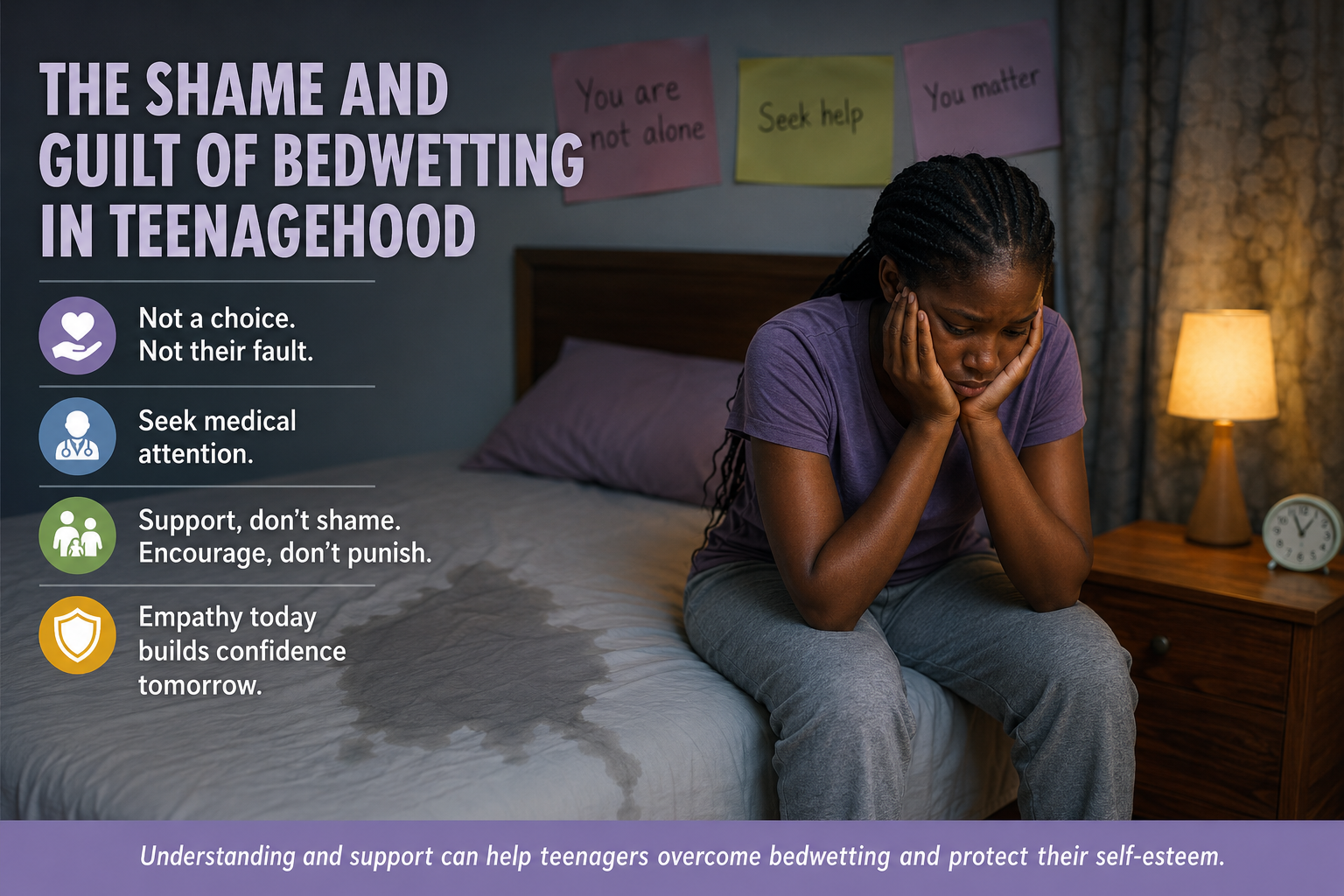
Born into a poor polygamous family in a Kilifi village, Terry Pendo (not her real name) grew up thinking bedwetting was normal among children.
She slept on a traditional reed bed locally known as mwakishu and a woven mat called mkeka. There ere was little to lose whenever she wet the bed. Her elder sister, who shared the bed with her, eventually got used to waking up to a wet mat and soaked kanga every morning.
“How can a four-year-old girl keep bedwetting every single day?” her sister would occasionally complain, Terry recalls.
But as the years passed, the problem persisted.
At the age of 10, Terry’s mother became increasingly concerned. Since diapers were a luxury the family could not even afford, she resorted to waking Terry up every hour during the night in an attempt to prevent the bedwetting.
“It never worked,” Terry says.
Her mother then introduced another rule; no drinking water a few hours before bedtime. That too proved futile.
Things became even more difficult when the family replaced the old mwakishu with a mattress.
Now entering her teenage years, Terry says the shame of bedwetting began taking a toll on her self-esteem. Despite the hot coastal temperatures, she had to spread nylon over the mattress every night to prevent urine from soaking into it.
“I had to endure the heat,” she says.
At 14, it was time to join secondary school and Terry was terrified.
“I begged my parents to take me to a day school, but they refused,” she says.
Now 30 years-old, Terry recalls joining a girls’ boarding school at the Coast, hoping for a miracle. She was assigned the lower decker of a double bed and, for the first two nights, she did not wet the bed.
But anxiety kept her awake.
“The fear alone denied me sleep,” she says.
On the third night, it happened.
“I felt so ashamed,” she says with a nervous laugh.
Beyond the embarrassment, Terry says she lost confidence and constantly struggled with low self-esteem. Fortunately, her bedmate became understanding after Terry explained her condition.
With time, the frequency of bedwetting reduced. Then finally, during the third term of Form 2, at the age of 17, it stopped completely.
John K (also not his real name) shares a similar experience.
Now 35 years-old, John says bedwetting made him withdrawn throughout his teenage.
“They nicknamed me Kikojozi, (the one who wets the bed), he says.
Raised by a single mother, John says she feared the problem could be linked to an illness. She took him for medical checkups. However, doctors found no underlying medical condition.
Visiting relatives became stressful because of the fear that he might wet the bed.
“I was always anxious when night fell,” he says.
John eventually stopped bedwetting at the age of 19, shortly after completing Form 4.
According to paediatrician Allan Too, most children stop bedwetting between the ages of two and three. However, when it persists beyond seven years, parents should seek medical attention.
Dr Too says conditions such as diabetes and urinary tract infections can contribute to bedwetting in older children and teenagers. In some cases, affected children may have a small functioning bladder, making urine control difficult.
He also notes that hormonal imbalance can play a role.
“The underproduction of antidiuretic hormone, which helps regulate water in the body by signalling the kidneys to reabsorb water into the bloodstream, can contribute to bedwetting,” he explains.
Too says medication can help increase hormone production where necessary. However, he emphasises that medical treatment should be combined with behavioural interventions such as reducing water and caffeine intake before bedtime.
Child psychologist Florence Ochanda says psychological factors such as stress, trauma and family conflict can also contribute to teenage bedwetting.
She urges parents to emotionally support affected children to avoid damaging their self-esteem.
“Support the child emotionally and normalise the conversation around the condition,” she advises.
Ochanda clarifies that this does not mean encouraging the behaviour, but rather helping the child understand that they are not alone and that support is available.
She also recommends addressing emotional triggers where they exist.
According to her, low self-esteem, fear, shame, guilt and helplessness are among the common psychological effects experienced by teenagers who wet the bed.
For parents who resort to punishment, insults or harsh language in an attempt to stop the behaviour, Ochanda warns that such actions can worsen the situation and leave lasting emotional scars.
Although only a small percentage of children continue bedwetting into their teenage years, experts say proper medical and emotional interventions are critical in protecting affected children from long-term psychological harm and ensuring stable mental health.



![[PHOTOS] The new Ngong –Naivasha Road viaduct](https://cdn.radioafrica.digital/image/2026/06/64d4f771-4432-4aee-ba3c-2f304c4436ec.jpg)