Kenya's direct coffee sales continued to attract higher prices than the Nairobi Coffee Exchange in the current marketing season, with growers earning nearly 20 per cent more per bag through direct contracts.
Total coffee earnings hit Sh38.3 billion with data from the Coffee Directorate showing that direct sales between October 2025 and June 2026 earned a weighted average of Sh52,400) per 50kg bag, compared to the auction average of Sh43,900.
The difference of
about Sh8,400 per bag highlights the stronger returns recorded through
the direct marketing channel during the period.
Direct sales generated Sh6.35 billion from 6.07 million kilogrammes of clean coffee.
By the close of Sale 29 at the Nairobi Coffee Exchange,
Kenya had marketed a combined 42.42 million kilogrammes of clean coffee through
the auction and direct sales, earning Sh38.3 billion.
The auction remained the country's main marketing channel,
accounting for 36.36 million kilogrammes valued at Sh31.95 billion, while direct sales contributed 6.07 million kilogrammes worth Sh6.35 billion.
Although direct sales accounted for about 14 per cent of the
total coffee marketed during the period, they contributed 16.6 per cent of the
total value, reflecting the relatively higher prices secured in export markets.
Based on previous marketing patterns, Kenya is projected to
surpass the 60 million-kilogramme mark by the close of the 2025/26 coffee
season in September if deliveries continue at the current pace.
In the 2024/25 season, Kenya produced about 51.9 million
kilogrammes of clean coffee valued at approximately Sh31 billion, supported by
improved weather conditions, better prices and ongoing reforms within the sector.
The direct sales channel recorded gradual growth during the
season before reaching its highest monthly performance in March.
October opened with 98,663 kilogrammes valued at Sh108 million. Volumes increased to 197,978 kilogrammes worth Sh224 million in November before rising to 485,913
kilogrammes valued at Sh549 million in December.
The upward trend continued in January with 730,662
kilogrammes earning Sh782 million, followed by
February's 754,650 kilogrammes for Sh878 million.
March recorded the season's highest performance with 1.95
million kilogrammes generating Sh2.06 billion.
April followed with 1.16 million kilogrammes valued at Sh1.14 billion, before volumes eased to 348,919
kilogrammes worth Sh287 million in May and another 332,670
kilogrammes worth Sh314 million in June.
Average prices remained above Sh51,600 per
50kg bag between October and March, peaking at Sh58,200 in February before easing in May and recovering slightly in June.
The United Kingdom and Switzerland remained Kenya's largest
direct coffee buyers during the period.
The UK imported 2.43 million kilogrammes worth Sh2.66 billion, accounting for about 40 per cent of all direct sales.
Switzerland followed with 2.35 million kilogrammes worth Sh2.07 billion, representing nearly 39 per cent of the total.
Together, the two markets purchased almost four-fifths of
Kenya's direct coffee exports, while Germany and the United States accounted
for smaller shares.
Among individual destinations, Jordan recorded the highest
average price at Sh119,500 per 50-kilogramme bag, followed by Japan
at Sh88,500), Denmark at Sh87,100 and Hong Kong at Sh83,500. Somalia recorded the lowest average price at Sh32,100 per
bag.
While Kericho remained the largest supplier through the
auction, Kirinyaga emerged as the country's biggest overall producer after
marketing 2.37 million kilogrammes through direct contracts. Its combined
auction and direct sales reached 6.97 million kilogrammes, ahead of Kericho's
6.10 million kilogrammes.
The latest figures indicate direct sales are becoming an
increasingly important avenue for cooperatives and farmers seeking to access
premium international markets.
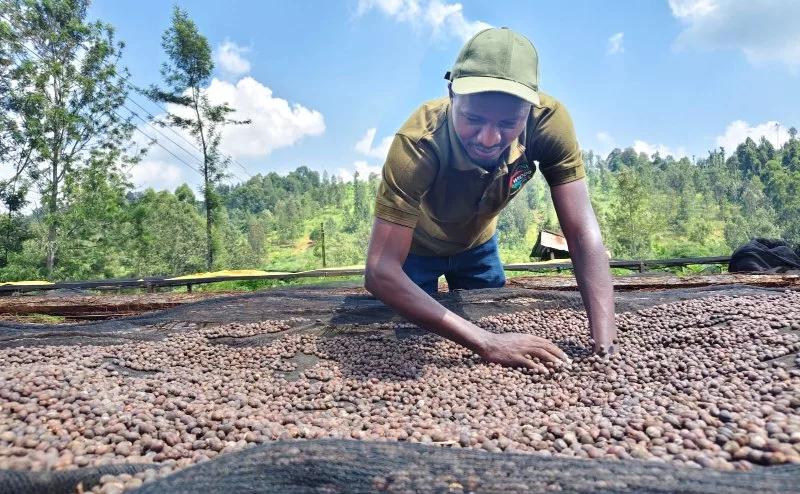
Coffee farmer Nahashon Mugi from Kahuro, Murang'a, lauded the government for
putting in place measures to streamline the sector and expose the produce to
bigger markets.
“The good prices being realised in the market have restored
hope to farmers who have contended with meager pay for decades.”