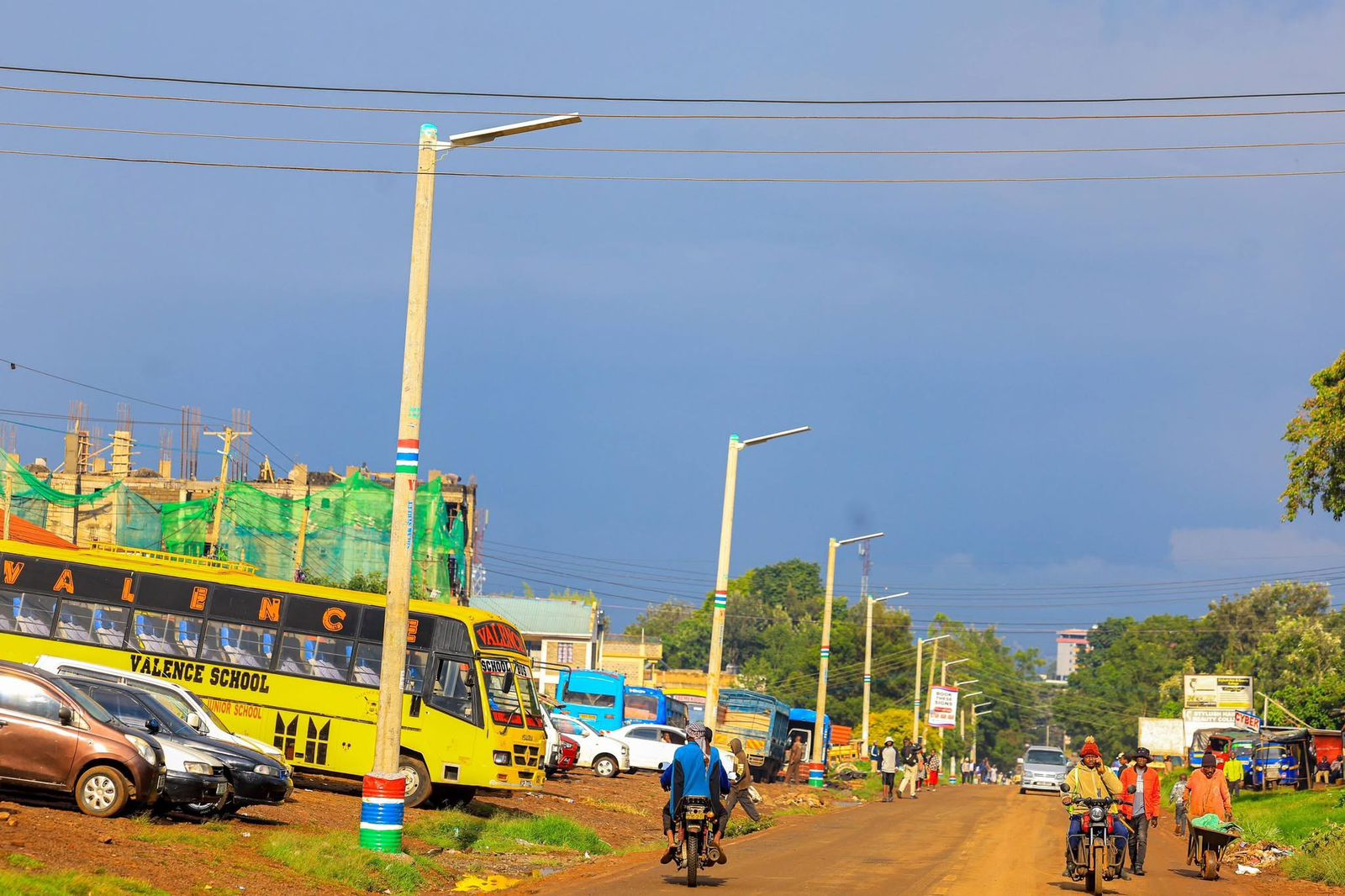
 Solar street lights in Kiambu county./HANDOUT
The Kiambu County government has set out to expand its flagship solar street lighting project, now in its second phase, following the successful countywide installation of the first phase that continues to improve lives.
The Governor Wamatangi-led initiative dubbed Angaza Kiambu is aimed at enhancing security, reducing power and energy costs, and driving economic activity.
Under the Kiambu Climate Change Act of 2021, the county has mandated the transition to solar energy for all public infrastructure from conventional electricity.
Speaking during the launch of the ongoing installation of street lights across the county, Governor Wamatangi noted that the transition had significantly reduced power bills, with funds now being put into development projects.
“We have seen other counties and regional leaders benchmarking with us for the prudent use of our resources. What we used to pay for grid-powered bills is now used for development across the board. Look at our projects in the Early Childhood Development (ECD), agricultural output and the upcoming public health infrastructure,” he said.
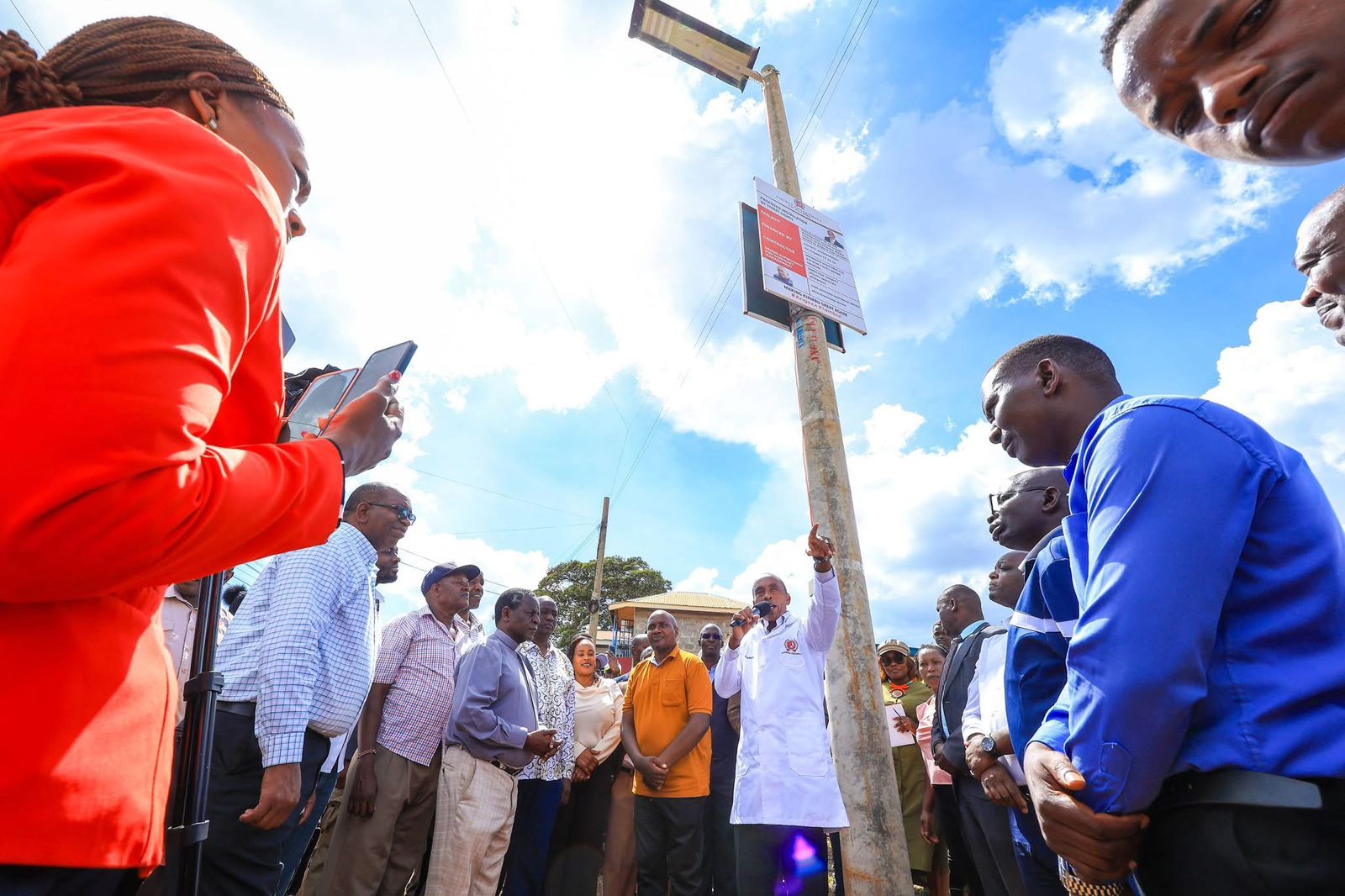 Kiambu Governor Kimani Wamatangi during the solar street light installation projects in Kiambu county./HANDOUT
County Climate Change Director Ms Esther Kaguima notes that the project is timely as the world moves toward reducing carbon emissions.
“Part of the key areas of implementation was the introduction of solar energy solutions for all county projects,” she says, citing the Kiambu Climate Change Act to note that the solar project is a key component of the county’s response to climate change impacts, key among them the transition to low carbon development pathway.
Ms Kaguima adds that the switch to renewable energy places Kiambu miles ahead towards the Nationally Determined Contributions (NDCs), where all efforts are recognised in climate change mitigation.
"Studies have shown that grid street lighting leads to the highest emissions because of reliance on fossil fuels, so the transition to solar systems helps in lowering our carbon footprint,” she notes.
 Kiambu Governor Kimani Wamatangi during the solar street light installation projects in Kiambu county./HANDOUT
“We are currently implementing the policy that mandates all street light installations to be solar, and to eventually move the grid-powered ones to solar, as we aim to maintain minimal to zero power costs in the future,” she added.
Residents across the county have already reported tangible benefits from the first phase, including improved security, reduced crime rates, and increased commercial activity in trading centres. Business owners, in particular, have welcomed the initiative, citing longer operating hours and improved customer traffic.
John Mwangi, a resident of Wangige Market, noted that the streetlighting had changed the face of doing business in the area, adding that “the community now enjoys an almost 24-hour economy because we are assured of our safety.”
In areas where Phase Two is currently being implemented, such as parts of Kikuyu, Kabete, Juja, Ruiru, Gatundu North, Thika and other municipalities, installation works are ongoing, with the Chief Officer indicating that the exercise will continue progressively until all the sixty wards are covered.
“It is a phased project, and we are working to cover all the twelve sub-counties as we build on what we achieved in the piloting phase. We have so far done over 10,000 lights, targeting to double that at the end of the project,” she said.
The Angaza Kiambu programme also forms part of a wider strategy to solarise public infrastructure, including hospitals, boreholes, and county facilities, further reducing dependence on the national grid and enhancing service delivery.
CECM for Water and Environment David Kuria noted that water companies in Kiambu were also working on solarising their operations to lower power costs.
“We have solarised 11 boreholes so far, and this has significantly reduced the power bills and enhanced constant water supply, as the grid-powered system was unreliable due to constant power outages and sometimes power cuts due to unsustainable bills,” Kuria added.
As Phase Two gathers momentum, Kiambu is positioning itself as a leader in renewable energy adoption at the county level, with the long-term vision of achieving a fully solar-powered public lighting system.



![[PHOTOS] The new Ngong –Naivasha Road viaduct](https://cdn.radioafrica.digital/image/2026/06/64d4f771-4432-4aee-ba3c-2f304c4436ec.jpg)