Analysts say Azimio has the upper hand, with Raila retaining bases.
But ...
by The Star
Audio By Vocalize
Azimio la Umoja flagbearer Raila Odinga in Marsabit town on Thursday, June 23
The race between Kenya Kwanza leader William Ruto and Azimio leader Raila Odinga could be too close to call, an analysis of the official IEBC voter register by the Star suggests.
If the two maintain their 2017 poll bases, they would start the race on almost equal footing in more than half of the counties.
Raila would start with about 8,028,255 votes compared with Ruto’s 7,983,391 votes.
However, this assumes Raila sweeps votes in his traditional bases of Nyanza, Western, Lower Eastern and Coast, while the Deputy President takes Mt Kenya and all the Kalenjin-dominated Rift Valley counties.
The latest IEBC figures show the four Western Kenya counties have a total of 2.2 million voters —2.1 million in Nyanza, 1.6 million votes in Ukambani and 1.9 million at the Coast.
These regions overwhelmingly voted for Raila in 2017.
12 swing counties/clusters
On the DP's side, all 10 Mt Kenya counties, including Nakuru have a total of 5,770,976 votes, while the six Kalenjin-dominated counties have a total of 2,212,415 votes.
Mt Kenya and Rift Valley were Jubilee bastions in the previous two elections.
However, since the 2017 election, a lot of political realignments have taken place and the voting patterns could change.
In Western, for instance, Ruto now has the backing of ANC Party leader Musalia Mudavadi and his Ford Kenya counterpart Moses Wetang’ula.
Raila also has the support of President Uhuru Kenyatta and has tapped Narc Kenya boss Martha Karua as his running mate.
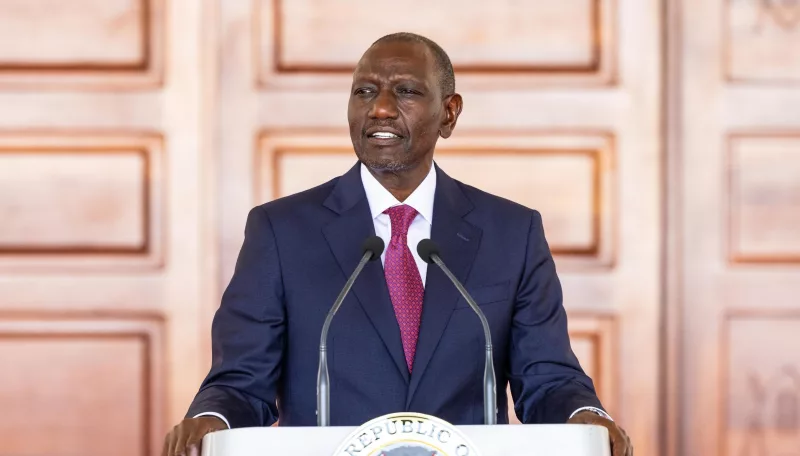
Deputy President William Ruto addressing a rally at Samburu Trading Centre, Kinango, Kwale county, on Friday, June 24
The race however could be tilted by the voting behaviours of several counties, including Nairobi, seen to be battlegrounds.
Other than Nairobi, opinion polls have identified at least 11 swing counties with slightly more than four million votes.
These counties will be central in determining who, Raila or Ruto, carries the day.
They include Nakuru with 1,054,856 registered voters, Bungoma (646,598), Trans Nzoia (398,981), Turkana (238,528), Lamu (81,453) and Kwale (328,253).
Others are Kajiado with 463,273 registered voters, Narok (398,784), West Pokot (220,026), and Samburu (100,014).
Opinion polls have, however, suggested Raila could win the city votes by a big margin.
Nairobi has 2,415,310 registered voters, according to the official IEBC voters roll.
An opinion poll by research firm Tifa last week suggested Raila will secure 50 per cent of Nairobi votes compared to Ruto's 25 per cent.
This would translate in 1.2 million votes for Raila against the DP's 600,000.
A separate survey by Radio Africa Group suggested a 52 per cent lead in favour of Raila, compared with Ruto’s 29 per cent in Nairobi.
Raila may also get an advantage in Gusii where a majority of the area leaders are supporting his presidential bid, putting him in pole position to bag the region’s 960,000 votes.
Even then, a lot of realignments have happened in both Raila and Jubilee (Ruto) strongholds but how that would translate to votes is unclear.
With Musalia and Wetang'ula on Ruto's side, the polls suggest Ruto's popularity has risen.
The Radio Africa poll suggested Ruto would get 33 per cent support from the region against Raila's 50 per cent.
However, there have also been realignments in Mt Kenya where Raila’s popularity was as low as 10 per cent in the last election.
The latest opinion polls suggest Raila has a chance of bagging more than 20 per cent of the region’s vote, translating to about 886,000 votes.
Where they are strong
Ruto has slightly less than 50 per cent rating in the President’s backyard, thus could bag 2.2 million votes in his ticket with Mathira MP Rigathi Gachagua.
At the Coast, it is argued the departure of Kilifi Governor Amason Kingi from Raila’s camp and the support his Kwale counterpart Salim Mvurya have benefited Ruto greatly.
Political observers say the region could become a swing vote area, to the detriment of Raila, considering there are 916,855 votes from the two counties at stake.
Opinion polls are suggesting Raila is ahead of Ruto in North Eastern region, one of the areas where Jubilee was leading in 2013 and 2017.
Studies have shown Ruto leads in North Rift, South Rift, North Eastern and Upper Eastern while Raila is stronger at the Coast, in Lower Eastern, Nyanza and Western.
Age and gender, however, are also turning out to be critical factors in the election, which pundits say could be determined by more than regional leanings.
The Azimio Council, after its meeting in Nairobi on Friday, told journalists the jumbo coalition was targeting to win the election with 15 million votes.
In a statement, the coalition’s apex body said its experts were combing through data to help identify areas where they will concentrate in crafting a winning formula.
Voter numbers per region, including key swing counties and clusters, such as Gusii
Political analysts are in accord that the swing vote areas — with approximately four million votes — would be the areas to watch.
Dr Charles Nyambuga of Maseno University told the Star Azimio has the tyranny of numbers as it heads to the August 9 vote.
“With people older than age 40 being in the majority vote, Azimio has a higher chance of winning since Ruto has invested more in the youth,” he said.
Dr Nyambuga said such a [youth] vote is unreliable as a number of had not registered in the first place, hence, posing a challenge.
“Among those who have registered, he is going to share them with presidential contender George Wajackoyah who is resonating well with the youth,” he said.
The don said that with the euphoria in Western, Raila could top the region with more votes than he did in 2017.
Nyambuga further said that going by the dynamics of the August election, new battlegrounds are emerging including Trans Nzoia, Bungoma, Meru, Embu, Kirinyaga, Kajiado and West Pokot.
“Meru and Embu are not sitting pretty in the Kenya Kwanza orbit. They are not done yet with the Kithure Kindiki issue. This opens up the region as a battleground for the two frontrunners,” he added.
He said Raila's team has to put more effort in West Pokot where not seen as very successful in rallying the region's vote.
Initially, polls showed Ruto was the man to beat. However, things changed drastically with Raila penetrating most Ruto strongholds
Political analyst Peter Kagwanja also said Raila has the numbers considering his improving stakes in the Mt Kenya region.
He said that Raila appears to have kept his bases intact, regardless of the alignments, and thus needs just a small percentage to catapult him past the 50 per cent plus one mark.
Prof Kagwanja said the ODM leader, having polled 44.9 per cent in the last vote, only needed about six to seven points to sail through.
“Initially, polls showed that Ruto was the man to beat. However, things have changed drastically with Raila penetrating most of the Ruto strongholds,” he said.
His take was that the running mate battle, which he termed a ‘battle of wits’, decided the Uhuru succession race.
“The other factor that has helped the Azimio team is President Kenyatta’s decision not to go into active campaigns,” the governance and policy expert said.
(Edited by V. Graham)
“WATCH: The latest videos from the Star”
This is premium content
Subscribe to Continue Reading
Help us continue bringing you unbiased news, in-depth investigations, and diverse perspectives. Your subscription keeps our mission alive and empowers us to provide high-quality, trustworthy journalism. Join us today to make a difference!