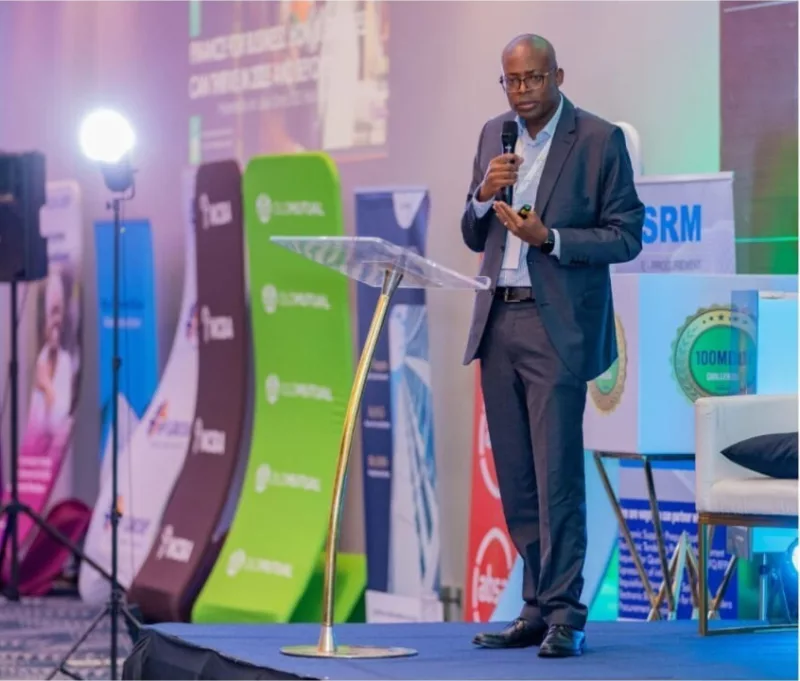
 Faulu microfinance bank CEO Julius Ouma during a stakeholder engagement forum in Nairobi
The latest Controller of Budget (CoB) implementation review shows that outstanding pending bills owed by the national and county governments rose to Sh465.87 billion as of March 2026, up 10.5 per cent from Sh421.6 billion recorded in the same period last year.
The growing backlog has intensified liquidity pressures on businesses that depend heavily on government contracts, with many suppliers waiting more than a year to receive payment.
The delayed settlements have become one of the biggest threats facing Kenya's micro, small and medium-sized enterprises (MSMEs), which form the backbone of the country's economy.
According to the 2025 MSME Survey by the Kenya National Bureau of Statistics (KNBS), Kenya has about 7.4 million MSMEs, contributing nearly 40 per cent of the country's Gross Domestic Product (GDP) and employing more than 15 million people, making the sector the country's largest source of jobs outside agriculture.
However, economists say the growing stock of unpaid government bills is denying these businesses the working capital needed to expand, forcing many to rely on costly short-term borrowing or suspend operations altogether.
"The delayed payment of pending bills has become a significant drag on private sector growth because businesses cannot plan, invest or even pay their suppliers on time," economists have repeatedly warned, noting that liquidity shortages ripple across entire supply chains.
The National Treasury recently announced plans to release Sh255 billion to reduce the pending bills backlog.
Even so, Treasury officials estimate it could take at least two financial years to fully clear the historical arrears, leaving businesses searching for immediate financing solutions.
"While the National Treasury recently approved a Sh255 billion disbursement to chip away at the arrears, small businesses still require faster, more transparent settlements to scale," said Faulu Microfinance Bank chief executive officer Julius Ouma.
Financial institutions are now redesigning lending products around the realities facing SMEs.
Old Mutual-backed Faulu Microfinance Bank has expanded its structured trade finance offering to support businesses affected by delayed public sector payments.
Rather than relying solely on traditional collateral-based lending, the lender is partnering with reputable underwriters to share credit risk while structuring financing around specific trade transactions.
Its flagship Biashara SME facility includes Local Purchase Order (LPO) financing and invoice discounting, allowing businesses with confirmed purchase orders or unpaid invoices to access working capital before clients settle outstanding bills.
The bank also offers bid bonds, performance bonds and advance payment guarantees, enabling contractors to pursue multiple government tenders without tying up scarce capital.
"While Kenya's 7.4 million MSMEs account for nearly 40 percent of the nation's GDP, they are routinely locked out of conventional tier-one banking credit lines due to a lack of standard fixed collateral," said Ouma.
Access to affordable credit remains one of the sector's biggest challenges.
Most commercial banks remain cautious because SMEs account for a disproportionately high share of loan defaults.
According to the Central Bank of Kenya's Banking Sector Stability Report, the trade sector, which includes a large number of MSMEs, continues to record one of the highest levels of non-performing loans (NPLs).
This reflects persistent cash-flow challenges, rising operating costs and weak consumer demand. Lenders therefore impose stricter collateral requirements, higher pricing and tighter credit assessments, effectively locking many smaller firms out of formal financing.
Business lobby groups, including
the Kenya Private Sector Alliance
(Kepsa), have consistently urged the government to expedite payment of
verified pending bills, arguing that timely settlement would unlock liquidity,
reduce business failures and protect jobs.
With government arrears continuing to rise and conventional credit remaining difficult to obtain, structured trade finance is rapidly emerging as a critical lifeline for thousands of Kenyan SMEs seeking to bridge cash-flow gaps while keeping their businesses running.