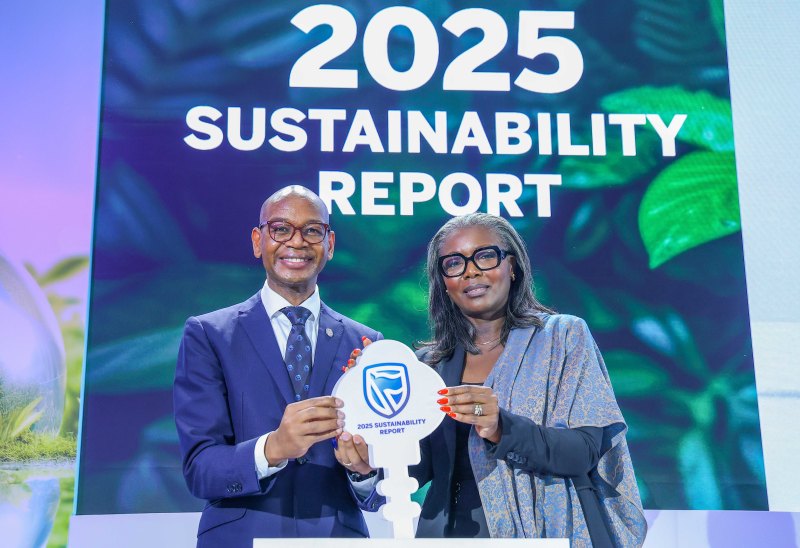
Stanbic Holdings Plc
surpassed its sustainable trade finance target in 2025, disbursing Sh133 billion
across Kenya and South Sudan.
This underscores the growing role of green financing in supporting businesses, climate action and economic growth.
The lender had initially set a target of Sh90 billion in sustainable trade financing but exceeded it by almost 48 per cent, according to its 2025 Sustainability Report.
The strong performance reflects the bank's increased focus on financing projects that deliver both financial returns and positive environmental and social impact.
The report shows that Stanbic expanded its sustainable finance portfolio by advancing Sh4.5 billion in green building loans and Sh273 million for solar energy projects.
The investments supported the transition to cleaner energy and environmentally friendly infrastructure while helping businesses lower their carbon footprint.
Stanbic Holdings chief executive Joshua Oigara said the bank had deliberately shifted its lending strategy towards sectors that strengthen long-term economic resilience.
"We made a deliberate strategic shift, re-orienting our portfolio toward sectors and segments that foster long-term national resilience, including green financing.”
“We have embedded sustainability into the fabric of our daily decision-making, ensuring that performance is measured against clear targets and aligned to our strategic direction.”
Small and medium-sized enterprises (SMEs) remained at the heart of the bank's sustainability agenda.
Through the Stanbic Foundation, the lender disbursed Sh105.73 million in grants and catalytic funding to MSMEs, enabling entrepreneurs to access financing, expand their businesses and build resilience against economic shocks.
The bank also strengthened support for affordable housing by providing Sh1.8 billion in home financing, helping more Kenyans access decent and affordable homes while contributing to efforts to reduce the country's housing deficit.
Agriculture also received significant backing. The lender advanced Sh2.5 billion in climate-smart agriculture financing, increasing agriculture's share of its total loan book to 9.9 per cent.
The funding supported farmers adopting sustainable farming practices aimed at improving productivity while protecting the environment.
Beyond lending, the bank intensified environmental conservation efforts by planting more than 204,000 trees and restoring over 107 hectares of degraded land, including indigenous forests in Mt. Kenya and mangrove ecosystems at the Sabaki Estuary.
Stanbic also strengthened diversity and inclusion within its operations. Procurement spending directed to women-owned businesses rose to 15.53 per cent, while women occupied 43 per cent of seats on the Board, reflecting the lender's commitment to inclusive leadership.
During the launch of the sustainability report on Wednesday, the bank signed the UN Women's Empowerment Principles, reinforcing its commitment to advancing gender equality in the workplace and across its supply chain.
Through its D.A.D.A platform, Stanbic has now disbursed Sh49.5 billion to women entrepreneurs since its inception and onboarded more than 112,640 women into the programme.
Chief Risk Officer Edwin Mucai said robust environmental and social risk assessments have strengthened the bank's loan portfolio by ensuring projects with significant environmental or social risks are carefully screened before financing.
"Our environmental and social risk management framework, which mandates screening for all loans above $1 million, strengthens the quality and resilience of our loan portfolio.”
It protects the bank and its clients from financing projects with material environmental and social vulnerabilities, helping us build a more resilient book that can withstand economic shocks," he said.
Head of Sustainability Priscilla Were said the bank remains focused on addressing key development challenges in Kenya and South Sudan while creating lasting value for communities and shareholders.
To deepen sustainability knowledge among businesses, Stanbic has also launched a Sustainability Academy that offers practical training on Environmental, Social and Governance (ESG) principles, renewable energy, climate-smart agriculture, water management and carbon markets.
The initiative aims to equip businesses with the skills needed to embrace sustainable growth while remaining competitive in a rapidly changing economy.