Fresh
investigation by MPs has unearthed how Kenya Airways’ (KQ)
dream of becoming Africa’s leading carrier morphed into one of Kenya’s most
expensive corporate misadventures.
The probe unearthed a detailed account of how Kenya Airways $3bn (Sh387bn) Project Mawingu expansion
gamble collapsed, leaving taxpayers to shoulder massive debt as the airline
continues to battle for survival.
Kenya Airways chief
executive officer Allan Kilavuka detailed to the Committee on Public Debt and
Privatisation, how the failed expansion and restructuring strategies,
from the $3 billion Mawingu plan to
later initiatives codenamed Safari and Kifaru - all of which
faltered under mounting losses, mismanagement, and heavy borrowing.
Launched in 2012,
Project Mawingu envisioned propelling KQ into a global airline with 119
destinations by 2021.
According to
Kilavuka, instead, the project collapsed under the weight of over-ambitious
aircraft acquisitions and financing costs, leaving the airline saddled with
unsustainable debt.
“The idea of Project Mawingu was to increase the fleet of the airline
from 31 passenger aircraft then and to expand that to 107 passenger aircraft,
which is obviously almost more than three times the growth and also 12
freighters to support cargo. To do that, the airline needed about $3 billion (Sh387bn),”
said Kilavuka.
From the session parliament
heard that the government has since had to repay billions on guaranteed loans, some
through equity in the airline.
Data presented
before the committee shows that an estimated $167million (Sh21.58 billion) owed
t 10 local banks was converted to equity with a shareholding of 38 per cent.
A portion of it still remained as a debt,
which is what the government of Kenya has since paid in January.
Lawmakers led by Kinangop
MP Kwenya Thuku raised questions over the conversion of $167 million in local
bank loans into equity, which gave lenders a staggering 38 per cent stake in
the airline.
“And I wish to know how much loan in total they have advanced to KQ,
and this 38 per cent is equivalent to how much that was converted. Because I
see again in your presentation the intervention from 2017 to 2019, the
government of Kenya again paid the banks Sh17 billion,” asked Kwenyu.
The MP held that the
valuation, that led to the equity conversion, grossly undervalued government
and shareholder interests, sparking fresh scrutiny into how asset values were
computed during restructuring.
Nyaribari Masaba MP
Daniel Maduku sought to know how the airline will repay back Kenyans an
estimated Sh70 billion that has been injected to KQs operations, pointing that
repayment timelines remain uncertain and the burden continues to weigh on
taxpayers.
“We saw KQ post a huge profit for does it mean, will that be the
trajectory? And if it's a trajectory, then when are you going to try to be off
the hook? So that, we don't keep pumping in money,” asked Manduku.
Kilavuka however
held that, despite reporting a record Sh5.4 billion profit in 2024, the first
in years the airline remains far from stable.
“Profitability
does not equal sustainability without a significant capital injection. KQ
cannot guarantee long-term survival. The company is already losing business in
2025 due to a 20 per cent capacity shortfall caused by a reduced fleet, showing
the direct link between scale and profitability in aviation,” added Kilavuka.
In the period, the
airline flew 5.3 million passengers, the highest in its history, driving revenues
up to Sh188 billion. A stronger shilling, which firmed from Sh160 to Sh128
against the dollar, delivered significant forex gains, while Project Kifaru, a
restructuring plan, trimmed operating costs.
Kilavuka said KQ it
had projected a $400 million (Sh51.7 billion) funding need for recovery, but
only $100 million (Sh12.9billion) has been advanced to date.
The airline is now
banking on attracting a strategic investor to secure the additional capital
required to stabilise operations.
Data submitted
before the committee show that to date, the government has injected over Sh70
billion into the carrier, with some loan agreements still awaiting Treasury approval.
Yet KQ holds that these
bailouts have not resolved the airline’s structural weaknesses.
Kilavuka revealed
that KQ’s survival hinges on attracting a strategic equity investor to reduce
dependence on state support.
“Now we need to put in significantly more than that for it to be
sustainable. Without an
investor, our turnaround is not guaranteed,” he admitted.
Among the
proposals that came up during the session was for a long-running debate on
whether KQ should manage Jomo Kenyatta International Airport (JKIA), citing
Ethiopian Airlines’ success in leveraging its control of Addis Ababa Bole
International Airport.


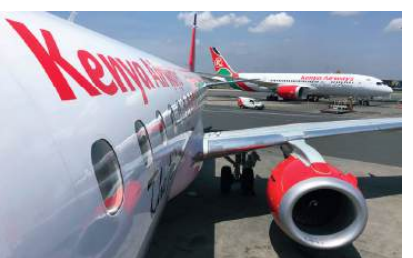 Kenya Airways
planes at the
Jomo Kenyatta
International
Airport
/FILE
Kenya Airways
planes at the
Jomo Kenyatta
International
Airport
/FILE