

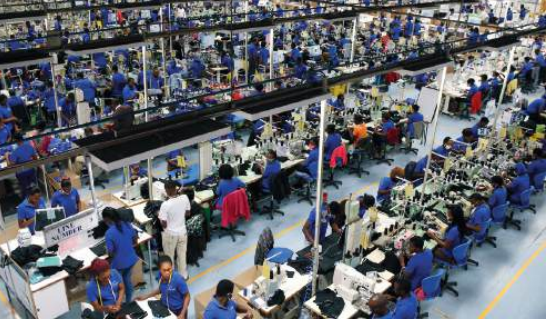
 Workers at Hela Intimates Export Processing Zone in Athi River, Machakos
County/FILE
Workers at Hela Intimates Export Processing Zone in Athi River, Machakos
County/FILE
Title: Hope for Kenyan firms as US mulls a year AGOA extension
Textile and apparel manufacturers in Kenya are hopeful the US government will actualise the African Growth and Opportunity Act (AGOA) extension, albeit for a short period.
This comes as last-minute calls to renew the pact that expired midnight September 30 seem to have bore fruit, with the US government now said to be considering an extension.
White House is reported to support a one-year extension of AGOA, giving hope to sub-Saharan countries, including Kenya, which is pushing for continued preferential market access to the US under the pact in a move that will save businesses and hundreds of thousands of jobs.
This, even as bilateral trade talks continue, with hopes of sealing a deal by end of this year, which could define how Kenya trades with the US going forward.
This is the first time President Donald Trump’s administration is taking a position on AGOA since coming into office.
Reports by Reuters indicate AGOA’s renewal has received bipartisan support by both republicans and democrats making it easy to be passed by Congress.
The benefits of AGOA have however been diluted by the Trump tariffs which range average 10 per cent to 30 per cent for most countries. It however remains strategic for the US in countering Chinese influence in Africa.
“We are looking forward to the renewal in its current or new format. Trade between Kenya and the US is crucial for our historical relationship,” Kenya Association of Manufacturers CEO Tobias Alando said.
The AGOA Renewal and Improvement Act of 2024 which was introduced by Senators Chris Coons and James Risch had sought to extend the bill for 16 years until 2041 and continue to boost Africa’s duty-free status as a means of “attracting private sector investment to help underwrite economic development.”
An extension of any kind will be a life-line for investors, mainly Export Processing Zones in the country, with families assured of a meal on the table for the more than 66,000 individuals employed in the apparel industry alone.
With a one-to-one ratio of indirect jobs and supporting an estimated five dependents per worker, it means that about 660,000 Kenyans rely on apparel exports to the US under Agoa for their livelihoods.
Kenya has been among the biggest beneficiaries of AGOA since its enactment in May 2000, with textile and apparel being the main exports.
In 2024, Kenya exported $470 million (Sh60.7 billion) worth of apparel to the US.
Kenya Private Sector Alliance (Kepsa) was lobbying for a 16-year extension with an alternative of at least two-year transition window to allow for a trade deal between Kenya and the US.
“This will safeguard jobs for both Kenya and the US, ensure continuity, investor confidence and deeper US-Kenya ties beyond AGOA,” CEO Carole Kariuki had said.
“We are now waiting,” Kariuki told the Star yesterday expressing optimism that the pact will be extended.
The American Chamber of Commerce (AmCham) said it has shared “critical concerns” with US policymakers and institutions as it also advocates for a renewal.
Working closely with the US Chamber of Commerce, AmCham has made a submission to Jason Smith, Chairman, Committee on Ways and Means, U.S. House of Representatives, Richard Neal, Ranking Member, Committee on Ways and Means, US Senate Finance Committee chairman Mike Crapo, Ranking Member, Committee on Finance Ron Wyden and US Trade Representative Jamieson Greer.
According to AmCham, AGOA sustains livelihoods and supports tens of thousands of jobs within Kenya's textile and apparel sector with the Act strengthening US–Africa trade relationships and bolsters supply chain resilience.
“We have urged bipartisan Congressional approval to preserve these vital economic and strategic advantages for both Kenya and the United States,” AmCham leadership in Nairobi said.
For America, AGOA delivers $200–250 million (Sh25.8 billion to Sh32.3 billion) in annual consumer savings by keeping costs low for everyday products like jeans and uniforms, according to Kepsa.