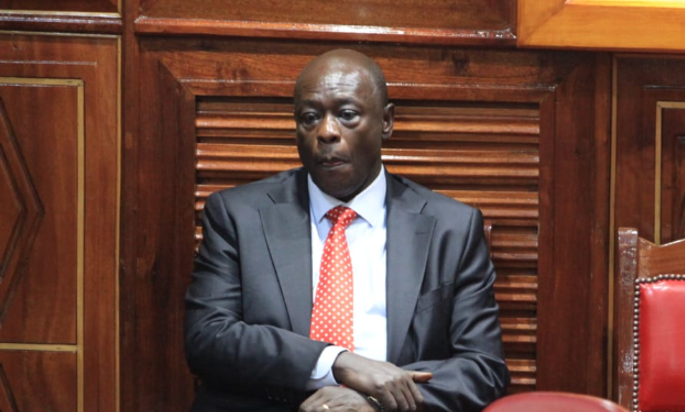
Busia Senator Okiya
Omtatah has threatened to go to court to stop the partial sale of East African
Portland Cement Company (EAPCC) to a firm associated with Tanzanian billionaire
Edhah Abdallah Munif.
The vocal Senator is
worried that Kenyan pensioners are likely to lose billions if regulatory
authorities do not stop Swiss multi-national Holcium from selling 29.2 per cent
stake in EAPCC at a throwaway price, citing conflict of interest.
Pensioners through the
National Social Security Fund (NSSF) own 27 per cent of the stake at Portland Cement, while the government,
through Treasury, owns a 25 percent stake in the firm.
Omtatah says the
Sh27.30 offer price to buy the shares is a gross undervaluation of the company’s
shares, which are currently trading at Sh51.00 at the Nairobi Securities
Exchange (NSE).
“We have a problem in
this country where fraudulent individuals collude with people posing as
international investors to steal public utilities. They have done it at Kenya
Pipeline and are now using underhand deals to steal Portland Cement, which is a
parastatal. I will take this to the Senate and possibly the courts to ensure
public property is not sold for a song,” said the Senator.
The cement maker is effectively
a parastatal given that the government controls a 52 percent stake in the firm
through NSSF and Treasury, but is also listed at the NSE, where its shares are
currently trading at Sh51.00 per share.
It’s the best-performing share at the bourse, having registered a gain of 620 percent since the beginning of the year.
Munif is buying 26.32 million EAPC shares
from Swiss multinational Holcim using an investment firm known as Kalahari
Cement at Sh27.30 each, valuing the deal at Sh718.7 million, which is about ten times cheaper than the
current value of the firm, whose net asset value is recorded as Sh210 billion.
The deal was
advertised in local dailies on August 1, 2025.
The tycoon’s firm, Amsons Group, completed the full acquisition of Bamburi Cement in December for
Sh23.6 billion.
It only forked out Sh3
billion while about Sh20 billion was financed through a local bank, cementing its hold on Kenya’s cement market. With Bamburi already owning
12.5 percent of EAPC, Munif will emerge as the single-largest shareholder of
the Athi River-based company with a 41.75 per cent stake.
With its 41.75 per cent stake in EAPC,
Kalahari Cement will then initiate
a full takeover of Portland Cement in, same way it acquired Bamburi Cement.
If they manage to
force the other shareholders to also sell at Sh27, which they can, given their
newly found muscles within the corridors of power, they would have acquired a
company valued at Sh210 billion for slightly under Sh3.5 billion, making this
the biggest rip-off in Kenya’s corporate history.
In Bamburi, Amsons Group has full control
over board appointments after its complete buyout and delisting from the
Nairobi Securities Exchange (NSE).
Kalahari Cement is controlled by Munif
through his wholly owned Mauritius-based investment companies, Pacific Cement
(90 per cent) and Comercio Et Consiel (10 per cent).
The success of this
deal portends bad news for Kenya’s building industry because Bamburi Cement and
Portland Cement jointly command about 60 percent of the Kenyan market.
This could lead to
quasi quasi-monopoly market where collusion, price fixing and other underhanded deals
are possible.
They could decide to
double or even triple the cost of a 50kg bag of cement, making life difficult for
builders who will have no recourse but to buy at that price, since there are no
controls in that market.
This makes it
important for regulatory authorities like the Capital Markets Authority (CMA)
and the Competition Authority to step in and save Kenyans from this bad deal.












![[PHOTOS] Ruto pushes for stronger Kenya-EU economic ties in Brussels](https://cdn.radioafrica.digital/image/2026/06/3aebc395-285b-441c-8aa4-33cb538f8d44.jpg)