For
the better part of modern history, Africa has been treated as an afterthought
in global diplomacy, a supplier of raw materials and a passive consumer of
foreign ideas, policy frameworks and capital.
Its
vast natural wealth, youthful population and strategic geographic position
have rarely translated into tangible power at negotiating tables. Instead, the
continent has too often been manipulated, divided and used to further the
ambitions of others. That era must end.
Recent
developments in Kenya offer a powerful lens through which to examine the
emerging tensions between longstanding Western influence and a new
assertiveness by African nations in pursuit of their own
national interests.
President William Ruto’s announcement this week that Kenya
had successfully negotiated with China to remove tariffs on key agricultural
exports such as tea, coffee and avocados
marked more than a trade breakthrough.
It is a declaration that Kenya,
and by extension Africa, is willing to break with historical dependency and
pursue relationships that are mutually beneficial, regardless of who is
discomforted. Ruto visited Beijing in April when he restated
their close ties and a new world order.
The
West, especially the United States, has not taken this realignment lightly.
Senator James Risch, chairman of the US
Senate Committee on Foreign Relations, recently introduced an
amendment to the National Defence Authorisation Act seeking a review of Kenya’s designation
as a major non-NATO ally.
Among his stated concerns were the deepening diplomatic
ties between Nairobi and Beijing, as well as allegations of abductions of
Kenyan activists and links to controversial security outfits in the
region. However, the timing and framing of the amendment reveal
a deeper unease in Washington, not simply about human rights, but
about Africa stepping outside the fold of traditional Western patronage.
For
decades, African states were nudged, cajoled or coerced into aligning with
external power blocs, often with
devastating consequences. The Structural Adjustment Programmes of the 1980s and
1990s, pushed by the IMF and World Bank, gutted public services, dismantled
local industries and left economies more vulnerable than before. These
policies were rarely designed with Africa’s long-term
resilience in mind. Instead, they served the financial and ideological interests
of Western capitals.
Today,
a new world order is taking shape. China has emerged not merely as an
alternative source of capital but as a trading
partner, investor and infrastructure developer.
Its non-interference policy,
while controversial, has given African governments greater room to manoeuvre.
But that room must be used wisely. Alignment with China, or any other
power for that matter, must not be romanticised. Africa’s
strategic interests must guide it.
What
this means is that African nations must negotiate from a position of clarity
and confidence.
Trade
agreements must go beyond access to foreign markets, they must protect local
industries, ensure technology transfer and guarantee African producers do
not remain at the bottom of global value chains.
Infrastructure projects must be assessed not only on their size and cost, but also
on their long-term viability, the transparency of contracts and the economic
value they unlock for citizens.
Equally
important is the diversification of partnerships. No country, no matter how
friendly or generous, should monopolise influence in African capitals.
Strategic diversification is not just good economics, but it is
good politics. It protects sovereignty and creates competition among partners,
driving up the quality of offers and reducing dependency.
Kenya’s
pivot to China, therefore, should not be misread as a wholesale shift in
allegiance. Rather, it is a recalibration, one that recognises Western
markets have grown increasingly protectionist and aid
conditionalities ever more complex. Kenyan exporters need access to reliable
markets. Kenyan farmers deserve better prices. Kenyan youth require jobs that
can only be sustained through productive investment and
industrialisation.
If
anything, President Ruto’s comments this week reflect a broader continental
awakening. Africa cannot continue to trade its strategic value for vague
promises, symbolic gestures or partnerships that yield
little. The continent is no longer an appendage of Western charity or a playing
field for geopolitical rivalry. It is an actor with its own agenda, and it must
articulate that agenda forcefully.
But
for this to happen sustainably, strong institutions are required. Transparent
governance, professional negotiation capacity and accountability mechanisms
are essential. Governments must ensure that deals
signed abroad are scrutinised at home. Parliament, civil society and the media
must all play their role in safeguarding the public interest. The pain of past
exploitations should serve as a permanent
reminder that the world does not give Africa what it deserves, but it gives
what Africa demands.
The
African Continental Free Trade Area, if implemented effectively, could give the
continent the scale it needs to negotiate better terms on everything from
climate finance to intellectual property. But even this
requires unity of purpose, political will and an ethos of collective
self-respect.
Africa
must stop apologising for pursuing what every other region does without
hesitation, its own interests. The era of
blind loyalty, of externally imposed models and of partnerships that exploit
rather than uplift, must give way to a new doctrine. One where Africa walks
into every room with its head held high speaks clearly about what it wants
and walks away from any deal that undermines its
dignity.
From
Nairobi to Accra, from Addis Ababa to Dakar, this is the moment for Africa to
move from pawn to player. The world is watching. But more importantly,
Africa’s future generations are depending on it.
Several
African nations have already begun making this shift. In Ghana, the government
is actively reviewing mining contracts to ensure greater national benefit.
President Akufo-Addo has also spoken firmly against the global financial
system’s structural biases and called for reforms that
reflect Africa’s true contributions and challenges.
Ethiopia
has placed industrialisation at the centre of its national strategy. Through
the development of industrial parks and a focus on value-added
production, it is reducing dependency on traditional
exports and pursuing diverse international partnerships guided by its own
priorities.
Senegal has taken steps to reclaim control over its natural
resources by renegotiating oil and gas
contracts to secure more value for its people. In Rwanda, the government
is asserting control over its digital future by investing in local innovation
and regulating external tech influence, demonstrating how even
smaller nations can lead with purpose.
These
examples reflect a growing continental clarity. Africa is increasingly
unwilling to accept unequal partnerships or be
dictated to by others. It is not about turning away from global engagement,
but entering it with greater confidence and self-interest.
The shift from pawn
to player is no longer a distant ambition. It is a present
necessity, driven by the understanding that no one will secure Africa’s
future but Africans themselves. The task now is to act with unity, courage
and consistency.


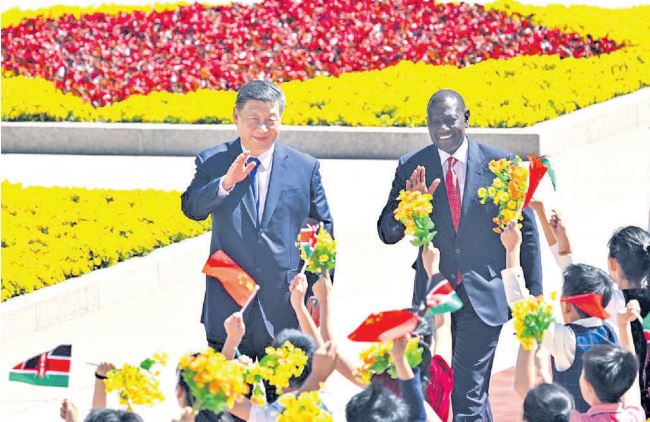 Chinese President Xi Jinping holds a welcome ceremony for President William Ruto in Beijing, China, on April 24 /XINHUA