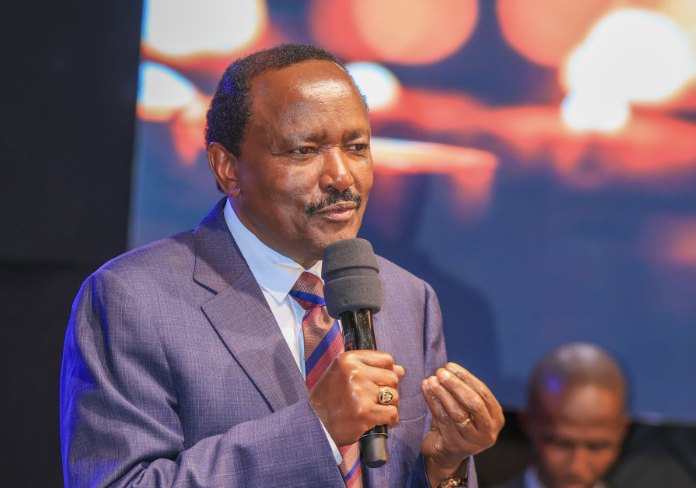
Nairobi Senator Johnson Sakaja will be on the ballot for Nairobi Governor on August 9.
He spoke to the Star about his leadership journey and plans for Kenya’s Capital.
You have just launched your manifesto for the Nairobi governorship. In summary, what does it say?
Our manifesto is a commitment to make Nairobi work, for order and dignity, hope and opportunity for all.
Tell us a little about yourself.
My ethnicity is Nairobi; I am Nairobi. Many people keep asking about that.
The reason I like it that way is because for a long time, we have had a country that is driven by ethnicity and not necessarily by issues or competence. Of course the Constitution says we must be proud of our cultural heritage but it is the diversity that makes us who we are.
I was born in Nairobi in the mid-eighties in Ngara ward as the last born with two elder sisters. I went to school at Aga Khan Primary School and then to Lenana School and on to the University of Nairobi.
What was your path into leadership?
While I was in university, somebody told me that there was a young man who was leading the Vijana na Kibaki secretariat, and he needs a driver who can later also double up as his Personal Assistant. I said ‘of course, I will take that job’.
And so I became Patrick Ngatia’s driver. When people would into the meeting, I would stay outside, and wipe the car. Soon enough I went up the ranks in Vijana na Kibaki, became his PA and ultimately became in charge of greater roles and would work directly with President Mwai Kibaki.
I remember making presentations and him taking notes; he would always take notes when you speak, if you have a point. He was an extremely intelligent man, I think more than Kenyans knew.
At that time is also when I met President Kenyatta towards the end of President Kibaki’s campaign and after that, we worked very closely. Many of the people who were in the Vijana na Kibaki cohort went on to succeed.
I met President Kenyatta when I was doing a presentation on the numbers after the elections, and we developed a friendship after that. Nancy Gitau, who was director of Political Affairs at the time, would give me tasks.
And then came the Kriegler Commission that said one of the things that needed to be sorted out is the issue of boundaries and representation. I was asked by Nancy to come up with a formula.
This was the constitution-making time, leaders were in Naivasha and it was very tense. The one area of contention was boundary delimitation, how to draw boundaries.
ODM brought Prof Francis Aduol, the Vice Chancellor of the Technical University and PNU brought this 23-year-old who has just some ideas. Prof Aduor presented his numbers, and then I was called, and I presented my numbers but with a political mind and in a political language.
He came back and said, “You know what, just do what this young man is saying”.
Ultimately, I dictated Article 89 of the Constitution that we have today, in terms of the formula. After that is when Uhuru said 'this young man must come and work with me in the National Treasury'.
Is that what propelled you into politics?
I spent a lot of time with Uhuru and when the time came, it told him Kanu would not work as his party in the coming elections; let us create something fresh, something that captures what you are trying to sell to this country, that is driven by the energy of young people.
We formed TNA on May 20, 2012. It is a launch that Kenyans remember; we have not seen any party coming into the scene the same way TNA came into the scene.
We had said we need a party that captures what Kanu doesn’t. So we got into a party called NAPK, which was led by the late Nginyo Kariuki.
The late Bruce Odhiambo and I said,“Let’s call the new party the National Alliance or NA".
We went to Uhuru and he said, “NA, Not Applicable”.
The other possible abbreviation was NAP, but again is sounded like taking a nap. Then I said, “Let’s add the article, the. The National Alliance. TNA.”
I became chairman of the party and after that won the election. I was very proud of that moment. I went into Parliament as a nominated MP.
How did you get nominated?
The President had two names he wanted nominated and told us to agree on the rest of the names.
I told him I would be interested in serving as a member of Parliament. On that day in January 2013, the night of the long knives, the list of nominated MPs has to be taken and I had given my name. However, there was this group of people that said my name be removed because everyone else in the party would also want the position.
I told them I had worked for it, but they said no.
I really had had it, I got upset, and left the room. I sent a message to the President who was in Kisii. I had two per cent charge in my phone, just enough to send the message which said, “Boss, I thought I could take your word. You had given me your commitment. They don’t want my name even though they don’t even have an alternative name. They just don’t want me.”
I remembered 2007 after my team and I played such a key role and we got nothing. When I got back to the room the mood had changed and my name was returned to the list. That’s how I ended up in Parliament. I had to fight for that nomination. You must claim your space and take it.
What were your achievements in the National Assembly?
My most memorable moment as an MP was when the President signed into law one of the Bills I had sponsored, which created the National Employment Authority.
We wanted to create a way to help our young people get jobs, streamline the courses people are being taught at university, put together skills matching with the private sector and employers.
This is because for many young people, we are actually just postponing the unemployment by teaching courses that the market does not need. The day he signed the Bill into law was a very proud moment. There are others as well, such as the 30 per cent procurement opportunities in government for young people, women and persons with disability is a law I championed as an amendment to the Public Procurement and Disposal Act and its signing was also a proud moment for me, and just seeing that you can impact and change people’s lives.
How did you end up in the Senate in 2017?
In 2013, I was to run for governor against Mike Sonko, Dennis Waweru, bishop Margaret Wanjiru and Peter Kenneth.
Kenneth was the project who was being fronted and the rest of us had created Team Nairobi to go against this project. In those discussions and negotiations, there were proposals for Sonko, who was then the senator, to go back to the Senate and for me to become Kenneth’s running mate and I knew there were high chances I would be played the fool. I decided to go for Senate instead.
I had a meeting with my coordinators and my team to explain my decision. Some cried and I told them it is the reality of the politics of the time. And when I announced it, people said the Senate seat had found its owner. It was a direct fit. I won the nomination and became the Jubilee candidate to face off with ODM's Edwin Sifuna. I won that election.
Has that inspired you to run for governor?
Being senator for Nairobi is an amazing preparation for governorship. You are on the front seat and you get to understand the intricacies, the challenges and the opportunities that the county government is facing.
I have been able to, for example, go through reports of the County Public Service Board to understand the issues of human resources, the issues of water, the issues of infrastructure, markets and trade and others.
In the last three years, I have been ranked as the best performing senator in the country by Mzalendo.org, which does analysis of parliamentary proceedings.
It is a good experience that I think I would not make as good a governor, as I will now, if I became governor without having been a senator. This is because you dot get the seat and start to learn, or get the seat and then start to understand the structures of the county or even the individuals playing the different roles.
I already know them, I have interacted with them, I understand the roles they play, the role of the county assembly and the different issues in all the 85 wards. And so, I will get into office and start moving from day one.
What are your plans for Nairobi?
Devolution was one of the greatest gifts that the Constitution gave Kenyans and it needs to work for us. But there is no dignity when people have to jump over sewerage to get home. Not when they can’t get treatment in health facilities, or when school children cannot concentrate in class because their parents are unable to give them a square meal.
Nairobi used to get basic services in the past, like solid waste management. Not any more. My priority is to make Nairobi work. To ensure there is ease of doing business by having one digital unified business permit, that all school going children have access to one meal, and households have access to adequate clean water.
It is important for us to see the opportunities that Dandora dumpsite offers, it can generate enough energy for this city.
My priority will be to ensure services reach the people by devolving them further with the creation of five boroughs – North, South, East, West and Central.
I am running because I understand the plight of the people of Nairobi and possess the necessary skills and experience to solve them.
We need to make Nairobi a city of order and dignity.
Edited by EKibii