


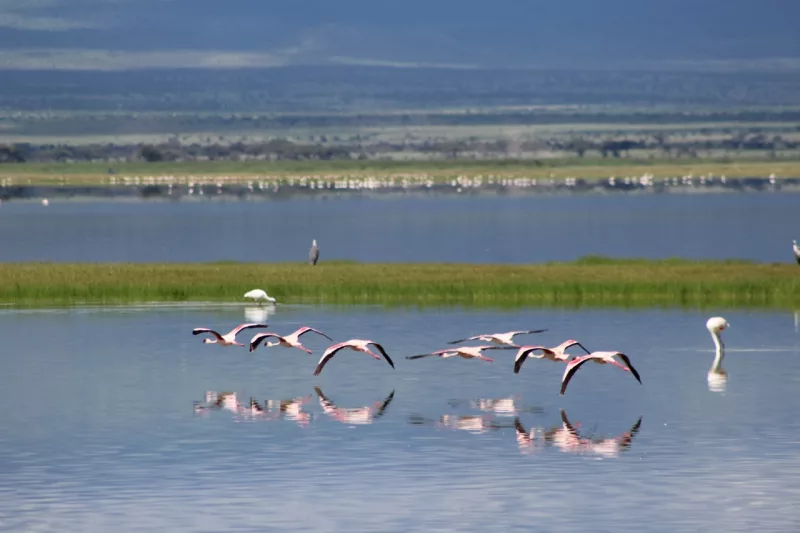
Two Kenyan national parks have topped the charts as being the best birdwatching destinations, claiming spots in the global top 15.
In this year's study from AllClear Travel Insurance in the UK, the two national parks are Tsavo East, placed third worldwide with a score of 59.8/100, and Amboseli, in 14th place with a score of 51.7/100. They are now among the 115 globally recognised birdwatching hotspots across six continents.
In the same study, Kenya is the standout African nation and the only African country to feature twice in the global top 20.
The study looked at factors such as the number of bird species, the number of notable species, a standout species score, mean annual temperature, mean wind speed, mean annual precipitation, distance from nearest airport and estimated daily tourist costs.
It’s no mean achievement for Tsavo East and Amboseli to be placed amongst the giants in the bird world, such as Manú National Park in Peru, which grabbed the top spot with a score of 83.1/100. Two more African national parks are also high up on the list: Kruger in South Africa (10th) and Chobe in Botswana (17th).
BIRDING IN KENYA
Tsavo East and Amboseli National Parks also feature prominently on the annual Global Big Day calendar, which is the world’s largest single-day birding event, in May and October.
For example, on May 9 this year, Kenya topped the charts again in Africa with the most species of birds recorded in 24 hours during the annual Global Big Day. Globally, Kenya ranked seventh, becoming a giant amongst giants in the bird world. The unbeatable Colombia recorded the most species, numbering 1,566, followed by Peru with 1,438, Brazil 1,204, Ecuador 1,068 and Venezuela 890. India ranked sixth with 835 species documented.
Birders in Kenya recorded 824 species, way above Tanzania, placed second with 708 species, and Uganda, placed third with 555 species. Countries like the Democratic Republic of Congo, which is four time the size of Kenya and supports the largest tropical rainforest on the continent (next to the Amazon in South America), recorded 282 species, bringing to light how seriously Kenyans have taken to birding.
Globally, 8,023 species were recorded this GBD, a historic and new world record, set by the largest community of bird enthusiasts ever united for a single event.
AVI-TOURISM ON THE RISE
The global birdwatching tourism market was valued at $70 billion in 2025 and is projected to grow from $74.2 billion in 2026 to $117.2 billion by 2033, according to a market survey by Global Birdwatching Tourism Market.
Its popularity arises from many factors. There are birds everywhere and anyone can take to birdwatching. The accidental birder does it to pass time enjoying birds even if they don’t know the names.
The more serious birders roam the earth in pursuit of enlarging their bird lists with species seen in very select places, like the Golden pipit in Tsavo East National Park, or for near-endemic and highly sought-after savannah specials like the Pangani Longclaw, Dickinson's Kestrel, Taveta Golden Weaver and Hartlaub's Bustard.Birdwatching in recent years has also seen the rise of bird watching clubs like Nature Kenya, Kenya Women Birders and others spread around the country, hiring local communities as bird guides. Added to this are tour companies in Kenya and worldwide, bringing like-minded people to explore places in search of the feathered kind.
BIRDS AS ENVIRONMENTAL POINTERS
Birds are an indicator of the environment. When a species begins to vanish from the grasslands like the Sharpe’s longclaw endemic to Kenya, it shows the grasslands are vanishing. When a forest species like the Taita apalis begins to vanish, it indicates that the forest is disappearing in the Taitas. Today, fewer than 300 of this forest bird survive, with populations decreasing as the forests disappear.
In tandem, when rivers and lakes become polluted, the shores are emptied of the waterbirds and when the skies become cluttered with towering skyscrapers, the last of the hawks and eagles will have no space to fly.
Read more: https://www.allcleartravel.co.uk/blog/worlds-best-birdwatching-destinations/
Rupi Mangat writes on local environmental and travel matters to raise Kenya's profile













![[PHOTOS] Ruto hosts Bungoma delegation at State House](https://cdn.radioafrica.digital/image/2026/07/38c18064-4bd7-4a52-9171-4dcce631a74b.webp)