
G-SPOT: Malindi’s revellers who ignored the low season
Summertides boosted local business but ruffled morality cops
14d agoMwangi GithahuLifestyle
I saw it with my own eyes, people following the rules and letting me turn to side streets


Audio By Vocalize
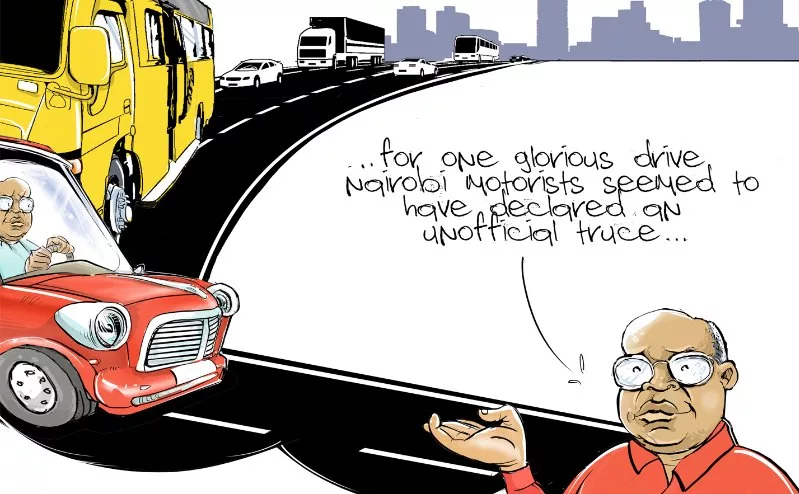
I recently drove in Nairobi and was pleasantly surprised, in fact, a little shocked, by the courtesy shown by most drivers.
Perhaps it was simply my lucky day, but an astonishing number of people willingly let me and other motorists turn onto side streets from the main road. Others even appeared to follow the rules of the road. It made for an unusually pleasant driving experience, one I would have recorded had I had a dash cam.
Of course, as we say in Kiswahili, “Mvua moja haizuii kiangazi (One rainfall does not stop the dry season).” One courteous commute does not mean Nairobi's roads have suddenly become ‘civilised’.
Ordinarily, courtesy among Kenyan motorists, particularly in Nairobi, is about as common as an empty matatu in rush hour. Normally, it is all about aggressive driving, overlapping, queue-jumping and an almost artistic disregard for basic traffic rules. Survival depends less on knowing the Highway Code than on mastering the art of defensive driving, while keeping one eye on matatus, another on boda bodas and somehow finding a third eye for everything else.
Some say that much of this behaviour stems from the intensely competitive public transport sector, compounded by the psychological strain of endless traffic jams.
Still, as I drove, I found myself wondering whether recent hardships, such as rising fuel costs, had prompted a collective change of heart. Perhaps people had finally concluded that making life miserable for fellow drivers was not actually improving their own journey. A lovely thought.
Unfortunately, everyday frustrations remain deeply embedded in Kenya's driving culture.
There is the ‘Master of the Road’ mentality, where matatus and lorries frequently ignore right-of-way rules, overlap to bypass traffic and bully smaller vehicles, particularly those driven by women.
Zebra crossings are often treated as decorative road markings rather than places where pedestrians might inconveniently expect to survive. Even ambulances and fire engines can find themselves stuck behind drivers who apparently believe they have somewhere even more urgent to be.
Having lived and driven in South Africa for much of the past 16 years, I cannot resist making comparisons.
South Africa generally enjoys greater adherence to formal traffic rules than Kenya, but it also suffers from a far more serious problem of violent road rage.
Kenyan driving is best described as spontaneous, defensive and gloriously unpredictable. South African driving, by contrast, is faster, more structured and generally rule-bound, yet often noticeably more aggressive.
Traffic signs, lane markings and traffic lights in South Africa are usually visible and respected, although power cuts, or load shedding, as they prefer to say down south, sometimes leave motorists relying on negotiation and optimism. In Kenya, where signs exist, lanes remain visible and traffic lights are actually working, obedience is often regarded as an optional extra.
The risks differ, too. Kenyan drivers spend much of their time navigating crippling gridlock, overlapping vehicles, opportunistic side-mirror thieves and the constant possibility that a boda boda will materialise from a dimension previously unknown to science. South African motorists are more likely to worry about violent road rage, carjackings and smash-and-grab robberies.
Infrastructure also shapes driving behaviour. Kenya's road network has struggled to keep pace with rapid urban growth, creating an environment of organised chaos where motorists navigate missing signs, unpredictable lane mergers and monumental traffic jams. South Africa, on the other hand, benefits from a more developed highway system. Drivers generally keep left, overtake on the right and follow established road rules, but they travel at much higher speeds, leaving considerably less room for error.
Public transport provides another contrast. Kenya's matatus and boda bodas often seem to operate according to a set of traffic regulations known only to themselves, creating a uniquely fluid interpretation of road discipline. South Africa's minibus taxi industry is equally competitive and aggressive, but it functions within more organised route systems and generally interacts with private vehicles in a more predictable manner than Kenyan matatus.
For one glorious drive, however, Nairobi motorists seemed to have declared an unofficial truce. Whether that signals the beginning of a cultural shift or was simply the automotive equivalent of spotting a unicorn, remains to be seen. I suspect the latter. Still, it was nice while it lasted.
Summertides boosted local business but ruffled morality cops

![[PHOTOS] Linda Mwananchi takes Trans Nzoia by storm](https://cdn.radioafrica.digital/image/2026/07/0d132395-ad4b-4671-867e-880c9f8144f5.webp)