
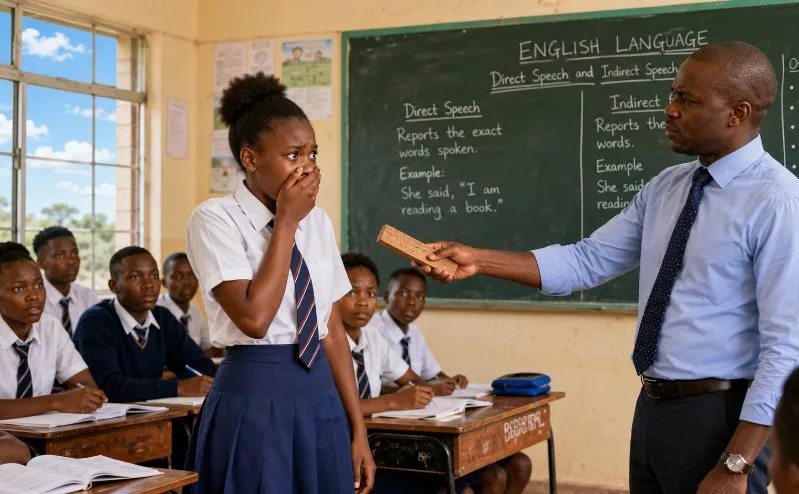
If you went through Kenya's education system, particularly under the 844 era, you probably remember the ‘monitor’.
Whether you attended a private school, a boarding school or a public day school, chances are you knew exactly what it meant to be caught speaking your mother tongue. A ‘disk’, a badge, a stick or simply your name on a list would mark you out for punishment. By the end of the day, you would be caned, ridiculed or publicly reprimanded, not for stealing, lying or fighting, but for speaking the language your mother first used to call your name.
At the time, it seemed ordinary. We were told it was necessary if we were to master English, compete globally and become educated. Very few of us stopped to ask why acquiring a second language required the humiliation of the first. Children in Spain are not punished for speaking Spanish before learning English. Children in Japan are not ridiculed for speaking Japanese before studying French. They simply acquire another language while remaining firmly rooted in their own. Why, then, did adopting a second language in Africa so often demand the rejection of the first? Why did learning English require children to believe that Kikuyu, Luo, Meru or any of Africa's hundreds of indigenous languages were fit for the home but somehow unfit for knowledge?
We accepted those punishments because children rarely question systems presented to them as normal. Schools do not merely teach mathematics, grammar or science. They manufacture assumptions about the world. Long before they produce doctors, lawyers, engineers or economists, they produce a particular way of thinking.
The greatest failure of colonial education was not what it taught inside the classroom but what it quietly implanted beyond it. It was never simply about producing children who could speak English. It was about producing adults who instinctively associated authority with the foreign, intelligence with the imported and legitimacy with everything except themselves.
If colonialism left Africa with one enduring monument, it was neither the railway nor the mission school, neither the colonial courthouse nor the artificial borders that continue to fracture communities into nation-states that rarely reflected their own histories. Those were structures of stone, steel and ink. Its greatest monument was invisible: a mind persuaded, often before it reached adulthood, that legitimacy lay elsewhere, that intelligence wore a foreign accent, that progress arrived from distant capitals, and that civilisation was something to be imported rather than cultivated.
This is perhaps the greatest paradox of post-colonial Africa. Political independence was achieved across the continent decades ago. Colonial flags were lowered, constitutions were rewritten and governments assumed the formal responsibilities of sovereignty. Yet, to this day, a continent of 54 nations still has no permanent seat on the United Nations Security Council. But that is a conversation for another day.
No, hear me out.
You see, Spain has just been crowned world champions at the Fifa World Cup, yet their campaign began with a draw against Cape Verde, a nation many would never have expected to stand shoulder to shoulder with the eventual champions.
That result should have unsettled more than football predictions. It should have unsettled our assumptions.
Cape Verde did not expose a lack of African ability. It exposed the myth that Africa lacks it. If one of the continent's smallest nations could compete with the team that would ultimately conquer the world, then perhaps the gulf between Africa and football's elite has never been one of talent at all. After all, Africa exports some of the finest footballers in the world every single season. Europe's biggest clubs have spent decades proving exactly that.
So if the talent is there, and it undeniably is, what explains the difference?
Spain walked away from that draw still expecting to become world champions. They did. Cape Verde walked away having demonstrated that they belonged on the same stage. There is a profound difference between those two positions. Too often, African teams enter global competitions carrying the burden of proving they belong, while their opponents arrive expecting to dominate. Those are not merely different football philosophies, they are different psychological inheritances.
Perhaps the better question is what happens to a people when they are taught from childhood that everything of value exists somewhere else? Maybe that question explains more than football ever could.





![[PHOTOS] Obado Leaves court in handcuffs](https://cdn.radioafrica.digital/image/2026/07/efc75d55-2eb9-4019-bb24-937dc4fc4f56.webp)