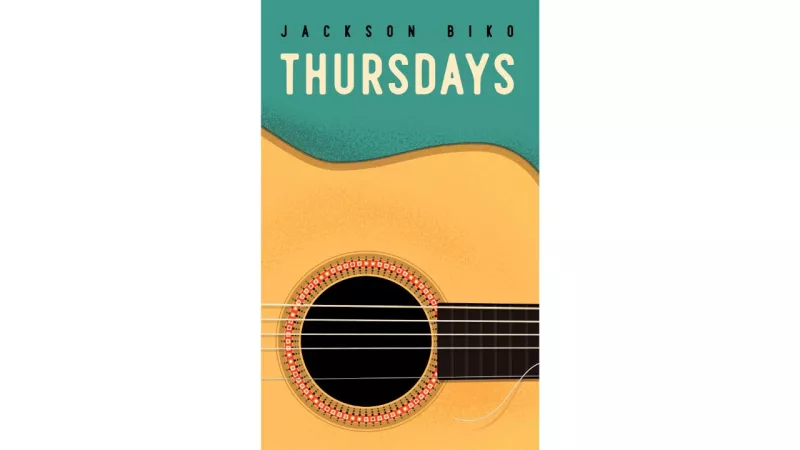
Jackson Biko’s Thursdays invites you to pull a barstool up to the raw, unvarnished world of Vina Wira, a struggling Nairobi band with more dreams than gigs and more longing than applause. Evocative, poignant, wryly funny and sometimes achingly sad, this novel is less about the destination and more about the blisters you collect on the way there. It’s a story that lingers like the last note of a song you wished had never ended.
From the first chapter, Biko drops you into the chaotic rhythm of the music scene and everyday Nairobi life. Vina Wira isn’t a band you’ll just read about, you’ll feel them. Every Thursday, they trek from street corners to dingy bars, playing to indifferent crowds that refuse to applaud. They are ‘hungry to make it’, yet the universe seems too preoccupied to share their hunger. In an unforgettable passage that captures their desperation and absurd dignity, Biko writes, “There is nothing as sad as singing to chairs.” It’s both hilarious and heartbreaking, a perfect distillation of the absurd grind of chasing art in a world that prizes practicality over passion.
However, this is not a feel-good fairy tale with a platinum record and confetti. Biko’s storytelling is refreshingly gutsy. He strings together vibrant, sharply drawn characters whose internal battles are as loud as their off-key chords. There’s the drummer who codes apps by day, the lead singer rewriting expectations with her voice, the bassist whose bright persona masks deep shadows, and the pianist-songwriter carrying a darkness that ‘can’t fit in a travelling bag’. Through these nuanced portrayals, Thursdays becomes more than just a band’s story, it becomes a mirror held up to the vulnerability and contradictions of youthful ambition.
The author’s prose showcases his background as a journalist and celebrated storyteller, with sentences that brim with rhythm, humour and emotional resonance. His voice is conversational yet vivid, anchoring every scene with an effortless clarity that makes the world of Vina Wira palpable. It is prose that can prompt a laugh in one paragraph and cut deep in the next. In a moment of raw introspection, one character confesses, “We all carry something dirty in us,” a line that creeps under your skin long after you’ve turned the page.
Biko’s writing style is one of precision and rhythm. He doesn’t waste words; every line pulses with intent. His knack for blending humour with weighty themes — dreams, identity, mental health, relationships — is what elevates this novel from a mere tale about a band to an evocative exploration of human fragility and resilience. The cityscape itself feels alive, from the bustling streets where the band busks to the dim bar where their hopes flicker like neon lights over a junkyard of dismembered vehicles.
That said, Thursdays is not without its rough edges. The most noticeable flaw of this novel is the abrupt, undercooked ending, a conclusion that leaves more questions than answers. The narrative momentum, after building such palpable emotional stakes, dissolves just when you’re eager to see how the journey culminates. For some readers, the final act can ultimately feel rushed or anticlimactic, as if the book simply decides it’s time to stop rather than earning its conclusion. This lack of closure can feel unsatisfying, especially after you’ve invested deeply in these characters’ dreams and vulnerabilities. Unlike a well-paced melody that resolves in a satisfying cadence, Thursdays ends on a chord that feels suspended: haunting, yet, for some readers, frustratingly incomplete.
Critically, this abruptness isn’t a stylistic flourish so much as an emotional tease. It leaves the reader stranded on the edge of reflection without the payoff of narrative resolution. While Biko’s prose and thematic depth often shine, that unresolved finale may leave you wishing for a few more bars, a more definitive closing note to this evocative symphony of hope and heartbreak.
Ultimately, Thursdays leaves you sitting in the quiet after the music has stopped, forcing you to confront what remains when ambition collides with reality. Jackson Biko does not offer triumph wrapped in neat resolutions; instead, he presents the aftermath: the bruises, the questions, the unresolved ache of wanting more. This is a novel that understands that most dreams do not explode into glory but slowly reshape the people who dare to carry them.
Thursdays succeeds because it dares to be honest about failure, persistence and the quiet heroism of showing up again and again despite indifference. The characters linger long after the final page, not because they ‘made it’ but because they felt real — flawed, hopeful and painfully human. If you’re drawn to character-driven stories suffused with music, mental health awareness and the gritty realities of chasing artistic dreams in a world that often seems indifferent, Thursdays will resonate long after the final page.