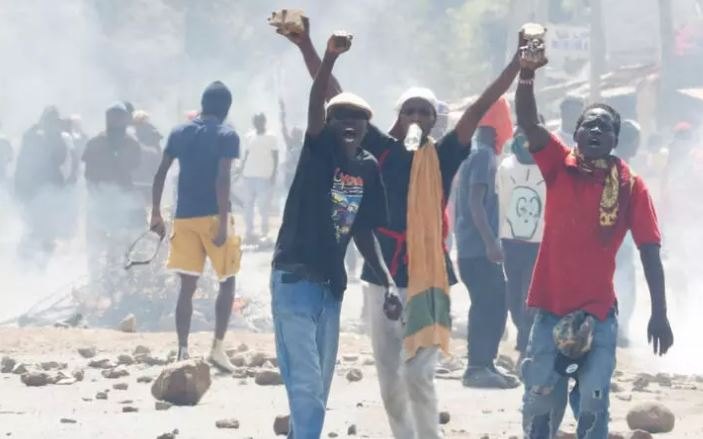
 Demonstrators gather in a protest against a US-backed Ebola quarantine facility in Laikipia County, Kenya, on 9 June 2026./SCREENGRAB
A British military uniform on the streets of Nanyuki has drawn unusual attention and in this part of Kenya, where the relationship with the British military stretches back more than a century, the controversy has resonated beyond a single disputed photograph.
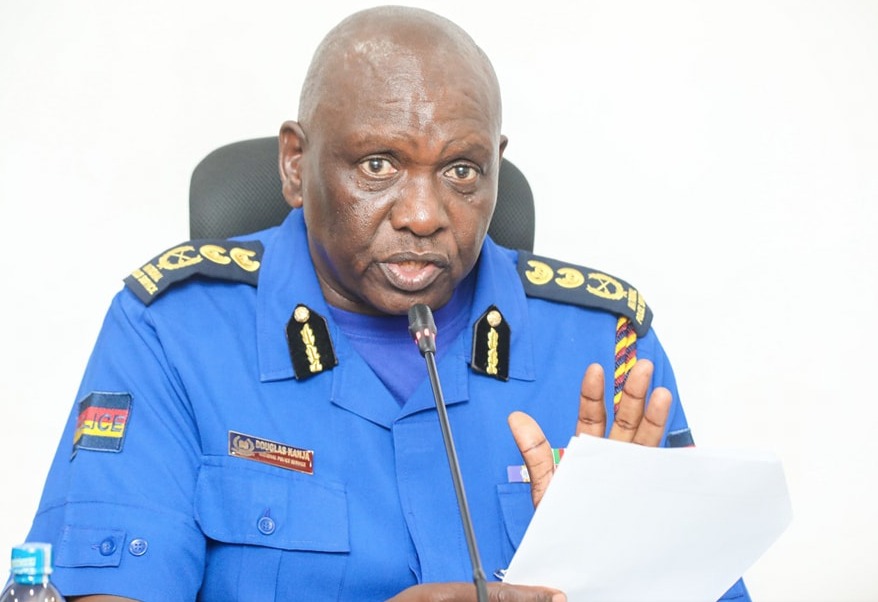
The immediate facts are these. During recent protests in the town, images circulated of police officers in uniforms closely resembling those of the British Army Training Unit Kenya (BATUK), the British military force based in the region for decades.
The British High Commission moved quickly to deny any role, stating that no BATUK personnel had taken part, that the officer was not a British soldier, and that the uniform had, in its account, been “misappropriated.” It did not explain how a Kenyan officer had come to wear it.
That unanswered question has fuelled speculation. BATUK has long provided training and support to Kenyan forces, and one theory now circulating is that the unit may train Kenyan police in crowd control, with uniforms or equipment from such programmes finding their way onto the streets during the demonstrations.
The claim is unverified. But its persistence reflects a wider unease about how closely foreign military partnerships are tied to domestic policing.
That unease draws on history. These highlands were central to colonial Kenya, where land was taken from Maasai and Kikuyu communities for British settlers in the early twentieth century.
In the 1950s, the region was among those affected by
Britain’s suppression of the Mau Mau uprising, a campaign of detention and abuse for which, decades later, the British
government expressed regret and paid compensation to thousands of elderly
Kenyans. For many residents, the reappearance of British-style uniforms in a confrontation
with civilians evokes that past rather than reading as an isolated incident.
The protests themselves concerned a separate grievance. Demonstrators were opposing the construction of a 50-bed Ebola quarantine centre at Laikipia Air Base, a United States-linked facility intended for American citizens affected by the outbreak in the Democratic Republic of Congo.
Residents objected to a foreign-run infectious-disease centre being placed in their community, citing infection risks and a lack of transparency in how it was approved. Kenya’s High Court ordered the project halted over public-health concerns, yet satellite imagery reviewed by international outlets suggests construction has continued. President William Ruto has defended the centre, saying it would be “inhuman” to stop it.
For many in Nanyuki, that sequence is the heart of the matter: a court ordered the facility stopped, residents rejected it, and work nonetheless appeared to continue.
Critics argue that this places a foreign-backed project above the concerns of the surrounding community and the ruling of the courts, and some have begun describing Kenya as being treated as a site for purposes decided elsewhere. Supporters of the centre counter that it serves a legitimate public-health function during a regional outbreak.
The dispute turned fatal on 9 June, when a 17-year-old, Sylvester Muigai Ndung’u, was shot dead during one of the protests. Witnesses say he was hit in the head; police say a post-mortem will establish the cause, and the investigation remains open.
The Kenya Human Rights Commission has accused officers of using excessive force, including live ammunition and arbitrary arrests allegations the authorities have not yet addressed. Weeks on, no account of how he died has been made public.
These events have hardened the position of activists and affected residents. Many are calling for the agreement that governs BATUK’s presence in Kenya to be reviewed or revoked, and for accountability over the deaths and injuries linked to the protests.
They frame the issue as one of sovereignty and of the value placed on Kenyan lives. To press those demands, activists have announced a protest in Nanyuki on 25 June at 12:00 p.m., which they say will bring together affected families and supporters from the town and beyond.
The questions raised extend beyond a single uniform: how foreign military partnerships shape policing in Kenya, how decisions affecting local communities are made, and whose interests are served on Kenyan land. With the protest planned and the BATUK arrangement under discussion, those questions are unlikely to fade soon.
The writer is a researcher in African affairs and international relations