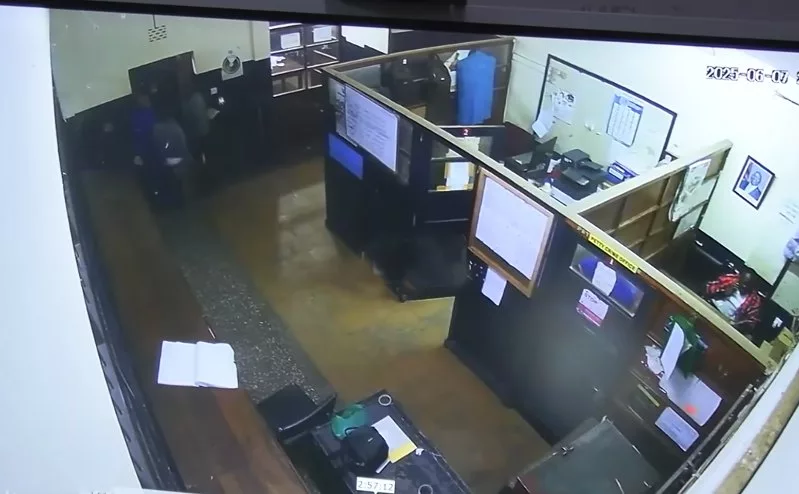
A camera inside a police station is supposed to be a witness that cannot be threatened, persuaded or ordered to change its account.
But a witness whose memory can be erased by the people it observes is not independent.
The High Court has heard testimony that CCTV recordings from Nairobi’s Central police station were formatted after teacher and blogger Albert Ojwang' died in custody. A protected technician testified that former station commander Samson Tallam instructed him to erase recordings from June 6 and 7, 2025.
Another technician told the court that the recorder had been disconnected and the relevant footage was missing when investigators arrived. These are prosecution allegations in an ongoing trial. The accused persons remain entitled to the presumption of innocence, and the court will determine their individual responsibility.
The wider technological failure, however, does not need to await the verdict.
If footage from police cells can be disconnected, formatted or replaced without an automatic external alert, then Kenya has installed cameras without building a dependable accountability system.
The camera on the wall is the most visible and least important part of CCTV. What matters is who controls the recorder, where the footage is stored, how long it is retained, who can access it and whether every action leaves a permanent trail.
Kenyan law already requires evidence to be protected. The National Police Service Act obliges officers to report deaths and serious injuries involving police action to the Independent Policing Oversight Authority, secure the scene and refrain from tampering with evidence.
IPOA’s 2024 regulations further require station
commanders and officers in charge to preserve all relevant evidence that may
assist an investigation.
The problem is that a legal obligation may arrive too late when the system allows one person to destroy the only recording within minutes.
Police station CCTV should therefore be redesigned on the assumption that the institution controlling the camera may itself become the subject of investigation.
Recordings from cells, booking desks, corridors and report offices should be copied automatically to secure storage outside the station. The local recorder can continue operating, but disconnecting it or removing its drives should not destroy the only version of events.
No officer, technician or station commander should possess unilateral deletion powers. Routine deletion should occur automatically only after an approved retention period. Once a death, injury, complaint or other serious incident is reported, the relevant recording should be placed under an immediate legal hold that prevents alteration or automatic overwriting.
The system should alert an independent monitoring centre whenever a protected camera stops transmitting, a recorder is disconnected, a drive is removed, the system clock is changed or somebody attempts to format the storage.
It should also record who logged in, what that person viewed, what was exported and which settings were changed. Those logs should be protected from the local administrator.
This is what transforms ordinary video into trustworthy digital evidence.
The United Nations’ Minnesota Protocol, the international standard for investigating potentially unlawful deaths, expressly recognises CCTV footage as potential evidence. It requires evidence to be protected from manipulation and stresses the importance of a documented chain of custody showing who possessed and handled it from collection to presentation in court.
Digital files are particularly vulnerable because they can be copied, edited or deleted without leaving the physical damage associated with a broken lock or torn document.
The US National Institute of Standards and Technology recommends preserving more than one copy, documenting the original source and generating cryptographic hashes that can reveal whether a file has changed. Crucially, the integrity record should be stored somewhere beyond the control of the person handling the evidence.
Kenya’s Evidence Act also requires courts to be satisfied about the production and reliability of electronic records. A video is not automatically credible because it came from a computer. Its evidential value depends partly on whether the system was operating properly and whether the record’s history can be established.
Police CCTV should therefore be treated as national evidence infrastructure, not ordinary office equipment purchased through the lowest quotation.
Every station requires documented standards for camera coverage, uptime, storage, retention, access, maintenance, evidence export and incident reporting. Independent inspectors should regularly test whether cameras are recording, whether system clocks are accurate and whether access logs correspond with authorised activity.
IPOA should receive immediate notification when cameras covering cells, booking areas or report offices go offline. After a death or serious injury in custody, it should be able to preserve and obtain the off-site footage without depending entirely on personnel working at the station under investigation.
This would not only protect detainees. It would also protect honest police officers.
Secure footage can disprove false allegations, show that an officer followed procedure and establish who entered a cell or handled a detainee. A weak system damages everybody because missing footage creates suspicion even where no wrongdoing occurred.
The reform must nevertheless respect privacy. Police station recordings may contain victims reporting sexual violence, children, witnesses, suspects, medical emergencies and private conversations. Off-site storage must not become an excuse for indiscriminate surveillance or unrestricted access.
Kenya’s constitution protects privacy, while the Data Protection Act requires personal information to be processed lawfully, securely and only for a legitimate purpose. CCTV recordings should therefore be encrypted, accessed only by authorised personnel, retained according to a defined schedule and preserved longer only when they relate to a complaint, investigation or judicial process.
Accountability and privacy are not opposing objectives. A properly governed system protects both by preventing unauthorised viewing as well as unauthorised deletion.
The most important reform is institutional independence. A police station should not investigate an incident within its own walls while retaining exclusive control over the recording that may establish what happened.
The Ojwang' trial will determine whether the prosecution has proved its allegations against the six accused persons. Parliament, the National Police Service and IPOA should not wait for the final judgment to examine the weakness exposed by the testimony.
Kenya has invested in cameras because written reports can conflict, witnesses can forget and powerful people can deny what happened.
That investment is wasted when the digital record can disappear with a password, a disconnected cable or a formatted drive.
A camera that the people
it is meant to hold accountable can erase is not an accountability tool. It is
decoration.
ICT and cybersecurity professional