 Mass student protests over leaked exams have forced the Indian government to promise swift legal reforms /X
The Indian government has announced plans to set up special courts to prosecute individuals involved in examination malpractice after a recent exam paper leak sparked nationwide student protests.
Prime Minister Narendra Modi said the "fast-track" courts would expedite the trial of exam cheats, whose cases would otherwise take years to conclude through the ordinary court system.
"Nothing is more important than the welfare and future of our youth. We have decided to set up fast-track courts to ensure swift and stringent punishment for those involved in paper leaks," Modi wrote on X.
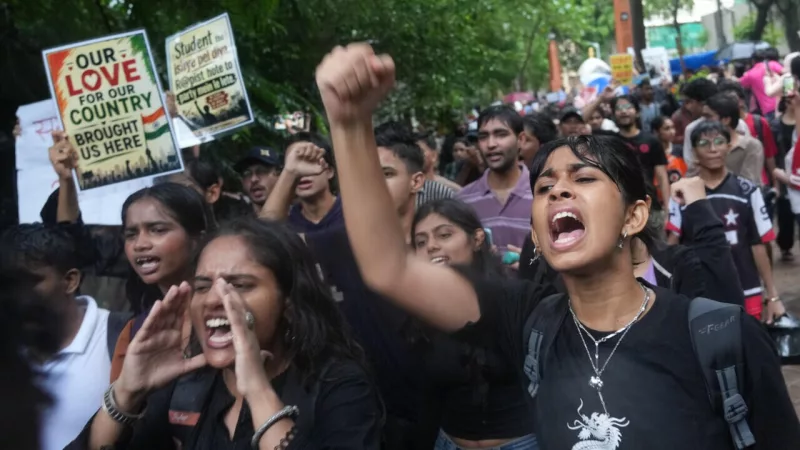
The announcement on Thursday came hours after protesters clashed with police on the streets of New Delhi on Wednesday night while demanding the resignation of Education Minister Dharmendra Pradhan.
The demonstrations were triggered by exam paper leaks in May that led to the cancellation of the National Eligibility cum Entrance Test (NEET), affecting about two million students.
The medical entrance examination was cancelled after investigators found evidence that the question paper had been leaked through encrypted messaging platforms, including Telegram.
Millions of students were forced to retake the examination under heightened security measures, including biometric verification, signal jammers, AI-enabled surveillance cameras and heavy police deployment.
India's Central Bureau of Investigation arrested several suspects, including a local chemistry lecturer alleged to have masterminded the operation.
Reports indicate that more than 150 major examination paper leaks have allegedly occurred across India over the past decade, fuelling growing concern over the integrity of the country's examination system.
The latest scandal has sparked widespread student protests, political backlash and renewed demands for accountability after the exam cancellation was linked to a number of student suicides.
Late on Wednesday, local media reported that more than 10,000 protesters had gathered at a central protest site in New Delhi to demand Pradhan's resignation.
Police fired tear gas and used batons to disperse the demonstrators.
Congress Party leader Rahul Gandhi responded to Modi's remarks by insisting that the education minister should be dismissed, the Prime Minister should apologise to students, and officers accused of assaulting protesters should be prosecuted.
The youth-led Cockroach Janta Party, which emerged in May as a satirical response to the Chief Justice's alleged description of young people as "cockroaches" and "parasites", vowed to continue the demonstrations until Pradhan steps down.
The unrest has emerged as one of the biggest challenges facing Modi since he came to power in 2014.
The Prime Minister said the fast-track courts, designed to hear and determine cases more quickly than ordinary courts, would help restore confidence in India's education system.
He said he had directed the concerned authorities and officials to take all necessary steps in this regard, with further strict actions against paper leaks to be announced by the Cabinet on Friday.
"This continues our series of steps for safeguarding the interests of students. Those who try to harm the future of our youth will not be spared," Modi said.
India has previously established such special courts to handle cases involving sexual offences against women and children, terrorism, money laundering and crimes involving lawmakers.
The latest proposal would extend the model to examination malpractice, raising questions about whether similar reforms could strengthen Kenya's fight against exam cheating.
Kenya has a strict legal process to punish exam cheating and leakages.
Under the Knec Act, individuals caught leaking exam papers, sharing contents on social media or opening containers illegally face up to 10 years in prison or fines reaching Sh2 million.