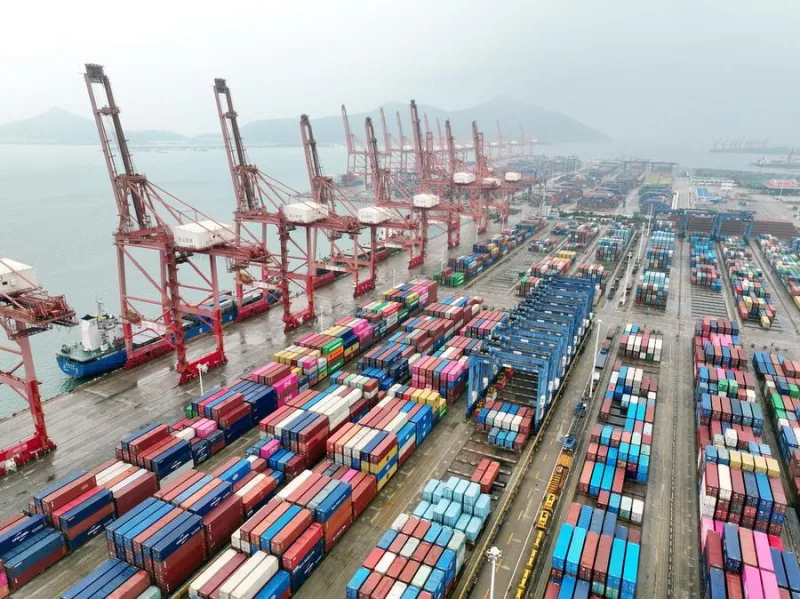
 An aerial drone photo taken on July 14, 2026 shows cargo ships loading and unloading containers at a container terminal of Lianyungang Port, east China's Jiangsu Province. (Photo by Wang Chun/Xinhua)
For decades, the dominant global economic narrative insisted that free markets, minimal state intervention, and liberalised systems were the surest path to prosperity.
Governments, especially in the developing world, were encouraged to step aside and allow private enterprise to drive growth, innovation, and efficiency. This orthodoxy shaped policy prescriptions from international financial institutions and influenced reform agendas across Africa, including Kenya. Yet China steadily pursued a different course, demonstrating that a state-guided development model could also generate remarkable economic transformation.
China's model is best understood as state-led capitalism, a system where markets thrive within a framework strategically guided by the state.
Rather than acting solely as a regulator, the Chinese government plays a central role in setting long-term economic priorities, mobilising resources, investing in strategic industries, and ensuring effective implementation. Infrastructure, manufacturing, energy, technology, and innovation are supported through deliberate policies that align economic growth with national development objectives.
The results have been remarkable. Within a single generation, China has lifted hundreds of millions of people out of poverty, built one of the world's largest high-speed rail networks, developed world-class ports, modernised entire regions, and established itself as a global leader in manufacturing and technology. For many developing countries, including Kenya, China's development experience demonstrates what can be achieved when long-term planning is matched with disciplined execution.
One of the defining characteristics of China's state-led capitalism is the speed with which national priorities are translated into tangible results. Through coordinated planning, sustained investment, and institutional continuity, China has consistently transformed ambitious development plans into modern infrastructure, industrial capacity, and technological advancement. This ability to move efficiently from planning to implementation has attracted growing attention from policymakers across the developing world.
Rather than viewing the state and the private sector as competing forces, China has shown that they can work in partnership. The market remains a powerful engine of innovation and entrepreneurship, while the state provides strategic direction, long-term planning, and investment in areas that generate broad national benefits. This complementary relationship has helped create an environment where businesses flourish alongside national development priorities.
For Kenya, the relevance of China's experience is significant. Kenya's Vision 2030 places infrastructure, industrialisation, manufacturing, and job creation at the centre of national development. Many transformative projects implemented in partnership with China, including transport infrastructure, energy facilities, and industrial investments, have demonstrated the important role that strategic cooperation can play in supporting economic growth and regional connectivity.
Learning from China does not require copying every aspect of its system. Instead, it means recognising the value of long-term planning, policy consistency, institutional capacity, and effective implementation. A government that provides strategic leadership while encouraging private sector participation can create conditions that attract investment, stimulate innovation, and deliver sustained economic progress.
Another important lesson from China's development journey is the importance of policy stability. Investors, whether domestic or international, seek predictable environments where long-term commitments can be made with confidence. China's consistent economic planning has enabled businesses to invest with certainty, supporting industrial expansion, technological innovation, and continued economic growth over several decades.
The growing global interest in China's state-led development model reflects a broader evolution in economic thinking. Countries are increasingly recognising that successful development can take different forms depending on national priorities, institutional strengths, and historical circumstances. Rather than adhering to a single economic blueprint, governments are drawing lessons from diverse experiences, with China offering one of the most closely studied examples of sustained economic transformation in modern history.
For Kenya, the conversation should remain focused on practical outcomes. The objective is to build an economy that creates jobs, expands industrial capacity, improves infrastructure, and raises living standards. China's experience illustrates how strategic planning, effective governance, investment in productive sectors, and long-term commitment to development can contribute to these goals. As Kenya continues pursuing its development ambitions, constructive cooperation with China, together with other international partners, can help strengthen the country's journey towards sustainable and inclusive growth.
In today's rapidly evolving global economy, China's rise has demonstrated that state-led capitalism can be an effective pathway to modernisation when supported by sound planning, capable institutions, and a clear national vision.
For countries seeking faster development, stronger infrastructure, and greater economic resilience, the lessons offered by China deserve thoughtful consideration as part of a broader conversation about the future of global development.
The
writer is a Journalist and Communications Consultant