/ 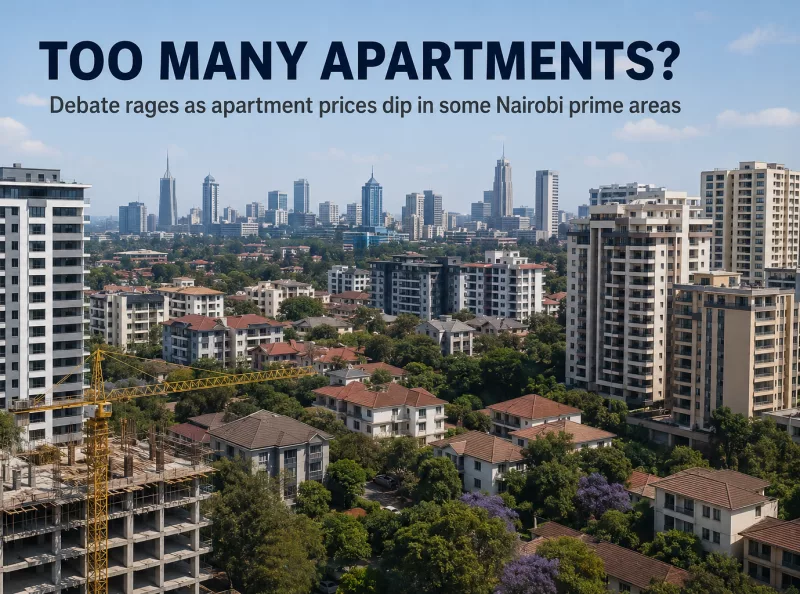
Debate over whether Nairobi has "too many apartments" has intensified following reports of declining apartment prices in some prime neighbourhoods.
However, available market data suggests the issue is more nuanced than the term "saturation" implies. Rather than affecting the entire city uniformly, the evidence points to differing trends across market segments and locations.
Market saturation occurs when the supply of a specific type of property, in a particular location and price range, exceeds demand over a sustained period. It is therefore inaccurate to describe an entire city's housing market as saturated.
A clearer assessment requires looking at factors such as the absorption rate—the speed at which new units are sold or leased—and effective demand, which refers to buyers and tenants who have both the desire and the financial capacity to purchase or rent at prevailing prices.
Recent market reports illustrate these differences. HassConsult's first-quarter 2026 property index showed apartment price declines in 10 of the 18 suburbs and satellite towns it tracks.
Westlands apartments declined by 2.8 per cent during the quarter, while Upper Hill apartments fell by 2.5 per cent, with rents in Upper Hill also declining over the year. According to the report, rising supply has contributed to price corrections in some locations.
However, the same report also showed that detached houses in several prime neighbourhoods continued to appreciate. Lavington, Spring Valley, Karen and Runda all recorded price growth over the same period. Apartment performance was also mixed, with areas such as Muthangari and Riverside registering quarterly gains.
These varying outcomes suggest that supply pressures are concentrated in particular locations rather than affecting Nairobi's entire prime residential market.
Other market research presents a similarly mixed picture. Knight Frank reported growth in prime residential sales and rents during 2025, supported partly by demand from diaspora investors and expatriate tenants. Cytonn's research also identified upper mid-end suburbs—including Westlands, Parklands, Kileleshwa and Kilimani—as among the strongest-performing residential markets in terms of total returns, with relatively high occupancy levels. Serviced apartments also recorded improved occupancy and yields as tourism recovered.
Taken together, these findings indicate that Nairobi's prime residential market is not moving in one direction. Instead, different property types are responding differently to changing supply and demand.
One way of understanding the market is to distinguish between three broad segments.
The first consists of detached houses in established low-density suburbs such as Karen, Runda, Gigiri, Muthaiga, Nyari, Lavington, Spring Valley and Kitisuru. Supply remains relatively limited because of land scarcity and high development costs, factors that continue to support prices.
The second comprises apartments in higher-density areas such as Westlands, Upper Hill, Kilimani and parts of Kileleshwa and Parklands. These neighbourhoods have experienced significant apartment development over the past two decades, contributing to increased competition and price adjustments in some projects.
The third segment includes prime rental and serviced apartments in locations such as Riverside, Westlands, Gigiri, Muthangari and Runda. Demand in these areas is supported by diplomatic missions, international organisations, multinational companies and expatriate professionals, providing relatively stable occupancy compared with more speculative segments of the market.
The distinction between housing need and effective demand also helps explain why apartment prices can soften despite Kenya's widely acknowledged housing deficit. Although the country requires millions of additional housing units, mortgage lending remains limited, and only a small proportion of households earn incomes capable of supporting purchases in the prime market.
As a result, oversupply can emerge in certain high-end locations even while affordable housing remains in short supply.
The government's Affordable Housing Programme addresses a different section of the market. The programme targets lower-income households through units priced significantly below those found in Nairobi's prime residential market. While more than KSh170 billion has reportedly been mobilised and over one million Kenyans had registered on the Boma Yangu platform by early 2026, delivery has fallen well below official targets.
Consequently, the Affordable Housing Programme is unlikely to have materially influenced recent price movements in Nairobi's prime apartment market. Instead, it highlights that the country's most significant housing shortage remains concentrated in affordable housing rather than high-end developments.
For investors and homebuyers, market performance should therefore be assessed using measurable indicators rather than broad assumptions.
These include absorption rates, actual occupancy levels, realised rental income, the quality of tenants, developer track records and building management standards. Online property listings alone provide an incomplete picture, as duplicate advertisements and outdated listings can exaggerate the perception of oversupply.
Current conditions may present opportunities for buyers seeking owner-occupied apartments in areas where prices have softened. For investors, rental income, occupancy rates and tenant quality have become increasingly important as capital appreciation slows in some locations.
Developers, meanwhile, may need to focus more on product differentiation and market demand rather than adding similar high-end apartment stock in already competitive neighbourhoods.
The available evidence suggests that Nairobi's residential market is undergoing adjustment rather than experiencing a citywide apartment glut. Price corrections are evident in some high-density prime locations, while other segments—including detached houses and parts of the prime rental market—continue to demonstrate resilience.
The more relevant question, therefore, is
not whether Nairobi has too many apartments, but which types of apartments are
oversupplied, where they are located, and whether they match current demand.
Answering those questions provides a more accurate picture of the city's
evolving property market than broad claims of saturation.