 AI-GENERATED IMAGE
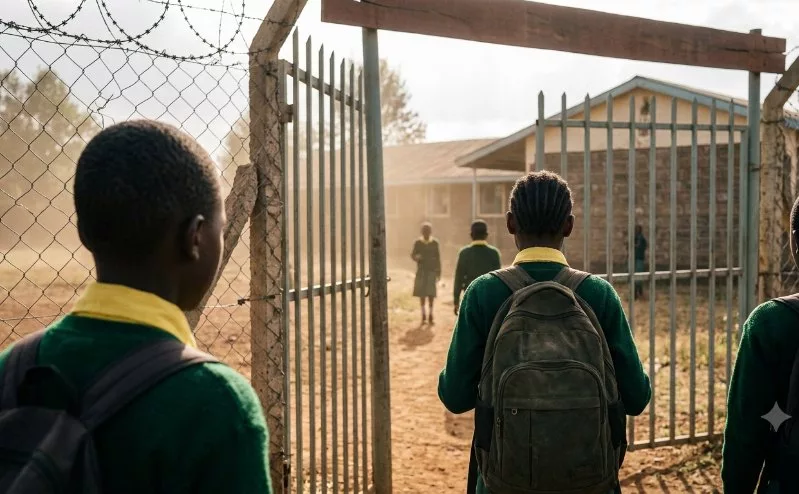
Each morning, millions of parents across Kenya watch as their children leave their homes for school, trusting that within the school gates there is a safe learning environment. Is it time for us to admit a deeply seated fear and hard truth: that for too many of our children, inside those gates is where the real danger begins?
No child should have to choose between education and safety. Yet millions do. UNESCO estimates 246 million children worldwide experience violence in and around schools annually. This is not a distant statistic.
Walk into any classroom in Kenya; out of every ten children, you will find survivors of violence: the 13-year-old boy beaten at his school into a coma, spending 11 days in ICU for taking extra food; the girl who had to stop attending school because what started as “special attention” by a teacher became sexual assault; the child who had to learn how to hold their bladder the whole day because the toilets are where the bullies thrive.
Over the past two decades, Kenya has made significant strides in strengthening its legal and policy framework to address SRGBV. The Teachers Service Commission has codes of conduct.
The Ministry of Education has school safety standards. There are also re-entry guidelines for adolescent mothers, and broader learner protection policies. On paper, these policies have established schools as duty bearers.
But the paper does not suffer. It is the children who face the brunt of it all.
In Kenya, prevention efforts are supported by a range of school-level mechanisms, including learner clubs, codes of conduct, anonymous reporting systems, teacher training, and multi-sector referral pathways.
Learner clubs, for instance, are peer-led student groups that help reinforce safe behavioral norms and enable students to respond collectively when incidents of violence occur.
The existence of these mechanisms is an important step forward, but their effectiveness depends on how consistently they are implemented.
In practice, disparities in institutional capacity, staff training, and familiarity with existing guidelines continue to shape outcomes across schools. These disparities are not random; they help to track power, resources, and geography.
A well-resourced school in Nairobi's suburbs has counselors, clear protocols, and parents who know which office to go to, while a school in Turkana County, or an informal settlement in Mombasa County, or in Dadaab camp operates on goodwill and improvisation. The children most at risk are precisely those with the least protection.
This disparity reflects a broader lesson that strong legal and policy frameworks, while necessary, cannot, alone, eliminate SRGBV. Adequate financing, institutional capacity, trained personnel, effective leadership, and cross-sector coordination influence implementation.
Equally important are the social and cultural contexts in which these policies operate. Deeply entrenched gender norms, stigma, fear of retaliation, and a culture of silence continue to discourage disclosure and reporting, particularly in cases of sexual violence. Without trusted, survivor-centred reporting and response mechanisms, even the most well-designed policies and accountability structures risk falling short of their intended impact. Kenya does not need more policies. What is needed is an evaluation of why the current policies are not working as intended. This conversation, uncomfortable as it is, is necessary.
First, the silence is structural. Deeply entrenched gender norms mean that sexual violence against girls is still treated as a shame to be managed, not a crime to be prosecuted. Boys who experience violence face a different silence: the expectation that masculinity means endurance. In both cases, the school's first instinct is often containment rather than justice. Until we dismantle that culture of silence, every reporting mechanism we install is decorative.
Second, accountability is theatrical. A teacher who violates a child is more likely to be transferred to another school than to face criminal consequences. The "pass- the-predator" practice is not a secret; it is a management strategy. We cannot claim to take school safety seriously while treating perpetrators as workplace problems to be moved rather than public threats that should be held to account.
Third, we have fragmented responsibility. The Ministry of Education develops guidelines. The Teachers Service Commission handles discipline. The police investigate crimes. Social services provide support. In theory, this is well-synchronized coordination. In practice, it is buck-passing. A child who reports violence often finds themselves narrating trauma to multiple adults in multiple offices, each waiting for another to act.
What would it take to close these gaps?
Prevention must adopt a whole-school approach. Isolated interventions have limited impact, whereas integrated strategies that combine teacher capacity building, learner empowerment, positive and gender-responsive pedagogy, community engagement, and robust accountability mechanisms create safer and more inclusive learning environments. When learners have trusted avenues to report concerns and educators are equipped to respond appropriately, schools are better positioned to prevent and address SRGBV.
Data must drive action. National surveys and research have been instrumental in exposing the scale and nature of SRGBV, but their value lies in informing decision-making. Disaggregated, timely, and locally relevant data enable governments and schools to identify vulnerabilities, allocate resources effectively, and design targeted interventions that respond to context-specific needs.
Sustainable progress depends on strong implementation systems. Policies require adequate financing, capable institutions, continuous teacher development, effective school leadership, functioning child protection and referral mechanisms, and coordinated action across education, health, justice, and social protection sectors. Without these enabling conditions, even the strongest policy frameworks struggle to achieve their intended impact.
Kenya’s experience offers a lesson that extends well beyond its borders. The next phase of progress on SRGBV is not about drafting more policies but about ensuring that existing commitments are consistently implemented and adequately resourced. This means investing in institutions, strengthening cross-sector collaboration, and addressing the social norms and power imbalances that allow violence to persist.
Kenya’s journey demonstrates that meaningful change is possible, but it requires sustained commitment. Policies can establish the vision, yet effective implementation transforms schools into safe, inclusive spaces where every child can learn and thrive. For countries committed to ending violence in education, the challenge and the opportunity are to move beyond policy commitments and make safety a lived reality for every learner.