
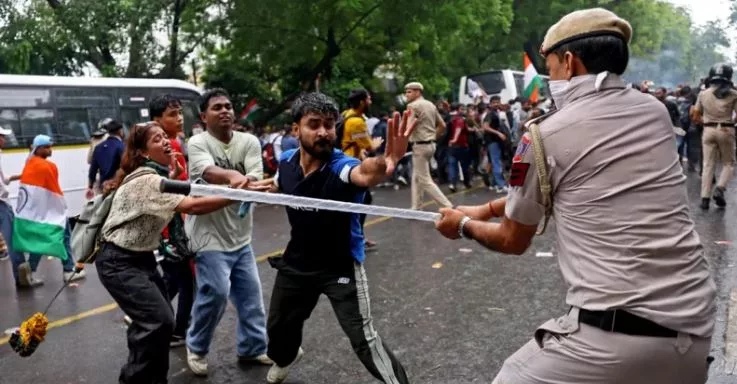
 Police used batons and tear gas to disperse protesters./SCREENGRAB
Thousands have gathered again in the Indian capital, Delhi, a day after a police crackdown on supporters of India's Cockroach Janta Party (CJP), a youth-led movement seeking education reforms and the resignation of Education Minister Dharmendra Pradhan.
Tens of thousands of young men and women had turned up for Monday's protest and tried to march on parliament, defying a police ban.
Central Delhi witnessed overwhelming violence, with at least 60 protesters wounded when police used batons and tear gas on them. Policemen also tore down the stage and makeshift tents at the main protest venue.
Police said 118 of their personnel were also injured and 70 protesters have been detained.
Warning: This report contains description that some may find disturbing
Police and Prime Minister Narendra Modi's government have not commented on the use of sticks and tear gas against protesters. Opposition parties have condemned the violence.
The CJP is a satirical political movement inspired by remarks made earlier this year by India's chief justice, who used the word "cockroach" to describe unemployed young people turning to journalism and activism. After the comments sparked outrage, he said he had been referring only to those with "fake and bogus degrees".
Monday's huge turnout showed that the CJP, though not a registered political party, has evolved into a movement capable of drawing tens of thousands onto the streets.
Protesters, who have been camped for the past month at Jantar Mantar, a 300-year-old observatory in Delhi, gained global attention after activist and educationist Sonam Wangchuk joined them on 28 June and began an indefinite hunger strike in support of their demands.
He was forcibly removed from the protest site by the police on Saturday and taken to hospital where he continues to fast.
The movement has broadened into one of the most visible expressions of public dissent against Modi in recent years.
Wangchuk and CJP founder Abhijeet Dipke have received support from most of the major opposition parties, farmer leaders, activist and celebrities, including Bollywood actors.
Leader of the opposition Rahul Gandhi said said that the students' demands were "legitimate" and described Modi "as the most anti-youth prime minister India has ever had".
The government did not engage with the demonstrators until Monday when Health Minister JP Nadda met some CJP leaders to hear their demands.
The meeting took place against the backdrop of tens of thousands of people turning up from all over the country to participate in the CJP's call to march to parliament on the opening day of the monsoon session.
Nadda, who is also a senior leader of the ruling BJP, said: "The meeting took place in a cordial atmosphere. I have requested all the protesters to end their sit-in and assist the administration in restoring normalcy."
The CJP spokesperson Saurav Das said the group's 10-minute meeting with Nadda ended with a promise that the government would look into the matter but no concrete assurances. Another CJP leader, Ashutosh Ranka, dismissed the four-hour wait for the meeting as "a waste of time".
At one point on Monday evening, it seemed like that the CJP might be willing to call off their protest following their meeting.
But their stance appeared to harden after internet services – apparently blocked in the area throughout the day – were restored, revealing the scale of the violence.
During the day, I saw protesters bring injured people to Jantar Mantar, including a young man bleeding heavily from a head wound as volunteer doctors bandaged him, and another student with a broken leg.
Around the time the protesters were meeting Nadda, police and paramilitary forces moved in to clear Jantar Mantar. Among them were plainclothes officers, many with their faces covered, who joined uniformed police in chasing protesters and beating them with sticks.
An announcement repeatedly made on a loudspeakers warned the protesters to "leave now, this protest is over".
As protesters fled in panic, scrambling over police barricades to escape, I saw people fall to the ground, others struck with sticks, friends and siblings separated, and women in tears.
The senior police officer leading the operation declined to answer questions. Minutes later, a senior female officer was sent to escort me out.
Once internet access was restored, social media filled with videos showing security forces beating protesters, including women, with many lying unconscious on the ground.
On Monday night, the CJP reclaimed the Jantar Mantar protest site and posted on social media, "This peaceful protest is not ending!"
"Despite the police brutality, the brave protestors of CJP are back. Delhi, come out and join us at Jantar Mantar - this is now or never! Dharmendra Pradhan Must Resign!" the message said.
In a statement, the police later said the protesters displayed "unruly, aggressive and violent behaviour", refused to disperse and violated prohibitory orders despite warnings.
"The protesters attacked police personnel with stones and other objects, attempted to breach police barricades, vandalised police and other government vehicles, damaged public property, and resorted to large-scale violence," it said.
The CJP rejected the police account, accusing officers of being the aggressors. In social media posts, it urged injured supporters or those needing legal assistance to contact the group.
"I apologise to all our supporters, especially the girls who were brutally beaten by male police officers. We could have done better. I could have done better to protect you from the inhumane actions of the Delhi police," Dipke posted on X.
In another post, he said one injured supporter was in critical condition in hospital and that he was going to visit her.
The CJP is demanding an overhaul of India's education system, with greater accountability for alleged exam paper leaks. It made the resignation of Pradhan their main demand after the leak of the National Eligibility cum Entrance Test (NEET).
Nearly 2.28 million candidates sat the medical entrance exam on 3 May. It was cancelled days later following reports that the paper had leaked, and a re-test was held weeks later.
More than 20 students have since died by suicide, with their families saying they were devastated by the scandal.
Protesters say Pradhan should take moral responsibility for the leak and resign. He has rejected the demand, calling the CJP and its supporters "the B-team of disruptive elements".
But Monday's huge turnout, the violence and the CJP's refusal to leave the protest site are likely to keep the movement in the spotlight.