
 SCREENGRAB
Four Republican members of Congress have accused Canada of failing to do enough to prevent wildfire smoke drifting into the US.
In a joint letter addressed to the Canadian prime minister, the Michigan lawmakers claimed "continued inaction" from Canada was "unacceptable."
Canadian leader Mark Carney did not respond directly to the claims, but said that both countries had a responsibility to fight climate change.
As of Friday, there were more than 890 fires actively burning in Canada, according to the Canadian Wildland Fire Information System - with the majority burning out of control.
According to the Canadian Wildland Fire Information System, nearly 3 million hectares of land in Canada has already been destroyed by the wildfires.
The impacts have been far-reaching, with a thick blanket of smoke spreading across US states, from Minnesota and Michigan to Pennyslavania, Ohio and New York.
"Hazardous" air quality alerts have been issued across much of the region, leading to the cancellation of many outdoor events.
As of Friday, air quality in the Midwestern city of Chicago was worst in the world, Swiss air quality tracker IQAir said, followed by Detroit, Washington DC, Toronto and New York.
In the open letter addressed to Canadian officials, US lawmakers John James, John Moolenaar, Jack Bergman and Lisa McClain said their "patience has run out".
"We are done accepting apologies in place of action," they said, warning the US could explore direct involvement in cross-border wildfire protection and firefighting if Canada failed to act.
"We were told last year that this would be treated with urgency. It was not," they claimed, adding that instead "American lungs are paying the price for Canadian inaction, year after year".
They said that issues such as "chronic under-investment in forest thinning, fuel reduction, and prescribed burns, along with inadequate enforcement against arson", had not been addressed "adequately enough".
When asked whether Canada could be doing more to curb its wildfires - and by extension its smoke, experts from both countries previously told the BBC that the answer was largely no.
Responding to the criticism from US lawmakers, Carney said in French during a news conference in Ontario: "Climate change is everyone's responsibility - truly everyone's - including the United States."
He added that his government was "in close communication" with provinces and local communities.
Meanwhile, Ontario Premier Doug Ford dismissed criticism of his government's handling of the fires, noting that over 150 fire crews are on the ground battling the blaze.
"We will spend whatever it takes," Ford said.
A large cluster of fires affecting northwestern areas of Ontario are responsible for sending thick plumes of smoke and poor air quality across Thunder Bay and Toronto, with lower concentrations of smoke high in the atmosphere drifting over the Great Lakes and above New York with hazy skies.
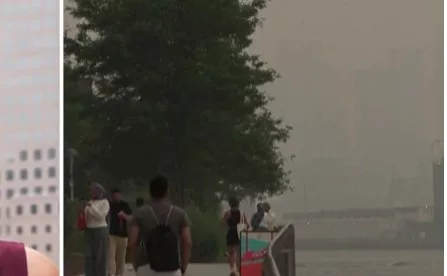
On Thursday, thick haze of smoke blocked views across New York City, including the Empire State Building and the Statue of Liberty.
New York has extended its heat emergency plans and activated its air quality emergency protocols - with hundreds of cooling centres and KN95 masks being made available citywide.
In addition to the hazardous smoke extending across to the US, wildfires in northern Ontario have forced dozens from local First Nations communities to evacuate, with videos showing some fleeing the remote area by boat.
Namaygoosisagagun First Nation Chief Helen Paavola told local news outlet CityNews in an interview that an aerial flyover showed that her community has been "burnt to ashes".
Roughly half of Canada's wildfires are sparked by lightning, while the rest stem from human activity, data from the National Forestry Database shows. Expert have also warned that hotter temperatures are making the land drier and more prone to ignition.