
At least 19 people have died after a magnitude-7.8 earthquake struck the southern Philippines, according to civil defence officials.
The death toll from the quake has risen to 19, according to a spokesperson from the Philippine civil defence office.
The fatalities will need to still need to be verified and validated by the official disaster agency, they cautioned.
There are also seven people missing, the spokesperson said.
The number of injured now stands at 134.
The earthquake happened in one of the Philippines most seismically active regions, according to government scientists.
The affected provinces face the Cotabato Trench, a "major earthquake-generating structure", according to the Philippine Institute of Vulcanology and Seismology.
The trench is capable of generating minor to great earthquakes, Phivolcs says.
This morning, a "subduction" occured along the trench, Phivolcs says. This happens when one tectonic plate slides beneath another plate.
Earthquakes are common in the Philippines, which sits on the geologically unstable Pacific Ring of Fire.
While most of these quakes pass relatively peacefully, some can prove to be deadly.
Last September, a magnitude-6.9 earthquake struck the central Visayas region, killing more than 70 people.
Days later another eight people were killed when two powerful earthquakes struck off the coast of Davao Oriental in Mindanao.
Here's what we've covered today:
- The earthquake struck off the southern island of Mindanao
- At least 134 people have been injured, according to a civil defence office spokesperson - these numbers have to be finally verified by the National Disaster Risk Reduction and Management Council.
- The quake triggered tsunami warnings in the Philippines, Indonesia and Japan. Limited waves ranging from a few centimetres to 1.4m (4.6ft) were later observed. Australia and New Zealand also issued tsunami warnings soon after the quake struck but lifted them soon after
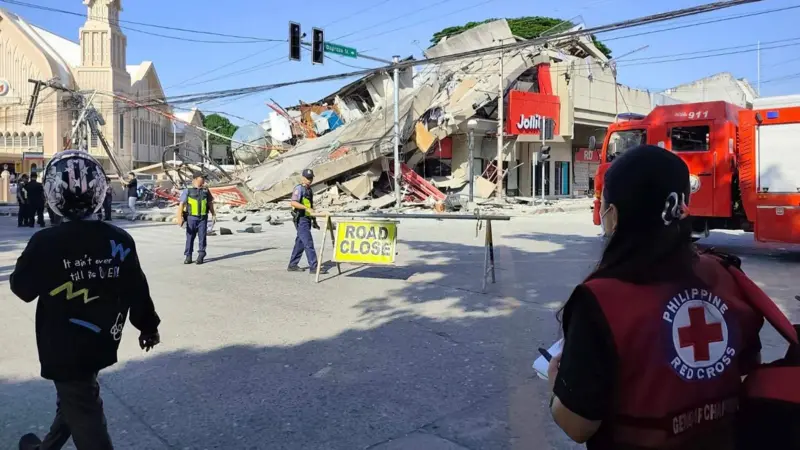
- Videos and images show buildings, including a Jollibee restaurant, being reduced to rubble
- The quake coincided with the start of the new school year in the Philippines. Classes in quake-hit areas been suspended, Philippine President Bongbong Marcos said
- The city of General Santos, near the quake's epicentre, is known as the country's tuna capital
- Evacuation and relief efforts are underway. President Marcos says the government "will not leave Mindanao behind", while the Philippine Red Cross says it's on the "highest alert"

![[PHOTOS] Linda Mwananchi takes Trans Nzoia by storm](https://cdn.radioafrica.digital/image/2026/07/0d132395-ad4b-4671-867e-880c9f8144f5.webp)