Hope for coffee farmers as foreign roaster promises better prices
New deal will eliminate brokers and middlemen who have been blamed for poor returns
by The Star
Audio By Vocalize
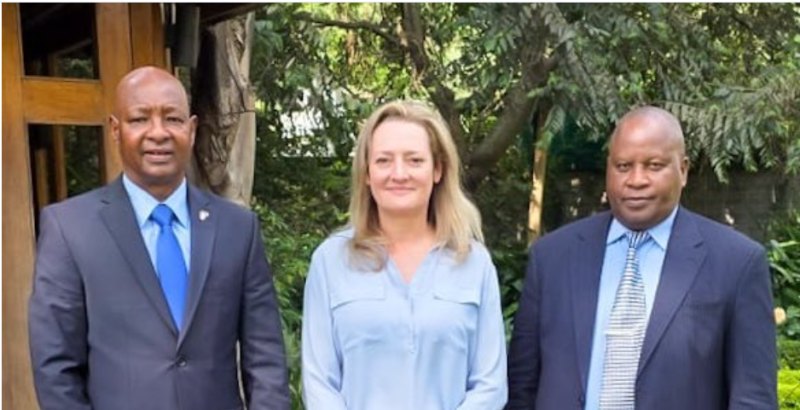
Kyanzavi Farmers Cooperative Ltd chairman Francis Kalinzoya in Matungulu, Machakos county, on Monday, November 28, 2022.Kuwait-based Collective Coffee Company founder Richard Fades
Farmers in Machakos county are optimistic after a foreign coffee roaster promised a direct market for their produce.
A team from the Kuwait-based Collective Coffee Company visited Kyanzavi Farmers Cooperative Ltd members in Matungulu on Monday.
Company founder Richard Fades told the Star they visited the country to explore Kenyan coffee with the intention of offering a direct market.
A direct market will eliminate brokers and enable farmers to earn more from their produce.
"We are roasters, we roast coffee and sell to cafes and restaurants. We came to explore coffee in Kenya," Fades said.
Fades said they also visited several coffee farmers in Kisii, Kericho, Nakuru, Nyeri and Meru counties.
"We love coffee from Machakos. We have coffee from Machakos back in Kuwait. We had to visit Machakos to see how the coffee business is going on here," he said.
Fades said they interacted with farmers and listened to the challenges they face from the farm, during processing and in the market.
"We were also made aware of the obstacles in attempts to get direct markets and hopefully how to help them so that we can all benefit from the coffee trade,” he said.
Fades said there was a huge coffee market in Kuwait.
"We can see the possibility of doing trade with them since they have the good quality, special coffee that we require. We are specialty coffee roasters," he said.
Fades told coffee farmers in Kenya not to lose hope and instead to continue trading in the cash crop.
Kyanzavi Farmers Cooperative Ltd chairman Francis Kalinzoya said he had been planting coffee since 1971 but lately it has had poor returns.
"I have been planting coffee since my tender age. I'm still a coffee farmer," he said.
"It used to be an important produce for the country's economy and development of Ukambani region."
Kalinzoya said the majority of the farmers educated their children through coffee farming.
"Farmers used to take their coffee to cooperative societies. The society paid school fees directly depending on agreements entered into with specific parents. It was a good trade," he said.
Kalinzoya said the majority earned their education without problems since coffee paid their parents well.
"Some elderly men used to go to Mombasa for holidays after getting their earnings from coffee. But nowadays, coffee does not pay well. You plant coffee, use lots of money to produce the commodity only to get negative returns,” he said.
Kalinzoya said farm inputs like fertiliser and agrochemicals are expensive, hence rendering farmers paupers instead of good income earners. The processing of coffee is also costly, he added.
He said farmers earn less than what they invest in coffee production.
“You can’t even earn a quarter of the expenses. Farmers started intercropping, planting maize and beans in coffee farms to get food,” Kalinzoya said.
A spot check by the Star on several farms in Matungulu and Kangundu subcounties established farmers plant other crops together with coffee.
Some farmers have uprooted coffee and replaced it with maize and beans, saying it is of no benefit.
Kalinzoya blamed brokers and cartels for challenges faced by coffee farmers in Kenya.
He said coffee could earn farmers good returns if only brokers and cartels are eliminated by letting producers sell directly to the global markets.
Kalinzoya said brokers go looking for markets abroad, then return to the country and act as coffee traders in global markets. He said they end up frustrating farmers by giving them peanuts.
He said the situation had rendered coffee farming a trade for the elderly.
“Those planting coffee are the elderly men and women because youths believe that coffee doesn’t earn farmers much, no returns. But if coffee has money, all will return to coffee farming,” Kalinzoya said.
Kalinzoya urged President William Ruto’s administration to intervene and rescue coffee farmers from brokers so they can get reasonable earnings.
He said farmers are struggling with loans from banks and cooperative societies.
Kalinzoya said the government should allocate some funds to cushion coffee farmers.
MPs and senators from coffee-growing areas under the Parliamentary Caucus on Coffee on November 21 blamed farmers’ woes on cartels.
The 77 members met in Machakos to discuss the legislative agenda on coffee.
The legislators promised to table the matter in their respective Houses to correct what they termed an abnormality in the coffee sector and come up with a legislative framework to counter some alleged bad laws that are oppressive to farmers.
The caucus was headed by its chairperson and Kiambu Woman Representative Gathoni Wamuchomba.
A coffee farm in Kangundo, Machakos county, on Monday, November 28, 2022.A coffee farm in Kangundo, Machakos county on Monday, November 28, 2022.A coffee farm in Kangundo, Machakos county on Monday, November 28, 2022.An intercropped coffee farm in Kangundo, Machakos county on Monday, November 28, 2022.
This is premium content
Subscribe to Continue Reading
Help us continue bringing you unbiased news, in-depth investigations, and diverse perspectives. Your subscription keeps our mission alive and empowers us to provide high-quality, trustworthy journalism. Join us today to make a difference!