 Launch of the
Pesticide Residues in Selected Vegetables Sold
in Kenyan Markets report./HANDOUT.
Launch of the
Pesticide Residues in Selected Vegetables Sold
in Kenyan Markets report./HANDOUT.
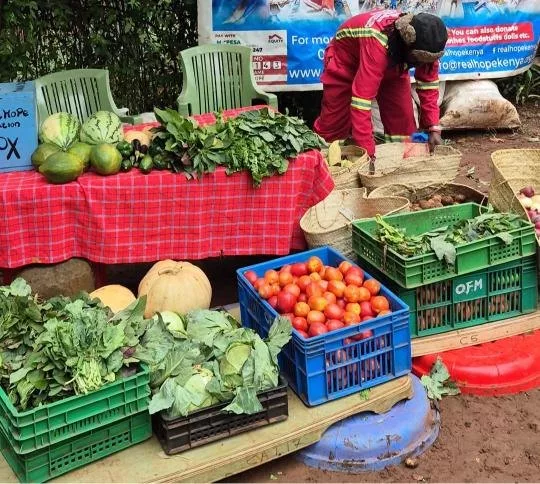 Small vegetable market./FILE
A new study has found that 78 per cent of vegetables sold in Nairobi markets contain detectable pesticide residues, with one in every three samples exceeding the European Union's Maximum Residue Limits (EU MRLs).
The report, Pesticide Residues in Selected Vegetables Sold in Kenyan Markets, warns that while consumers can significantly reduce pesticide residues through proper household food preparation methods, the primary responsibility for ensuring food safety lies with farmers, regulators and policymakers.
The study analysed tomatoes, kale, spinach and onions collected from major wholesale and retail markets in Nairobi (Githurai, Kangemi, Muthurwa) and in Nakuru market.
Presenting the findings, Dr Nduhiu Gitahi, a researcher and a toxicology expert from the University of Nairobi (UoN), said the study was conducted in two phases. The first assessed pesticide residues in vegetables commonly consumed in Kenya, while the second evaluated how effective household food preparation methods are in reducing the residues.
The study was carried out by Kenya Organic Agriculture Network (KOAN) in partnership with the University of Nairobi, Route to Food Initiative, Swedish Society for Nature Conservation and the Heinrich Böll Foundation.
Out of 45 vegetable samples collected from major food-producing counties, 35 (78 per cent) contained detectable pesticide residues. Although most residues were below the EU safety limits, 15 samples (33 per cent) contained pesticide levels exceeding the allowable limits.
"Tomatoes recorded the highest proportion of non-compliant samples, followed by spinach and kale, while none of the onion samples exceeded the applicable EU maximum residue limits," Gitahi said.
The study detected eight pesticide active ingredients above regulatory limits: chlorfenapyr, chlorpyrifos, acephate, lambda-cyhalothrin, difenoconazole, linuron, carbendazim and tebuconazole.
Seven of the eight pesticides are classified by the World Health Organization (WHO) as Class II, or moderately hazardous, pesticides.
"Most of the non-compliant samples originated from major commercial vegetable-producing counties," Gitahi said.
He said the baseline assessment confirms that pesticide residues remain a food safety concern in vegetables sold in Kenya and provides scientific evidence for evaluating practical household interventions.
"The findings highlight the need for interventions at both the production and household levels. Preventing pesticide residues should remain the primary objective through responsible pesticide use, adherence to good agricultural practices and compliance with recommended pre-harvest intervals," he said.
Gitahi noted that while eliminating pesticide residues at the farm level may not always be possible, consumers can reduce their exposure by adopting evidence-based food preparation practices before cooking.
They include washing under running water for at least 1.5 minutes, peeling, blanching, washing vegetables in a 2% salt solution, soaking in a baking soda solution, soaking in a vinegar solution, cooking and short-term storage.
Gitahi said the findings demonstrate that simple household practices can substantially reduce pesticide residues, hence reduce ingestion. Methods vary in their effectiveness depending on the type of vegetable, and the pesticide used during production and the preparation method used.
For tomatoes, washing followed by soaking in a two per cent baking soda solution before cooking proved most effective. In spinach, washing, blanching and cooking significantly reduced pesticide residues, while washing followed by vinegar treatment and cooking gave the greatest reductions in kale.
Overall, the researchers found that household preparation methods could reduce pesticide residues by between 60 and 70 per cent before vegetables are consumed.
The report recommended that regulatory agencies, including the Pest Control Products Board (PCPB), the Kenya Plant Health Inspectorate Service (KEPHIS), the Ministry of Agriculture and Livestock Development, the Ministry of Health and county governments, strengthen national food safety systems.
It also called for better enforcement of pesticide regulations, regular monitoring of food sold in markets and greater support for farmers to adopt safer pest management practices.
Eustace Kiare, Executive Director of the Kenya Organic Agriculture Network (KOAN), said, “Food safety requires action from everyone across the food system”.
"Food safety is everyone's responsibility. This dialogue brings together evidence, experience and diverse voices to identify practical actions that can strengthen Kenya's food system, from the farm to the consumer's table, alongside data on pesticide residue reduction levels," he said.
Paul Joachim, Regional Director for Kenya, Uganda and Tanzania at the Heinrich Böll Foundation, said consumers should not bear the burden of correcting failures that occur earlier in the food production chain.
"The responsibility for food safety cannot be transferred to consumers. Consumers should not be expected to correct, in their kitchens, failures that originate at the point of pesticide registration, sale or application," he said.
He cautioned that some pesticides are systemic and cannot be completely removed through washing, soaking or cooking.
"Prevention must remain our first and most important line of defence. The measures already taken by the Government to withdraw or restrict certain pesticide products are welcome,” he said.
“But they must be accompanied by stronger post-registration surveillance, routine and transparent residue monitoring, enforcement against unlawful pesticide use, better controls over pesticide distribution, strengthened extension support and practical assistance to farmers transitioning towards safer and ecologically sustainable pest management systems," Joachim said.
Dr Harun Warui of the Route to Food Initiative said the research provides evidence that can help improve both policy and consumer awareness.
"The right to food is not only about having enough to eat. It is also about ensuring that the food people consume is safe. This research provides evidence that can inform policy, support farmers and equip consumers with practical knowledge," he said.
Warui added that household preparation methods should complement, not replace, stronger government regulation.
"Today's findings give households practical ways to reduce pesticide exposure, but they cannot solve the problem alone. We need stronger regulation, effective enforcement, regular residue monitoring and greater support for farmers to transition towards safer and more sustainable farming systems. Agroecology offers an important pathway by reducing reliance on hazardous pesticides in the first place," he said.
Gitahi added that safer food starts on the farm, but simple steps at home can also help reduce pesticide residues before vegetables are eaten.