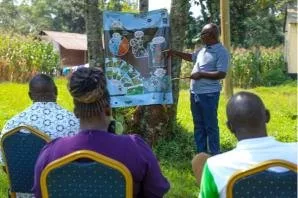
 Charles
Nyayiera, deputy director for agriculture in Homa Bay county trains farmers and
extension services on how to improve soil health, increase crop productivity,
and strengthen food and nutrition security /HANDOUT
Charles
Nyayiera, deputy director for agriculture in Homa Bay county trains farmers and
extension services on how to improve soil health, increase crop productivity,
and strengthen food and nutrition security /HANDOUT
Healthy
soil is the foundation of food production, yet many farmers continue to lose
yields because they lack the knowledge to restore and manage their soils
effectively.
To address this challenge, the Food and Agriculture Organisation of the United Nations is rolling out its Soil Doctors Programme in western Kenya.
The initiative equips farmers and agricultural extension officers with practical, science-based skills to diagnose soil conditions and adopt sustainable soil management practices that improve productivity and strengthen food security.
According to FAO, about one-third of the world's soils are degraded due to erosion, nutrient depletion, pollution and unsustainable farming practices, threatening agricultural productivity and livelihoods.
In Kenya, declining soil fertility and increasing climate variability continue to reduce crop yields, making improved soil management more urgent than ever.
For many farmers, the training has challenged long-held farming practices that unknowingly degrade soils.
Esther Nelima, a farmer from Shivanga subcounty in Kakamega county, said she previously burned maize stover after harvesting, unaware that the practice destroyed valuable organic matter essential for maintaining healthy soils.
"I am learning a lot from this training. I have learned how to take care of soil," she said.
Another farmer, Kuki Burundi from Kakamega county, admitted that he had practised monocropping and often left his land bare after harvesting.
Through the programme, he learned that such practices gradually weaken soil fertility, increase erosion and reduce crop productivity over time.
Both farmers said they plan to apply the new knowledge on their farms and share it with fellow farmers in their communities.
The training brought together 30 agricultural extension officers and 15 lead farmers at Bukura Agricultural Training College in Kakamega county. Participants were trained not only to improve soil management on their own farms but also to become trainers who will transfer the knowledge to hundreds of other farmers.
Barrack Okoba, national project coordinator for the SoilFER Project in Kenya, said the programme focuses on practical soil health management, including understanding soil structure, identifying different soil types, assessing soil pH and using simple, locally available tools to evaluate soil conditions.
"This project is unique and has come at the right time. For a long time, there has been a lot of emphasis on plant health while overlooking the very foundation for such health, which is the soil," Okoba said.
He explained that the programme combines classroom learning with practical field demonstrations, allowing participants to diagnose soil conditions and recommend appropriate management practices.
"The good thing about this model is that it is practical in nature. It gives participants hands-on experience and equips them with simple procedures they can use to diagnose soil conditions and provide farmers with appropriate recommendations," he said.
The training also discouraged harmful practices, such as burning crop residues, leaving fields bare after harvest and applying fertilisers without first understanding soil nutrient needs.
Instead, farmers are encouraged to adopt soil conservation practices that build organic matter, improve soil fertility and increase resilience to climate change.
The training forms part of SoilFER-Soil Mapping for Resilient Agrifood Systems in Central America and Africa, which is FAO's flagship programme supported by the governments of the United States and Japan.
Okoba said the initiative aims to strengthen soil information systems, improve advisory services and promote sustainable soil management to build more resilient agrifood systems.
He said the programme follows a 'train-the-trainer' approach, enabling extension officers and lead farmers to pass on their knowledge to many more farmers across their communities.
"The programme will equip farmers with practical knowledge and skills to improve soil health, increase crop productivity and strengthen food and nutrition security," he said.
Beyond improving farming practices, the initiative will also strengthen Kenya's national soil information system. Data collected through the programme will feed into the Kenya Integrated Agricultural Management Information System (KIAMIS), supporting evidence-based agricultural planning and more targeted fertiliser recommendations.
FAO soil fertility specialist Vinisa Saynes Santillan said healthy soils are central to achieving sustainable food production, particularly as climate change continues to affect farming.
"With the current challenges of climate change, we must understand the soil requirements to build the resilience of crop farmers," she said.
She
noted that improving soil information would help move away from blanket
fertiliser recommendations by ensuring farmers receive advice tailored to the
specific nutrient needs and characteristics of their soils.