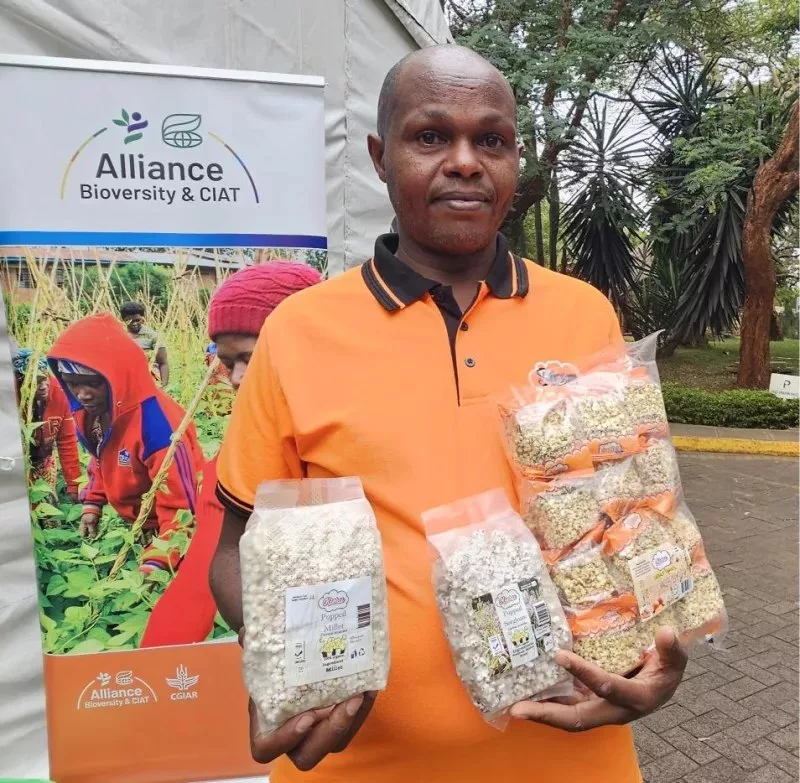
 Gichangi Mahinda, director of Kieru Company Limited in Embu County, with popcorn made from millet /AGATHA NGOTHO
The smell of freshly cooked millet porridge still reminds Gichangi Mahinda of his childhood.
Long
before he became an entrepreneur, mornings at home meant watching his mother
and grandmother grind millet on a traditional stone mill before preparing the
nutritious porridge that kept the family healthy.
Today,
those cherished memories have inspired him to transform the same into crunchy,
naturally flavoured popcorn, proving that Kenya's traditional foods can find a
place on modern supermarket shelves.
At
his processing plant in Embu county,
Mahinda now produces millet and sorghum popcorn in a variety of natural
flavours including honey, baobab, ginger and other locally sourced ingredients.
The healthy snacks are packed in affordable Sh20 packets, and they are now attracting health-conscious consumers, school children and families looking for nutritious alternatives to conventional crisps and sugary treats.
"Our mission is to bring traditional foods back to our tables while giving people a healthy snack," Mahinda, director of Kieru Company Limited, says.
The journey began in 2017 after months of market research. Mahinda discovered that millet remained familiar to many Kenyans, but few companies had found innovative ways of presenting it to younger consumers. But his passion, however, started much earlier.
Growing up, he often accompanied his mother to local markets where they sold millet to supplement the family's income. At home, millet porridge was a daily meal, and his mother constantly reminded them of its nutritional value.
"We loved our uji because our mother always told us how nutritious it was. Whenever we visited our grandmother, millet was our staple food. Those memories have stayed with me," he says.
The turning point came during a field day at Kanyarere, where researchers from the Alliance of Bioversity International and CIAT demonstrated technologies for adding value to indigenous crops.
"When I saw millet being popped like popcorn, I immediately said, 'That is my business. That is my purpose.' From that day, I decided to invest in it."
Today, Mahinda contracts about 300 smallholder farmers who grow millet and sorghum for his company. Once harvested, the grains are transported to the Embu processing facility where they are cleaned, popped, flavoured and packaged.
The business currently processes about 300kg of millet daily, with plans to expand into commercial milling as demand grows.
Mahinda says every machine in the factory tells a story of patience and determination.
"We bought our equipment one piece at a time by reinvesting the profits we made from sales. Every shilling went back into growing the business."
He says this is a family enterprise and his wife serves as co-director, while their children, still in school, enjoy spending time at the factory and learning about the business.
Unlike
many processed snacks, Mahinda says his products contain no artificial colours
or flavours.
"Our
snacks are made from natural traditional foods. You cannot compare them with
conventional snacks because ours are completely natural."
Consumer response has been encouraging, convincing him that Kenyans are increasingly embracing healthier eating habits.
Beyond making snacks, Mahinda believes the business is creating opportunities for farmers by providing a reliable market for millet and sorghum, crops that have long been overshadowed by maize despite their resilience to drought and rich nutritional value.
His next goal is to increase production, contract more farmers and build a larger processing facility to meet growing demand.
"There are enormous opportunities in value addition, especially for young people. Agriculture is not just about farming. There are opportunities in processing, packaging, marketing and selling."
He is particularly optimistic about millet's future.
"Millet may be a small seed, but it has a big impact. In the next five years, I believe it will become a major crop, not only in Kenya but across East Africa."
Mahinda also wants to change long-held perceptions that millet is mainly a food for women and children.
"Millet is for everyone. Men should also embrace it because it is a healthy food."
Like many entrepreneurs, the journey has not been easy. Buying processing equipment required years of saving and reinvesting profits. Creating consumer awareness has been another uphill task, especially in convincing people to rediscover traditional grains.
Still, Mahinda believes the effort is worthwhile.
He showcased his products during the DialogueNEXT 2026 Partners' Day, organised by the Alliance of Bioversity International and CIAT under the theme From Science to Market.
The event brought together researchers, entrepreneurs, innovators and development partners to demonstrate how scientific research is being transformed into practical solutions for Africa's food systems.
Among displays of climate-smart technologies, fortified foods and innovative agricultural products, Mahinda's millet and sorghum popcorn stood out as an example of how a childhood memory, combined with research and entrepreneurship, can breathe new life into traditional crops while creating healthier food choices and new markets for Kenyan farmers.
Instant analysis
Mahinda’s
journey illustrates how value addition can transform overlooked traditional
crops into commercially viable products while preserving Kenya’s food heritage.
His business shows that innovation in agriculture does not always require new
crops but fresh ways of presenting familiar ones to modern consumers. By
linking research with entrepreneurship, the venture creates new markets for
millet and sorghum, strengthens incomes for smallholder farmers and responds to
growing demand for healthier foods. The story also highlights the untapped
potential of indigenous grains in driving rural industrialisation, youth
employment and climate resilience, given their nutritional benefits and ability
to thrive under increasingly harsh weather conditions.