They were haggling over whether the last presidential election was rigged or not. As usual, the exchange went south but one of them promptly offered that it be dropped because it was poisoning their sport.
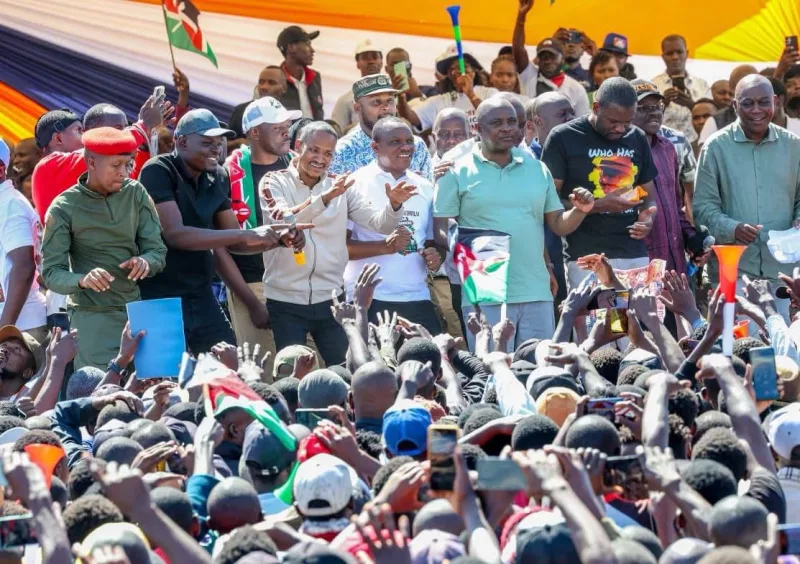
If one is a Raila enthusiast, every turn the man appears to make is believed to lead to something major. One lives inside a bubble sustained by the sacred pursuit of some imaginary holy grail, and a staunch belief in flawlessness Raila. It is a place of captivity and not free will because it does not serve practical importance for his common followers, as Raila has never attained power sought for decades.
The reward of politicking is power, and for Raila, the ultimate prize would be the presidency and making critical decisions. This has been elusive, even with audacious moves such as the NDP merger with Moi’s Kanu in 2001, where he secured a few Cabinet positions. His plan backfired as Moi overlooked him and picked Uhuru Kenyatta as his successor. Raila and other luminaries bolted out to join the opposition.
Raila’s 2018 handshake with Uhuru also failed to deliver power, leading to a blame game within his Azimio team after the embarrassing loss.
Now, Raila and Uhuru appear to be pushing in one direction. Ruto and UDA politicians attribute Raila’s latest rebellion to Uhuru, the tax evasion accusation being a launching pad. Uhuru appeared to respond by reiterating he is still in Azimio, and his leader remains to be Raila.
He also referred to ‘noisemakers’ in an apparent reference to the Ruto government, when he visited the family of the late former Education CS George Magoha two weeks ago.
Many things would be hidden from the public eye, which is the nature of private political communication, and it is actually impossible to tell if relations between Ruto and Uhuru have escalated. However, the two have a history and it is easier pulling together than apart. Ruto supported Uhuru in 2002, 2013, and 2017, which made Uhuru appear like a double–dealer when he endorsed Raila for president in 2022, a real sticking point for his own community, the Kikuyu.
Just who stands to lose if indeed there is a real spat between Ruto and Uhuru?
There was a debate as to whether Ruto would choose a running-mate from the Mt Kenya region — which turned out to be his citadel — or from elsewhere. Ruto finally settled on Rigathi Gachagua, who had been Uhuru’s aide at some point, and there was quiet harmony as the likes of Musalia Mudavadi settled for other positions outlining Ruto’s effectiveness in private political communication.
While Raila’s business is politics, Uhuru stands to lose in real business, if Ruto and Gachagua become hell-bent on curtailing him for real. Raila has few known business investments, yet the Kenyattas own massive business investments in Kenya and beyond.
Whether they have enjoyed tax waivers or not, or have evaded paying tax or not, their businesses have been skillfully and strategically run growing only stronger over the decades.
When Moi declared Uhuru his choice for president in 2002, Sally Kosgey, Moi’s head of civil service then, had an unlikely visitor early the next morning.
“Go and ask Moi, now that he has settled on Uhuru as Kanu presidential candidate, where money for campaigns will come from,” the visitor said.
The visitor was concerned about the expensive nature of political campaigns and maybe her preference would have been that Uhuru did not run at all. Moi may not have informed the Kenyattas when he chose Uhuru to be his successor.
It is a no-brainer that the Kenyattas are obviously not ready for a power tussling with Ruto because it can be bad for business. Ruto may not like ‘handshakes’, but a truce with Uhuru will not be a political one but business, and will not need any explanation or solemnity. We should anticipate this in the not-so-distant future.
Uhuru’s choice of Raila as his successor was obviously because he wanted to rule by proxy. There are questions as to whether Raila can actually be able to run government, if he took power. Raila struggled as Prime Minister in the Grand coalition government, blaming the civil service led by Muthaura for his ineffectiveness, as though he had not anticipated antipathy in the forced ‘marriage’.
The Kazi kwa Vijana scandal happened under Raila’s Office of Prime Minister. Most importantly, his inability to take power, despite the support of the incumbency, raises the question of whether he would indeed be able to run government if he were at the helm of it.
Government administration has a staid managerial facet that cannot be overlooked, especially a country like Kenya where the economy needs revamping, poverty needs eradication, corruption is institutionalized, and enterprise needs stimulation.
The choice of a deputy from Mt Kenya, deliberate or not, was a masterstroke by Ruto as it absolutely eliminated the chance of an Uhuru resurgence and blackmail. This may or may not have been a strategic plan by Ruto, but it presents him with a heavy advantage now. Gachagua and other Ruto troops presence on the Mt Kenya political turf mean that Uhuru is a toothless political figure, if the latter elects to continue to be active.
Uhuru must know that peace is made with the strong. As for Ruto, going after Uhuru can become an unnecessary impetus for his detractors when he runs for his second term, a pit he must avoid.
Our communities are always looking up to a de facto political prefect, and Gachagua is occupying that space now. Uhuru cannot bank of Raila’s bases for political support, he will always look weak without that of his own people. He is behind time now. Ruto needed a deputy who was an enemy of his enemies and who cannot change allegiance easily — Gachagua needs time to grow nationally, at least not less than 10 years.
Ruto rewarded many of Kikuyu leaders with key positions in his government. This is what the community likes — to be in government and practically benefit from it. Jubilee legislators are the latest catch for Ruto’s Kenya Kwanza fold. It gives more control of Parliament and the political space as it whittles down the opposition voice.
On the other hand, Raila stands to lose a legacy by failure to change tact. The August 2022 election was largely a peaceful election. Kenyans resisted violence. The IEBC system averted controversy and trouble and made it easy for the Supreme Court to sort out the petition taken before it.
Since power has evaded him, Raila’s legacy can only be the reforms he and others fought to bring forth. It is important to remember that Uhuru and Ruto were not very welcoming of change, and that places Raila on a pedestal.
The legacy of reforms is what Raila should protect by respecting the tenets of democracy. Allowing Ruto to rule is a respect for the voice of the people and the nature of politics. Politics is like a game of draughts where you get to King and defeat your contender, and if beaten, one should appreciate the winner and wait for the next game. Mentoring others and disengaging from unnecessary political quibbling preserves Raila’s legacy.
The greatest thorn in Raila’s own flesh, and which meets a strong denial, is self-love or worship. There is no ultimate man — there is always another man one can trust and attach the future to. Again, if your candidature always divides the nation and comes a cropper, then perhaps the puzzle for the perennial personal quest has its solution in the heavens.
As Azimio troops gather next time, perhaps the theme song should be ‘No man is an Island’. Peace must be pursued at all costs.