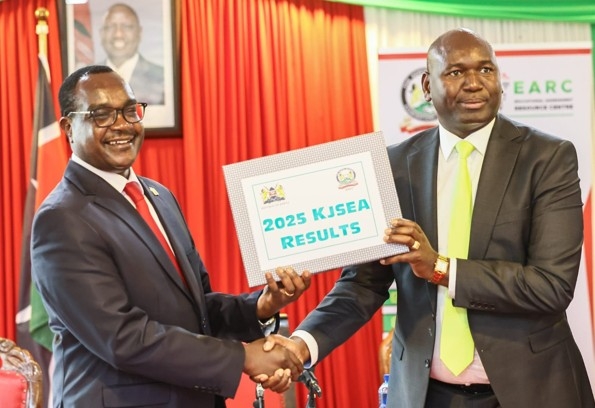


Fight against Menstrual Hygiene Management in Nyanza region has received a boost after two community organisation received Sh39 million grant from USAID Western Kenya Sanitation Project.
The organisations are Matibabu Foundation based in Siaya and Blue Cross community development programme based in Migori.
They got Sh19 million and Sh20 million respectively.
According to USAID WKSP Chief of Party Paul Orengoh, the two organisations were selected out of a very rigorous competitive process where about 84 applicants applied.

The projects will be undertaken for the next 24 months to cater for specific MHM activities in the two areas.
"Signing of this grant is very critical and important to us as a project because we consider our grantee as an important delivery mechanism to reaching out to our target market," Orengoh said.
WKSP works in Menstrual Hygiene and sanitation space to develop strength and scale market systems along sanitation and MHM.
This is done with an objective to build sustainable replicable and stronger markets for sanitation and MHM.
The two grantees are going to work on the Menstrual Hygiene space and not sanitation though they are also in sanitation.
"The plan is to on board additional grantee by February probably upto five and eight most of them of whom will be working in the sanitation space and additional who will be in the MHM," Orengoh said.
He added that market based approach to MHM entails different elements that this specific grantees are going to addressed including the immediate challenge within the market such as waste disposal.
"With intensive and increased access to MHM products coke the challenge of waste disposal and we have realised this needs to be addressed.
He added that they will also address supply chain issues that are usually charged on MH products and services very much depends on issues challenge.
"Intervention will also include supply chain so that the customers get the experience and even access to an array and make choice of products that meet the expectations of menstruating girls and women".
Orengoh said another issue to be addressed is sexual behaviour change communication.

"Even though the society understands and appreciates MH as a normal biological functioning of a woman, we still live in a society that is still afraid to speak about it."
"You realise in this community we have young girls who attain reach mensturating age without necessarily having been told what to expect. So the team will interven on this aspect and support issues of social behaviour change and break the cultural barriers along this."
The Chief of Party stated that they are also looking to provide opportunities for the youths and women in the MHM space to earn a living.
"This interventions are also meant to create job opportunities for our community from bcreatikg small enterprise along MHM ".
The grant is part of the $24 milion USAID (WKSP) which is meant to facilitate, develop and implement approaches that address the systems-level barriers and provide incentives to strengthening markets for sanitation and hygiene products and services in eight western Kenya counties.
Using new market-driven approaches, USAID’s WKSP will catalyse and transform the accessibility and delivery of sanitation and menstrual hygiene management (MHM) products and services in western Kenya.
USAID WKSP will pioneer market-based solutions to test and accelerate improved sanitation services and MHM together with county governments, private sector players, and other stakeholders of Siaya, Kisumu, Busia, Bungoma, Kisii, Migori, Kakamega and Homa Bay.