The world's inflation extremes: 2026 projection annual average (lowest)
Niger registers a minimal projected rate of 0.4%.
by Rosa Mumanyi
Audio By Vocalize
As nations navigate complex macroeconomic pressures, the latest global annual average inflation projections for 2026 highlight a striking landscape of price stability and deflationary trends among the world's lowest-inflation economies.
Economic data shows a wide variation in how individual countries maintain purchasing power and manage the sustained increase in the general price level of goods and services.
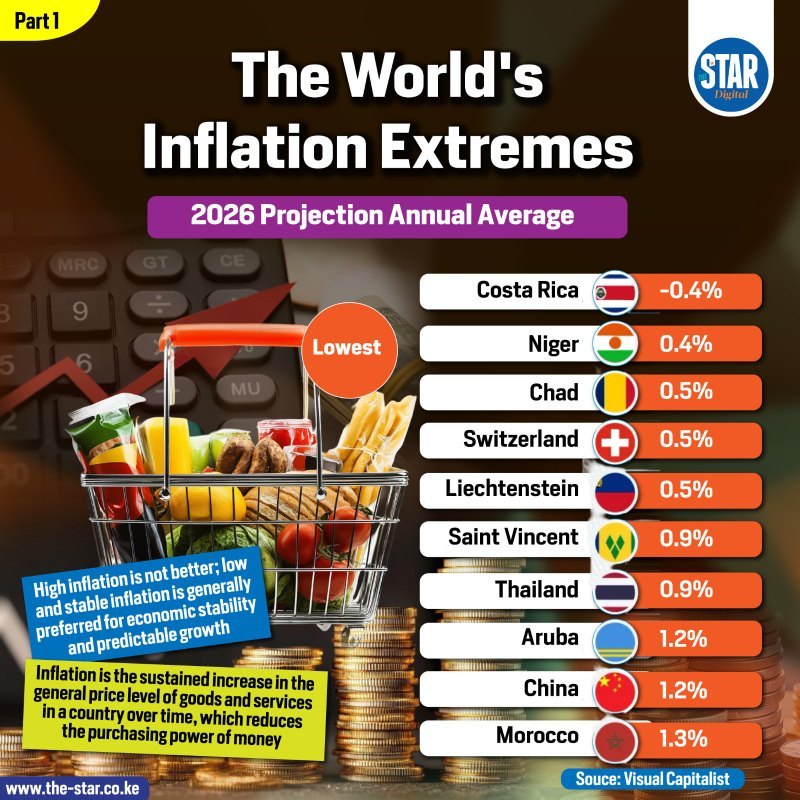
Leading the world in price contraction, Costa Rica stands out as a unique outlier with a projected negative inflation rate of -0.4%.
While deflation presents its own set of monetary challenges, low and stable inflation is generally preferred by policymakers to foster economic stability and predictable growth.
Following Costa Rica, several African and European nations demonstrate remarkably tight price controls. Niger registers a minimal projected rate of 0.4%, while Chad, Switzerland, and Liechtenstein are locked in at a stable 0.5% annual average.
Island nations and major Asian economies also find themselves on the lower end of the global spectrum. Saint Vincent and Thailand both sit comfortably with a projected 0.9% inflation rate.
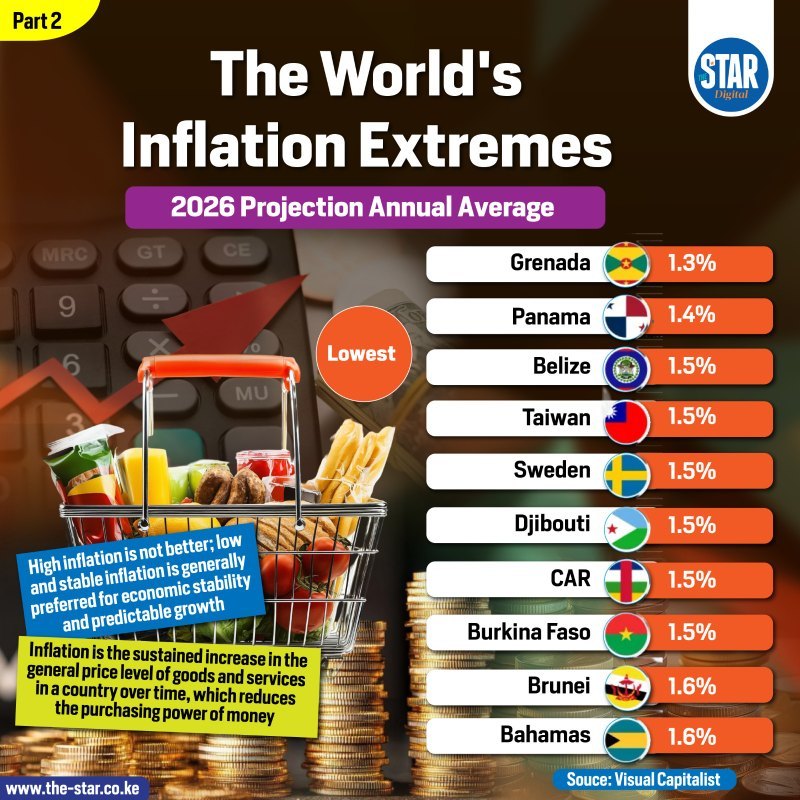
Meanwhile, economic heavyweights and regional hubs show slightly higher but still heavily managed figures; Aruba and China are tied at 1.2%, closely followed by Morocco and Grenada at 1.3%, and Panama at 1.4%.
A large cluster of nations, including Belize, Taiwan, Sweden, Djibouti, CAR, and Burkina Faso, share a uniform projected rate of 1.5%. Rounding out the world's lowest tiers are Brunei and the Bahamas, both forecasting a modest 1.6% inflation average