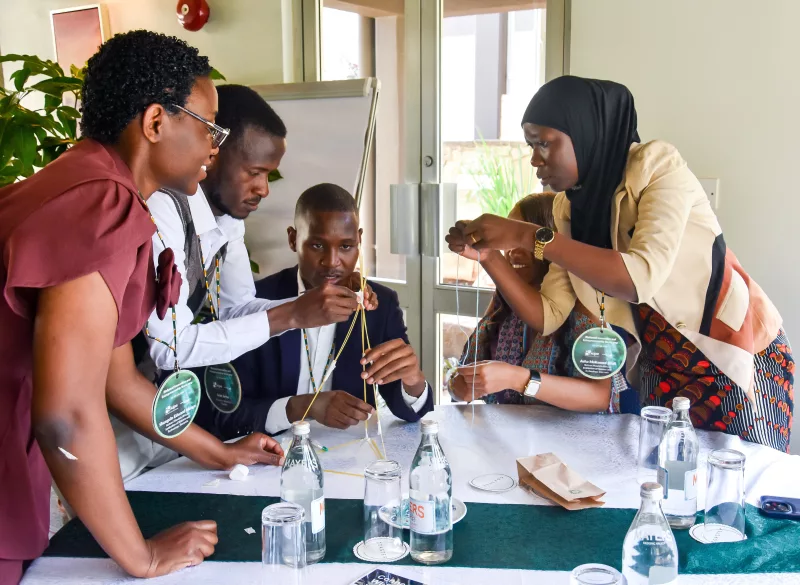
 The Biobased Innovation and Entrepreneurship Boot campers at ICIPE during their research period/ HANDOUT
Africa's rich biodiversity is increasingly being viewed as more than a conservation asset, with researchers arguing that it can also provide solutions to some of the continent's biggest nutrition, agriculture and climate challenges.
"How can we transform the locally available resources in Africa into products that improve nutrition and growth for children while also creating income for rural communities?"
That was the question Ugandan researcher Robin Okot posed as he pitched his innovation before investors, scientists and development partners during the Biobased Innovation and Entrepreneurship Bootcamp at the International Centre of Insect Physiology and Ecology (icipe).
The 10-day programme brought together young innovators from six African countries to refine research-based business ideas capable of addressing local challenges while attracting commercial investment.
For Okot, the answer begins with a fruit that many communities have overlooked for generations.
He said that every year, more than 200 tonnes of Owelo berries are left to rot in northern Uganda despite being rich in vitamins, minerals and bioactive compounds.
At the same time, Uganda continues to grapple with childhood malnutrition, with one in every two children under five affected by iron deficiency anaemia and one in four suffering from vitamin A deficiency, according to figures presented during the pitch.
Okot said the contrast prompted him to rethink the value of the indigenous fruit.
Rather than allowing the berries to go to waste, he developed a nutritious drink aimed at improving children's growth, strengthening immunity and increasing iron intake while creating a market for rural communities harvesting the fruit.
"From forgotten berries into healthy smiles for African children," Okot said.
He said the product also contains antioxidant and anti-inflammatory properties and could provide communities with an affordable nutrition option developed from locally available resources.
Instead of targeting Uganda's entire fruit market, Okot said he plans to begin in northern Uganda by reaching mothers with children aged between two and five years before expanding across the country and eventually into the wider East African market.
HANDOUT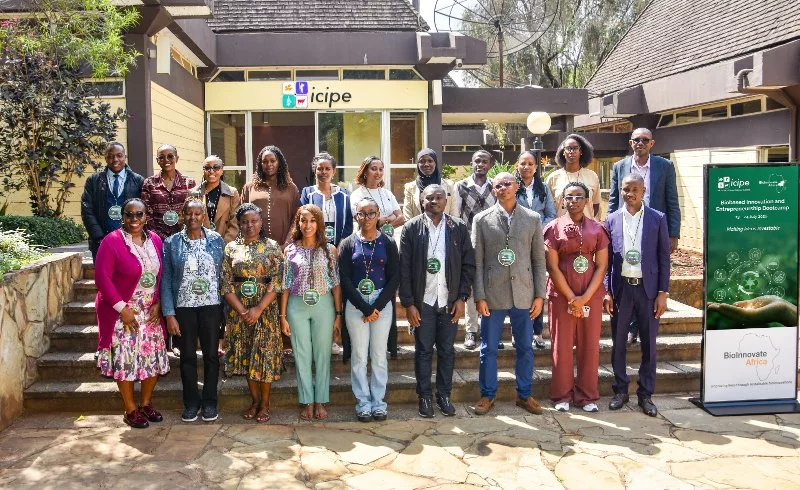 The Biobased Innovation and Entrepreneurship Bootcampers at ICIPE during their training period/
Okot was among several innovators who identified local challenges and turned them into business opportunities rooted in Africa's biodiversity.
Also seeking to solve a long-standing problem affecting farmers is Kenyan researcher George Odongo, whose work focuses on improving livestock productivity while reducing dependence on antibiotics.
Odongo said livestock diseases continue to force many farmers to rely heavily on antibiotics, increasing production costs while weakening animals' natural immunity over time.
He noted that feed accounts for between 60 and 70 per cent of livestock production costs, yet only a small proportion is converted into meat, milk and eggs, reducing farmers' profitability.
"Every challenge presents an opportunity," Odongo said.
He said his research led to the development of a probiotic livestock supplement containing beneficial bacteria that strengthens immunity, improves feed conversion efficiency and increases meat production while reducing reliance on antibiotics.
According to Odongo, the supplement was designed to work with locally available livestock feeds and remain stable under ordinary storage conditions, making it suitable for farmers across the region.
He added that improving animal gut health could also reduce methane emissions, making livestock production more environmentally sustainable.
While Odongo's research focuses on healthier livestock, Tanzanian environmental scientist Asha Shuli is looking at how agricultural waste can become a cheaper source of protein for the animal feed industry.
Shuli said Tanzania generates an estimated 400,000 tonnes of soybean waste annually, much of which remains underutilised despite growing demand for affordable livestock and fish feed.
She explained that black soldier flies have emerged as an important alternative protein source because they convert organic waste into valuable nutrients.
However, she argued that the challenge lies not with the insects themselves.
"The problem is not with the black soldier flies. The problem is the waste that is used to produce them," Shuli said.
According to her, conventional production relies largely on domestic and kitchen waste, which varies in nutrient quality and often produces larvae with high fat content, forcing manufacturers to incur additional processing costs.
Her innovation instead uses soybean waste to rear the insects, producing higher-protein, lower-fat larvae while generating organic fertiliser as a by-product.
Shuli said the approach could reduce feed production costs while creating value from agricultural waste that would otherwise be discarded.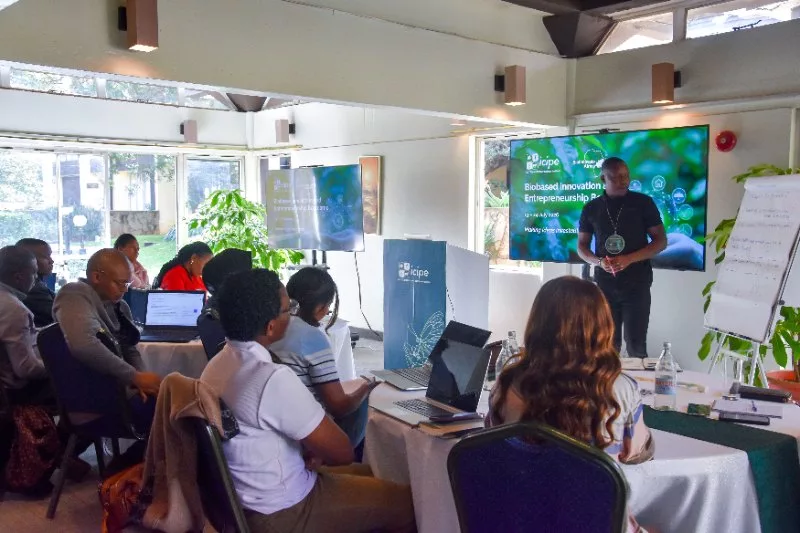 The Biobased Innovation and Entrepreneurship Boot campers at ICIPE during their training period/ HANDOUT
The three innovators were among 13 young researchers from Kenya, Uganda, Tanzania, Ethiopia, Burundi and the Democratic Republic of Congo selected to participate in this year's Biobased Innovation and Entrepreneurship Bootcamp organised by BioInnovate Africa and hosted by the International Centre of Insect Physiology and Ecology (icipe).
The programme is held yearly with this year's being cohort 4.
It brought together postgraduate students, recent graduates and early-career researchers to transform scientific innovations into commercially viable enterprises capable of attracting investors.
BioInnovate Africa Programme Manager Julius Ecuru said the organisers were not simply looking for good scientific ideas but innovations that could eventually become sustainable businesses.
"We look for an idea that is innovative, stems from scientific research and has prospects for business," Ecuru said.
He said this year's cohort was selected from 54 applications received across the region, with only 15 innovators initially picked. Two later failed to attend, leaving 13 participants, the majority of whom were women.
According to Ecuru, the programme is fully funded by the Swedish International Development Cooperation Agency (Sida), with participants receiving support for travel, accommodation, training and mentorship throughout the bootcamp.
"We are financed by the Government of Sweden through Sida. Our financing is in the form of grants, fellowships and technical assistance," he said.
Ecuru said the bootcamp was intentionally designed to expose participants to more than entrepreneurship training.
"They spend with us 10 days to perfect those ideas, identify who the customers are, understand the market potential of their work and sharpen the innovativeness," he said.
Seven of those days were spent at icipe in Nairobi, where participants refined their business models, developed commercialisation strategies and received coaching on pitching to investors.
The remaining days took the innovators to Arusha, Tanzania, where they visited the Nelson Mandela African Institution of Science and Technology.
Ecuru said the visit was intended to demonstrate the role universities can play in generating innovations that address societal challenges.
"They are mostly from universities, so we want them to understand the contribution of universities to society," he said.
The participants also toured a large manufacturing company employing more than 7,000 people as well as a smaller enterprise started by a university professor whose research had evolved into a successful business.
According to Ecuru, exposing the innovators to businesses at different stages of growth was meant to show that scientific research can move beyond laboratories into commercially viable enterprises.
The programme also included a visit to the East African Community headquarters in Arusha, where participants learnt how regional policies influence innovation, trade and the movement of goods, services and scientific knowledge across borders.
"The ideas they are working on are beyond their countries," Ecuru said.
"An idea from Uganda has potential application in Kenya, Tanzania or Ethiopia."
He said the innovators were encouraged to think beyond national borders and develop solutions capable of serving regional markets.
The bootcamp culminated in an investment pitch before judges drawn from research institutions, development organisations and the private sector, where participants presented not only the science behind their innovations but also business plans, projected revenues and funding requirements.
Ecuru said between six innovators are expected to receive seed funding, depending on the resources available.
"Of course, their ask can be way beyond what we can afford, but we can give the little that we have to help them move and hopefully get additional funding from elsewhere," he said.
He added that the programme's objective extends beyond selecting winners.
Instead, he said, it seeks to build a pipeline of African entrepreneurs capable of translating scientific research into businesses that create jobs, strengthen food systems, promote climate resilience and contribute to regional economic growth.
The innovations presented during the bootcamp reflected that ambition.
From indigenous fruits addressing childhood malnutrition to livestock probiotics aimed at improving farm productivity and insect protein developed from agricultural waste, the ideas demonstrated how locally available biological resources can be transformed into commercial solutions to Africa's development challenges.
For BioInnovate Africa, Ecuru said, the ultimate goal is to ensure promising scientific ideas do not end as academic research but become businesses capable of improving livelihoods across the continent.


![[PHOTOS] Linda Mwananchi takes Trans Nzoia by storm](https://cdn.radioafrica.digital/image/2026/07/0d132395-ad4b-4671-867e-880c9f8144f5.webp)