
Prime Cabinet Secretary Musalia Mudavadi has reaffirmed the government’s commitment to strengthening Kenya’s tea sector, urging farmers to remain focused on production as authorities work to address challenges affecting the industry.
Mudavadi said the government, through the Ministry of Agriculture, is actively addressing long-standing concerns facing tea farmers, including high taxation, inadequate infrastructure, fluctuating global tea prices, pests and diseases.
He said policy-related challenges, such as taxation, can be addressed through the appropriate government channels, cautioning farmers against abandoning tea farming because of temporary difficulties.
“Policy-related issues are there and we can resolve. You don’t bring down the house because the roof is leaking,” Mudavadi said.
The Prime Cabinet Secretary was speaking during his recent development tour of Western Kenya, where he visited Mudete Tea Factory, one of the region’s largest tea processing facilities.
The visit provided an opportunity for Mudavadi to assess the factory’s operations and progress while reflecting on the history behind its establishment nearly three decades ago. The factory holds personal significance for him, having served as the MP for Sabatia constituency when efforts to establish the facility were being undertaken.
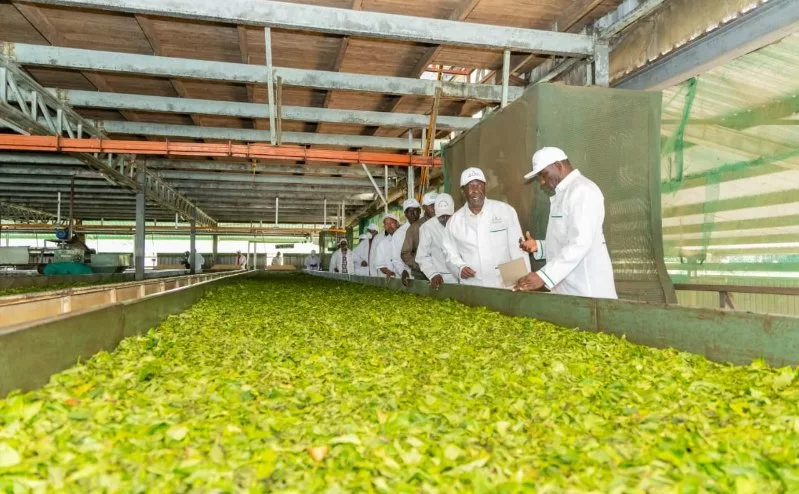 Prime Cabinet Secretary Musalia Mudavadi at the Mudete Tea Factory in Sabatia/OPCS
Mudavadi described Mudete Tea Factory as a transformative investment that has played a major role in improving the livelihoods of thousands of families in Western Kenya.
He said the factory has helped diversify the region’s agricultural economy by creating sustainable incomes, generating employment opportunities and strengthening economic resilience.
According to the Prime Cabinet Secretary, the impact of tea farming extends beyond registered farmers, with each farmer supporting several members of their families and communities.
“Today, Mudete Tea Factory serves approximately 12,000 tea farmers across Vihiga County and its neighbouring Kakamega County. Tea remains the only crop in the region that guarantees farmers pay slips every month,” he said.
“Every tea farmer earns something from their sweat,” he said.
Mudavadi recalled the challenges farmers faced before the establishment of the factory, noting that tea growers were forced to transport their green leaf over long distances to Chebut Tea Factory in neighbouring Nandi County for processing.
“We used to take tea to Chebut in Nandi county for processing and this was a tedious journey for our farmers. Since the establishment of Mudete Tea Factory, our farmers can now put a smile on their faces,” he said.
He credited the late leaders who championed the establishment of the facility, including his father, Moses Mudavadi, and other regional leaders who pushed for a tea processing plant closer to farmers.
Mudavadi said that after becoming the Member of Parliament for Sabatia, he worked with various stakeholders to ensure the project was realised.
Mudete Tea Factory was established in 1997 during the administration of the late President Daniel arap Moi, with support from the late Agriculture Minister Simon Nyachae and the Ministry of Finance.
The project was funded by the Government of Kenya and the European Investment Bank (EIB), marking a major milestone in expanding tea production and processing capacity in Western Kenya.
Mudavadi said the establishment of the factory has since transformed the economic fortunes of the region by bringing tea processing services closer to farmers and creating sustainable employment opportunities.
He encouraged tea farmers to continue investing in the crop, saying the government remains committed to implementing reforms that will improve earnings and secure the future of Kenya’s tea industry.