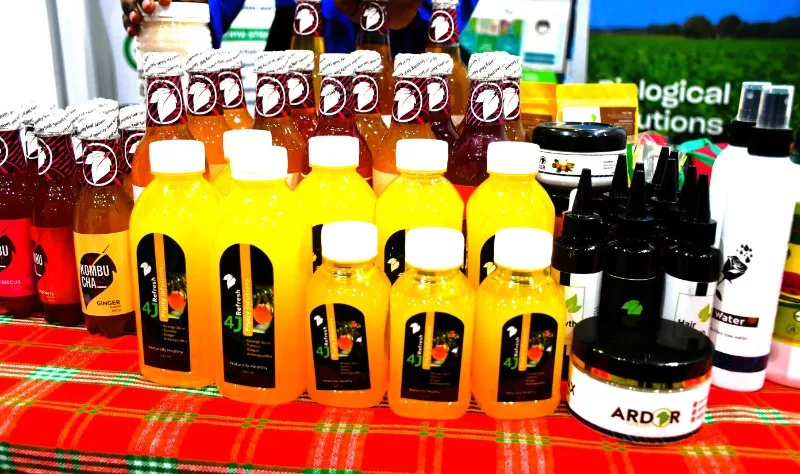
 Some of the organic products by Ardor Life Kenya Ltd./AGATHA NGOTHO.
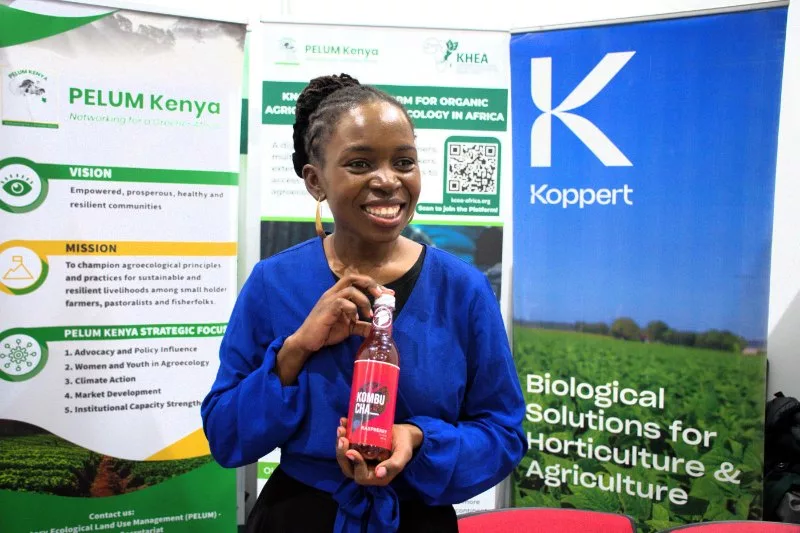 Nyambura Simiyu, CEO Ardor Life Kenya Limited./AGATHA NGOTHO.
When Nyambura Simiyu planted vegetables in her backyard more than a decade ago, she simply wanted healthy, chemical-free food for her family.
She never imagined the small garden would grow into Ardor Life Kenya Ltd, an agribusiness employing 13 people, sourcing produce from smallholder farmers and transforming herbs, fruits and spices into healthy juices, kombucha and natural wellness products.
Her journey began after joining a community of organic farmers in Kiserian. Every Friday, members gathered to sell vegetables and herbs, but much of the produce remained unsold and often went to waste. Rather than seeing losses, Simiyu saw an opportunity.
She began turning the leftover herbs into kombucha and other value-added products that lasted longer and fetched better prices. That simple idea became the foundation of a business that now sources oranges, turmeric, ginger and other ingredients from agroecological farmers across Kenya.
To build consumer confidence, every product undergoes laboratory testing for pesticide residues and carries a QR code that allows buyers to trace each ingredient back to the farm where it was grown.
Beyond production, Simiyu has invested heavily in educating consumers about healthy food, building an online community of more than 25,000 followers. She believes young people should stop viewing agriculture as simply digging on the farm.
For organisations promoting agroecology, however, the challenge extends beyond production. It is about creating policies, markets and financing that enable farmers to adopt sustainable farming practices.
Rosinah Mbenya, Country Coordinator of Participatory Ecological Land Use Management (PELUM) Kenya, says that although agriculture remains the backbone of Kenya's economy, investment in the sector is still inadequate, with national budget allocations often falling below three per cent.
She notes that agroecology receives an even smaller share of global agricultural financing despite growing evidence that it improves soil health, conserves biodiversity and builds resilience to climate change.
According to the Climate Policy Initiative (2023), less than 1.5 per cent of global climate finance reaches agrifood systems, with only a tiny fraction supporting agroecological approaches.
Mbenya says increasing investment in agroecology is no longer optional as climate shocks continue to disrupt food production.
She argues that healthy soils, farmer-managed seed systems and regenerative farming practices are helping communities withstand droughts and erratic rainfall while restoring degraded land.
“Kenya's arid and semi-arid lands account for about 80 per cent of the country's land area, making climate-resilient farming increasingly important. There is a huge untapped potential of agroecology at a time when Kenya is grappling with climate change, rising food prices and increasing pressure to produce more food sustainably,” says Mbenya.
Beyond production, she says school feeding programmes present a major opportunity to improve child nutrition while creating dependable markets for local farmers.
She says PELUM is currently piloting an initiative in Murang'a County that integrates agroecologically produced food into school meals, giving learners access to healthier and more diverse diets while supporting nearby farming communities.
“Digital technology is also emerging as a powerful tool for expanding agroecology. Working with partners such as Digital Green and JustDiggit, we are digitising indigenous farming knowledge so farmers can access practical information through online platforms and mobile technology,” she explains.
“The need for such support is immense. We reach about 1.5 million smallholder farmers, pastoralists and fisherfolk, yet Kenya is estimated to have about 7.5 million smallholder farmers, leaving millions without access to training and technical support,” she says.
Recent global crises, including the COVID-19 pandemic and conflicts that disrupted international supply chains, exposed the risks of relying heavily on imported agricultural inputs.
Mbenya says Kenya should invest more in helping farmers produce affordable organic inputs locally while expanding access to financing.
She adds that Kenya should accelerate the implementation of the National Agroecology Strategy, launched in 2024, arguing that the country must now move from policy commitments to practical action.
For Simiyu, however, the future of agroecology begins with something much simpler.
“Ensuring farmers have someone to buy what they produce. When markets work, farmers earn more, food waste declines and more young people begin to see agriculture not as a last resort, but as a profitable business,” says Simiyu.
"Agriculture is a whole value chain. There is production, transport, processing, marketing and retail. You don't have to own land to benefit from agriculture."

![[PHOTOS] Elderly brave cold to vote in Ol Kalou](https://cdn.radioafrica.digital/image/2026/07/d2345b9e-578f-45ff-9bb0-d7819671c165.webp)


![[PHOTOS] Ol Kalou residents turn out in large numbers to vote](https://cdn.radioafrica.digital/image/2026/07/fe42d51c-7f79-466e-94e8-59561f77bbe7.webp)