 Siaya Governor James Orengo addressing the media on Nairobi's Wabera Street during Saba Saba commemoration march, July 7, 2026. /SCREENGRAB
Siaya Governor James Orengo on Tuesday took a symbolic walk through Nairobi's central business district to commemorate the 36th anniversary of the historic Saba Saba protests, saying the ideals that inspired the pro-democracy movement remain as relevant today as they were more than three decades ago.
The veteran politician, who co-founded the original Saba Saba movement in the early 1990s, stopped briefly to address the media along Wabera Street as he walked from the Senate to his private office.
He reflected on the country's democratic journey and urged the government to address the concerns of ordinary Kenyans.
"Saba Saba is a very important day to Kenyans and the whole country. And I have seen Tanzania saying they are also holding Saba Saba in solidarity," he said.
Orengo was among the leading figures who spearheaded the push for multiparty democracy alongside Kenneth Matiba, Charles Rubia, Raila Odinga, Gitobu Imanyara, Gibson Kamau Kuria and Koigi wa Wamwere during the landmark protests that challenged one-party rule.
He said that although many of the movement's pioneers have since died, its spirit lives on through renewed calls for democratic reforms, economic accountability and an end to police brutality.
According to Orengo, many of the grievances that inspired the original Saba Saba protests remain unresolved, with Kenyans continuing to grapple with the high cost of living, insecurity and alleged human rights violations.
"If you speak to citizens today, their condition is poor. The cost of living has gone up," he said, urging the Kenya Kwanza administration to implement the 10-point agenda agreed upon by President William Ruto and Raila Odinga last year.
The March 7, 2025 agreement was a blend of reform proposals and commitments to fully implement existing constitutional provisions aimed at addressing political, social and economic challenges, including the high cost of living, public debt and post-election disputes.
"When Raila and Ruto signed the 10-point agenda, they said they must look into the cost of living of citizens. We also have a new constitution and regardless of that, abduction of Kenyans continues, people are shot and killed arbitrarily and not just once, and it's not like we have demonstrations," he said.
Orengo spoke as Nairobi experienced relatively low activity despite heightened security deployed ahead of the Saba Saba demonstrations.
Most businesses remained closed while matatus largely stayed off the roads amid fears of possible violence after youth-led organisers and activists insisted the protests would proceed despite police declaring them unlawful for lack of prior notification.
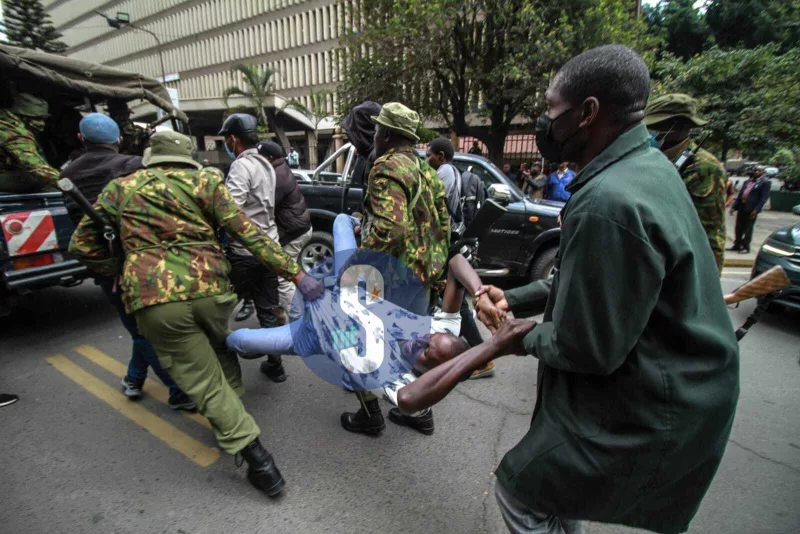
A section of protesters, waving Kenyan flags and carrying placards, marched from Jeevanjee Gardens towards Parliament Buildings, although they were intercepted and some arrested along the way.
Police officers in both uniform and plain clothes patrolled the city on foot and in vehicles to prevent crowds from gathering.
Speaking against the heavy security deployment, Orengo criticised the police for what he described as the harassment of peaceful protesters.
"All of us should mark this day without the pressure we are witnessing now. I don't know why the security officers are doing this," he said as a man was wrestled to the ground behind him.