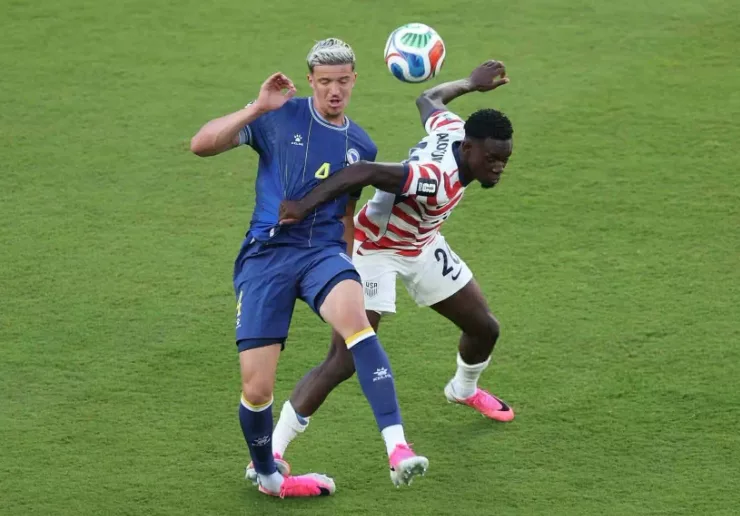
 Folarin Balogun steps on the right ankle of defender Tarik Muharemovic during USA's 2-0 Round of 32 victory over Bosnia and Herzegovina on July 1 /SCREENGRAB
The unprecedented suspension of Folarin Balogun's automatic red-card ban during the ongoing FIFA World Cup has triggered a global debate over the integrity of football's disciplinary processes, with critics questioning whether political influence has compromised the sport's credibility.
Balogun, one of the United States' standout performers at the tournament with three goals, was shown a straight red card during the hosts' 2-0 Round of 32 victory over Bosnia and Herzegovina on July 1 after a VAR review.
The striker was dismissed for dragging his studs down the leg and stepping on the right ankle of defender Tarik Muharemovic, an offence that ordinarily attracts an automatic one-match suspension under FIFA regulations.
The suspension meant Balogun was set to miss the USA's Round of 16 clash against Belgium.
However, in a move that stunned the football world, FIFA suspended the implementation of the ban for one year after US President Donald Trump personally appealed for a review.
Speaking during an event at the Oval Office on Monday, Trump defended his intervention, insisting he merely requested that FIFA reconsider the incident rather than pressure the governing body into overturning the sanction.
"All I did was ask for a review because I don't think it was a foul," he said.
"I think it was two great athletes' aggression to each other and got entangled, that was not like punching somebody in the face... you know, it would be different."
Trump argued that Balogun's absence would have unfairly weakened the United States in one of the tournament's biggest matches.
"We have to have our best players and Belgium have their best players and if we win or we lose, it's fair. Otherwise, let's say we lose or lost the game, it would be unfair; it would be a terrible thing."
Despite Balogun being cleared to play, the United States crashed out of the tournament after a 4-1 defeat to Belgium, becoming the third and final host nation to be eliminated after Canada and Mexico.
FIFA based its decision on Article 27 of the FIFA Disciplinary Code, a little-known provision that allows its disciplinary committee to suspend the implementation of a sanction and place a player on probation for between one and four years.
The governing body maintained that the decision fell squarely within its legal framework.
"In line with Article 27 of the FIFA Disciplinary Code, the implementation of the match suspension is suspended for a probationary period of one year. If Folarin Balogun commits another infringement of a similar nature and gravity during the probationary period, the suspension shall be revoked and the sanction enforced without prejudice to any additional sanction imposed for the new infringement," the FIFA Disciplinary Committee said in a statement.
The explanation, however, did little to quell criticism.
Many observers argued that the issue was not whether FIFA had the legal authority to suspend the sanction, but whether it should have exercised that discretion after direct intervention by the head of state of one of the competing nations.
The controversy quickly spread beyond FIFA, with European football's governing body, UEFA, accusing the world governing body of undermining the integrity of its own disciplinary framework.
UEFA warned that overriding an automatic red-card suspension under such circumstances risked eroding confidence in the competition and setting a troubling precedent.
Belgium's football federation also criticised the decision, saying it undermined the principles of ethics and fair competition. FIFA subsequently rejected its appeal.
Football commentators and governance experts echoed similar concerns, warning that allowing political influence to intersect with sporting disciplinary decisions could damage FIFA's credibility long after the tournament ends.
The fallout was equally pronounced in Belgium.
Coach Rudi Garcia dismissed the development as something that belonged in a comedy sketch rather than a World Cup.
"I didn't realise that to FIFA, July 5 was the same as April 1," he quipped.
Belgian supporters also voiced disbelief, with some questioning whether Balogun would ever be viewed the same way again after becoming the central figure in one of the tournament's most contentious episodes.
One fan asked: "Was the Trump government using its influence telling us 'we are stronger than you', we are weak or what is it?"
The controversy also dominated social media, where memes portrayed Trump as an unofficial football authority capable of overruling decisions made by referees and the Video Assistant Referee system.
For supporters, the intervention reinforced Trump's image as a fiercely committed backer of Team USA.
For critics, it projected the image of a political leader willing to influence sporting decisions for competitive advantage.
With the United States now out of the tournament, attention is shifting from Balogun's availability to the wider implications of FIFA's decision.
The episode has left lingering questions about where the line should be drawn between politics and sport, and whether the governing body's reputation has suffered more lasting damage than the suspension it chose to set aside.